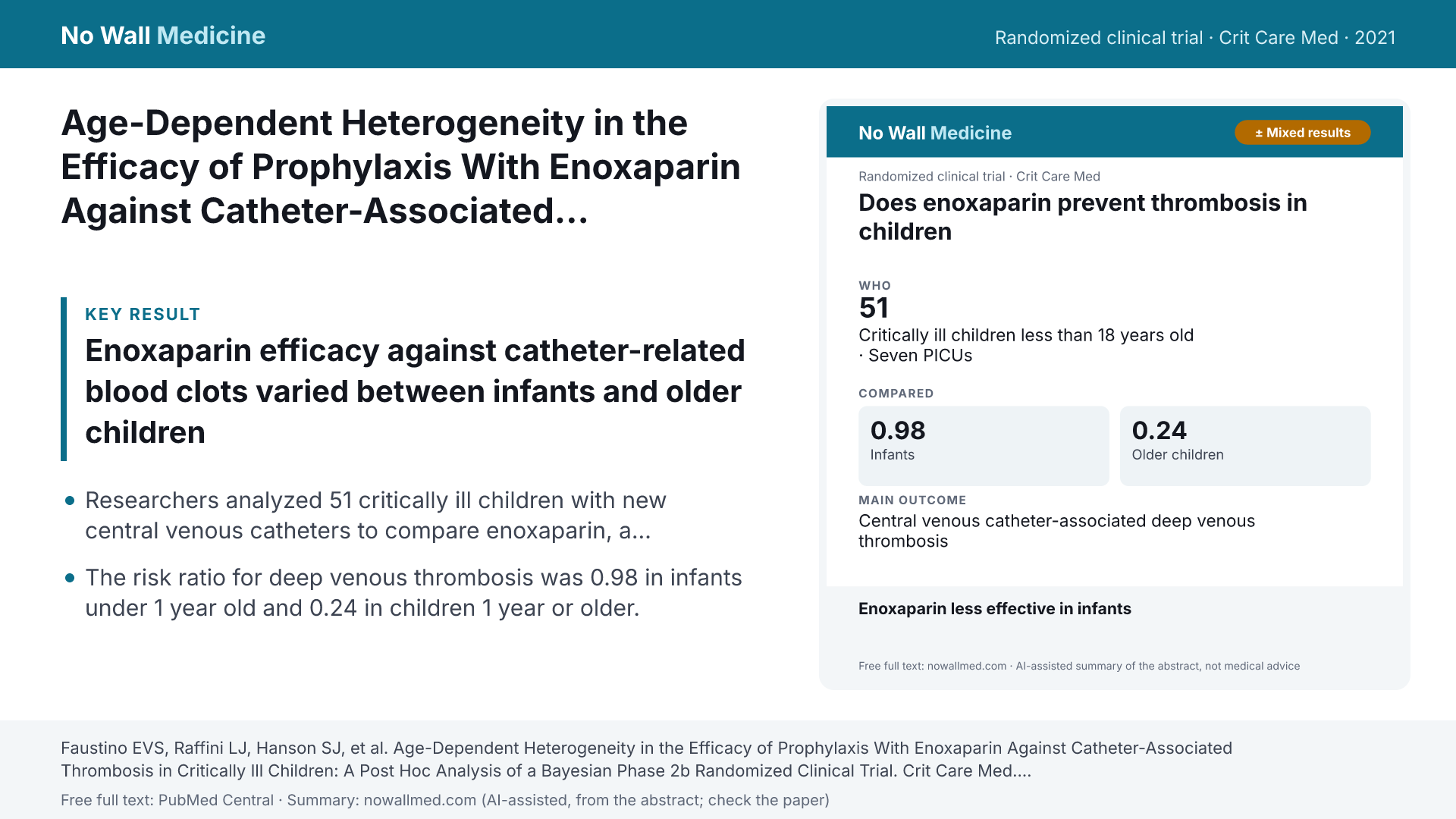
Enoxaparin efficacy against catheter-related blood clots varied between infants and older children
Age-Dependent Heterogeneity in the Efficacy of Prophylaxis With Enoxaparin Against Catheter-Associated Thrombosis in Critically Ill Children: A Post Hoc Analysis of a Bayesian Phase 2b Randomized Clinical Trial
Randomized clinical trialMixed results
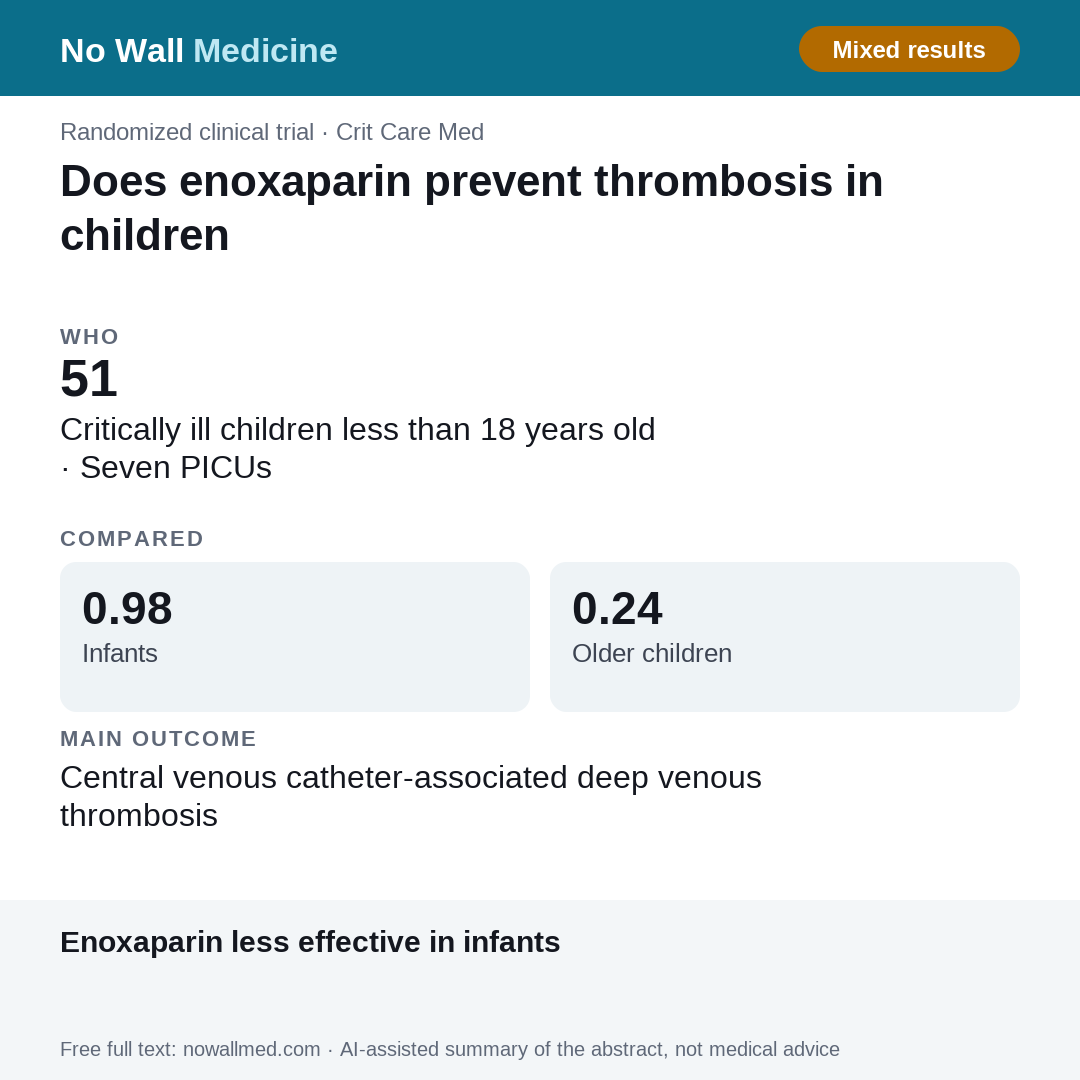
Does enoxaparin prevent thrombosis in children
Who
51
Critically ill children less than 18 years old · Seven PICUs
Compared
0.98Infants (95% credible interval, 0.37-2.44)
0.24Older children (95% credible interval, 0.04-0.82)
Main outcome
Central venous catheter-associated deep venous thrombosis
Result: Risk ratios of 0.98 and 0.24
Bottom line: Enoxaparin less effective in infants
Crit Care Med · 2021-02-11Download image
Why it matters: It was unknown if the effectiveness of enoxaparin for preventing blood clots in central venous catheters differs based on a child's age.
Key points
- Researchers analyzed 51 critically ill children with new central venous catheters to compare enoxaparin, a blood thinner, against usual care.
- The risk ratio for deep venous thrombosis was 0.98 in infants under 1 year old and 0.24 in children 1 year or older.
- Infants had 45.1% lower factor VIII activity, a protein that helps blood clot, compared to older children.
Headline and key points written with AI from the paper’s abstract, with every number checked against it. Read the paper before relying on them.
Was this summary helpful?
Subject terms
Cite this article
Faustino EVS, Raffini LJ, Hanson SJ, Cholette JM, Pinto MG, Li S. Age-Dependent Heterogeneity in the Efficacy of Prophylaxis With Enoxaparin Against Catheter-Associated Thrombosis in Critically Ill Children: A Post Hoc Analysis of a Bayesian Phase 2b Randomized Clinical Trial. Crit Care Med. 2021. doi:10.1097/CCM.0000000000004848
Spotted a mistake? Suggest a correction