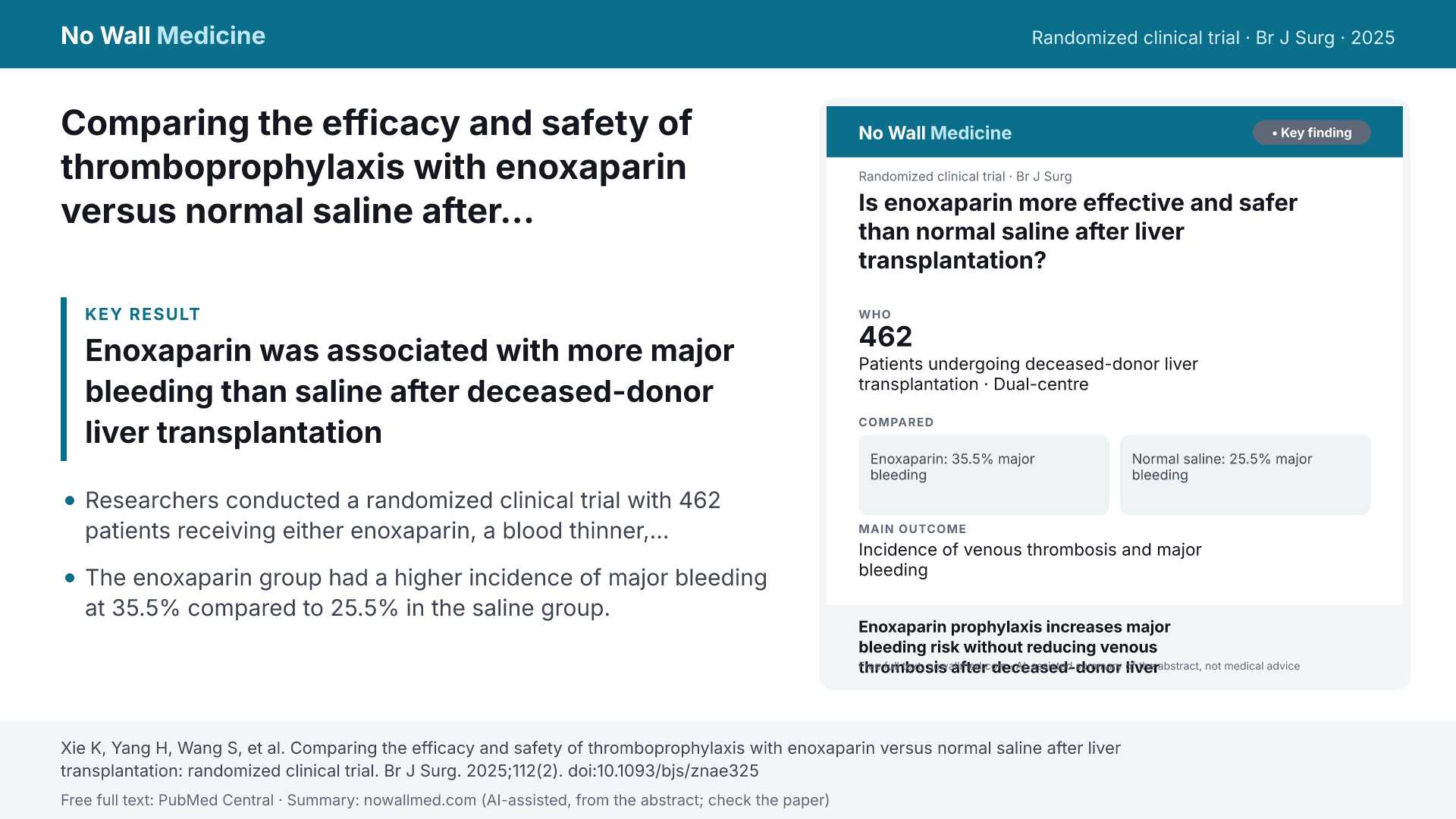
Enoxaparin was associated with more major bleeding than saline after deceased-donor liver transplantation
Comparing the efficacy and safety of thromboprophylaxis with enoxaparin versus normal saline after liver transplantation: randomized clinical trial
Randomized clinical trialKey finding
Is enoxaparin more effective and safer than normal saline after liver transplantation?
Who
462
Patients undergoing deceased-donor liver transplantation · Dual-centre
Compared
Enoxaparin: 35.5% major bleeding
Normal saline: 25.5% major bleeding
Main outcome
Incidence of venous thrombosis and major bleeding
Bottom line: Enoxaparin prophylaxis increases major bleeding risk without reducing venous thrombosis after deceased-donor liver transplantation.
Br J Surg · 2025-02-24 · Save PNG
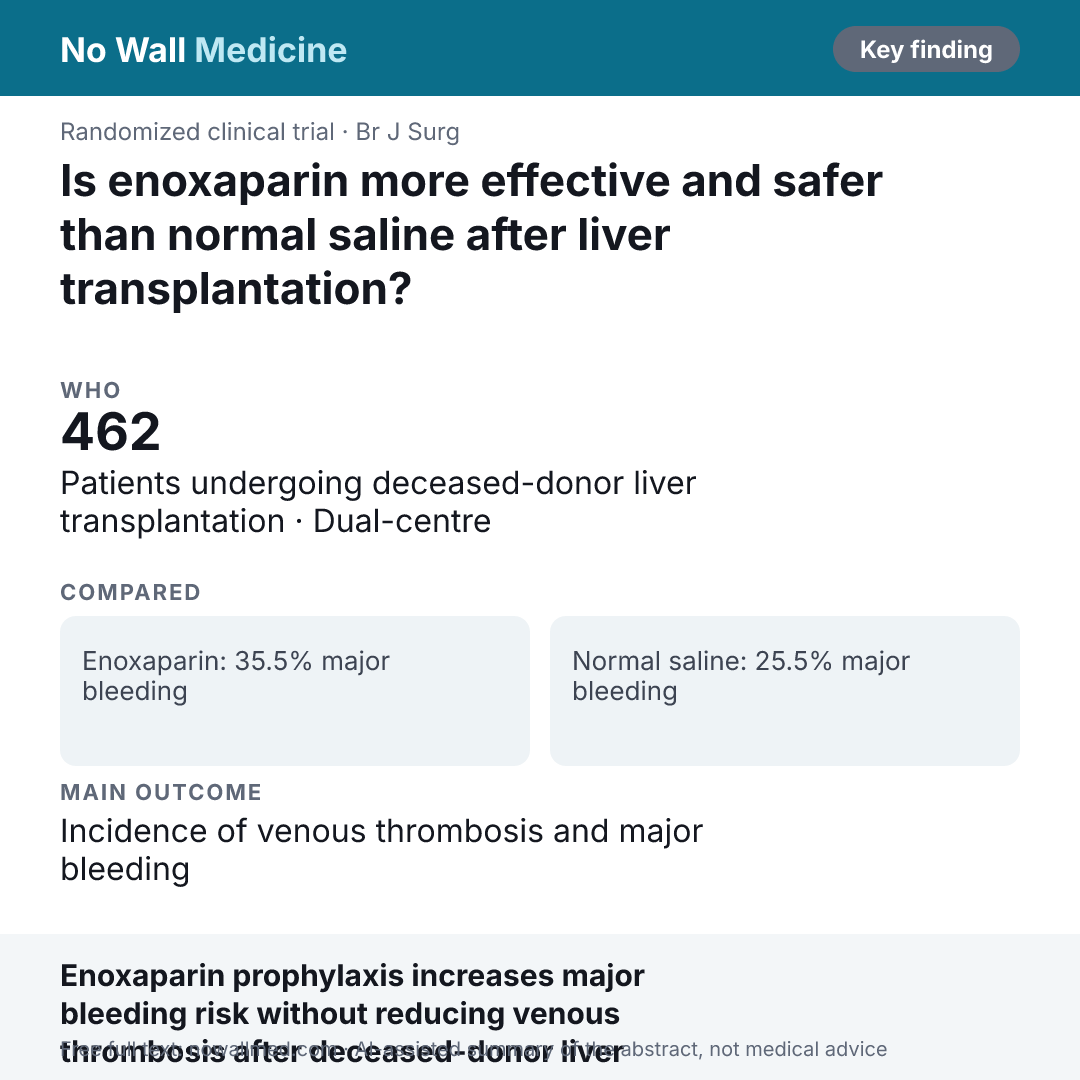
Clinical question: Is enoxaparin more effective and safer than normal saline after liver transplantation?
Why it matters: There are currently no established protocols for preventing blood clots through medication after deceased-donor liver transplantation.
Key points
- Researchers conducted a randomized clinical trial with 462 patients receiving either enoxaparin, a blood thinner, or normal saline after liver transplantation.
- The enoxaparin group had a higher incidence of major bleeding at 35.5% compared to 25.5% in the saline group.
- There were no significant differences in the incidence of venous thrombosis, portal vein thrombosis, or deep vein thrombosis between the two groups.
Headline and key points written with AI from the paper’s abstract, with every number checked against it. Read the paper before relying on them.
Was this summary helpful?
Subject terms
Headline, design, result, key points, caveat and citation as plain text.
Cite this article
Xie K, Yang H, Wang S, et al. Comparing the efficacy and safety of thromboprophylaxis with enoxaparin versus normal saline after liver transplantation: randomized clinical trial. Br J Surg. 2025;112(2). doi:10.1093/bjs/znae325
Spotted a mistake? Suggest a correction