Aggressive risk factor management increased rhythm success after catheter ablation for atrial fibrillation
Aggressive Risk Factor Reduction Study for Atrial Fibrillation Implications for Ablation Outcomes: The ARREST-AF Randomized Clinical Trial
Open-label, multicenter, randomized clinical trialBenefit found
Does risk factor and weight management impact atrial fibrillation ablation rhythm outcomes?
Who
122
Patients with nonpermanent symptomatic atrial fibrillation, body mass index ≥ 27, and cardiometabolic risk factors · 3 sites in Adelaide, South Australia
Compared
61.3%lifestyle and risk factor management
40%usual care
Main outcome
Proportion of patients free from atrial fibrillation at 12 months
Result: hazard ratio 0.53 (95% CI, 0.32-0.89)
Bottom line: Aggressive risk factor management reduced arrhythmia recurrence after catheter ablation in patients with elevated body mass index.
JAMA Cardiol · 2025-10-29Download image
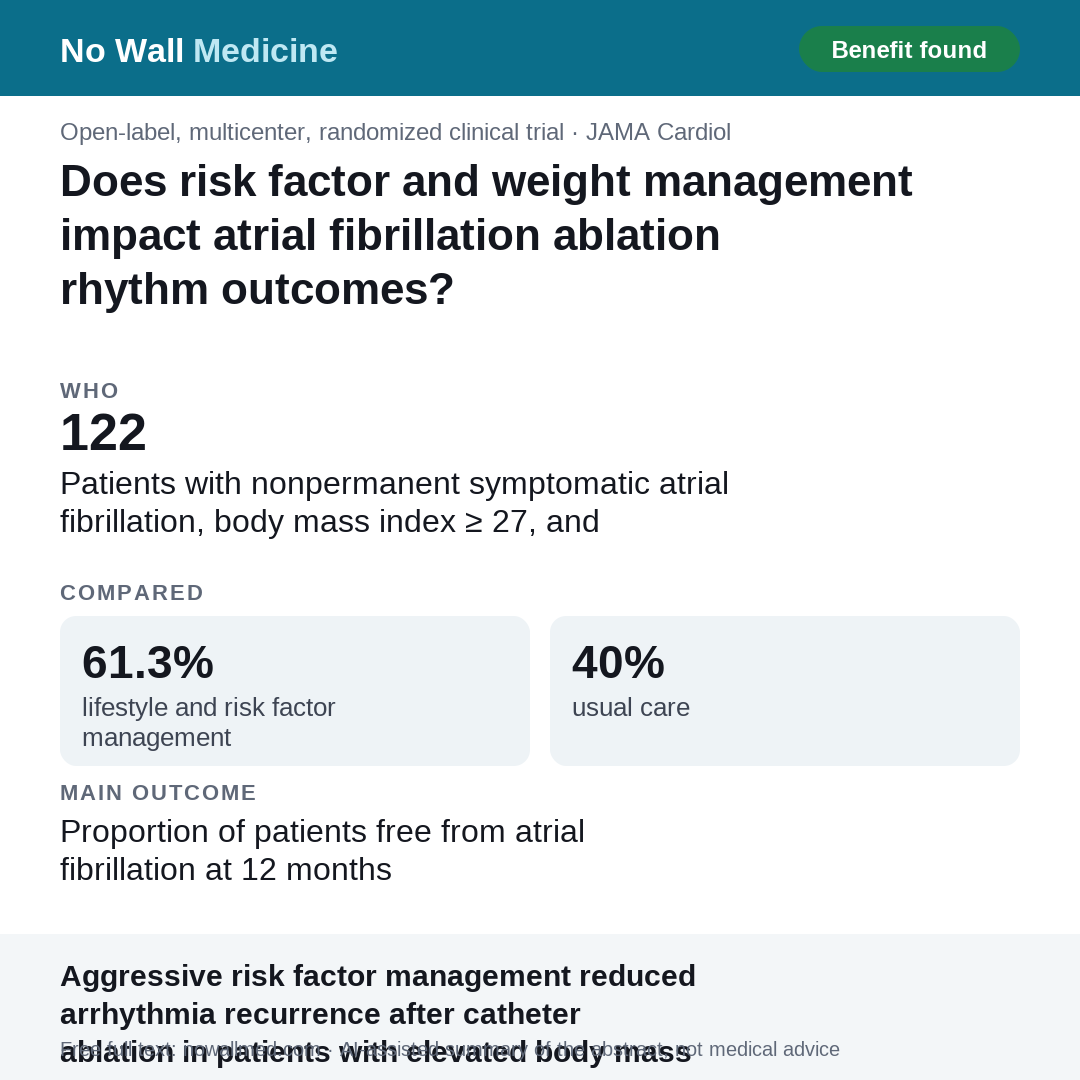
Clinical question: Does risk factor and weight management impact atrial fibrillation ablation rhythm outcomes?
Why it matters: It was unclear if structured lifestyle and risk factor management could improve rhythm outcomes after catheter ablation for patients with atrial fibrillation and high body mass index.
Key points
- Researchers studied 122 patients with symptomatic atrial fibrillation and a body mass index of 27 or higher who underwent catheter ablation.
- At 12 months, 61.3% of patients in the lifestyle and risk factor management group remained free from atrial fibrillation compared to 40% in the usual care group.
- The lifestyle group showed a mean reduction in body weight of 9.0 kg and a mean reduction in waist circumference of 7.0 cm compared to usual care.
Headline and key points written with AI from the paper’s abstract, with every number checked against it. Read the paper before relying on them.
Topics
Cite this article
Pathak RK, Elliott AD, Lau DH, Middeldorp ME, Linz D, Fitzgerald JL. Aggressive Risk Factor Reduction Study for Atrial Fibrillation Implications for Ablation Outcomes: The ARREST-AF Randomized Clinical Trial. JAMA Cardiol. 2025. doi:10.1001/jamacardio.2025.4007
Spotted a mistake? Suggest a correction