Motorized exoskeleton for arm movement showed comparable clinical results to standard care
AGREE: an upper limb motorized exoskeleton for restoring arm functions: a single-blinded randomized controlled trial
Single-blinded randomized controlled trialNo clear difference
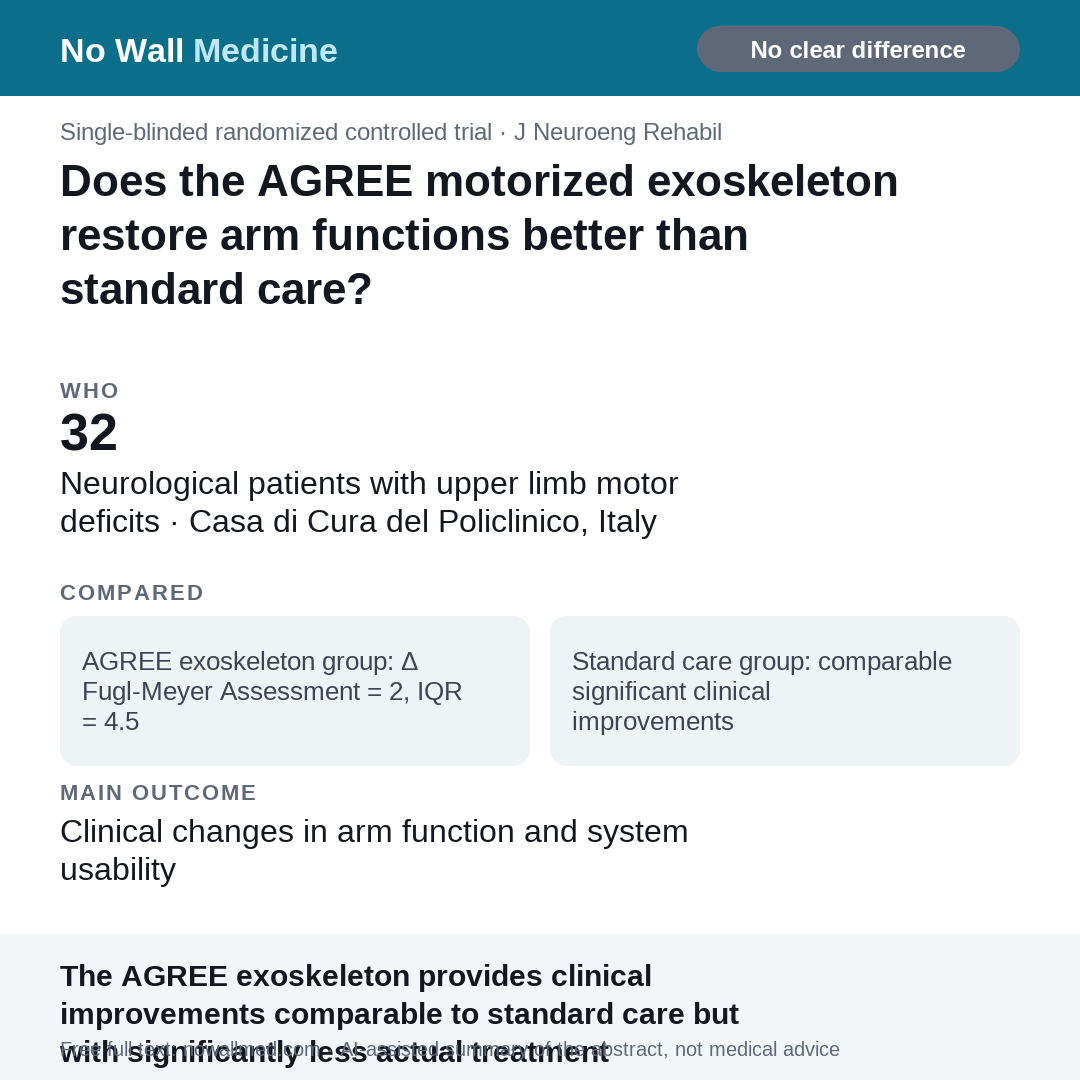
Does the AGREE motorized exoskeleton restore arm functions better than standard care?
Who
32
Neurological patients with upper limb motor deficits · Casa di Cura del Policlinico, Italy
Compared
AGREE exoskeleton group: Δ Fugl-Meyer Assessment = 2, IQR = 4.5
Standard care group: comparable significant clinical improvements
Main outcome
Clinical changes in arm function and system usability
Bottom line: The AGREE exoskeleton provides clinical improvements comparable to standard care but with significantly less actual treatment time.
J Neuroeng Rehabil · 2025-06-11Download image
Clinical question: Does the AGREE motorized exoskeleton restore arm functions better than standard care?
Why it matters: There is a lack of concordance on the effectiveness of upper-limb exoskeletons for restoring arm functions.
Key points
- Researchers conducted a randomized controlled trial with 32 neurological patients with upper limb motor deficits to compare the AGREE exoskeleton against standard care.
- Both groups showed comparable significant clinical improvements in all measures, including the Fugl-Meyer Assessment and the Action Research Arm Test.
- The experimental group received significantly less actual treatment time than the control group despite having an equivalent number of sessions and therapy duration.
Headline and key points written with AI from the paper’s abstract, with every number checked against it. Read the paper before relying on them.
Topics
Cite this article
Gandolla M, Luciani B, Longatelli V, Tropea P, Seregni A, Corbo M. AGREE: an upper limb motorized exoskeleton for restoring arm functions: a single-blinded randomized controlled trial. J Neuroeng Rehabil. 2025. doi:10.1186/s12984-025-01651-7
Spotted a mistake? Suggest a correction
Top studies every Monday
The week’s key trials and guidelines in your specialties, plus any topics you follow. By email, free.
Get the weekly digest