Systematic review shows evolution of control strategies for cable-driven lower-limb rehabilitation robots
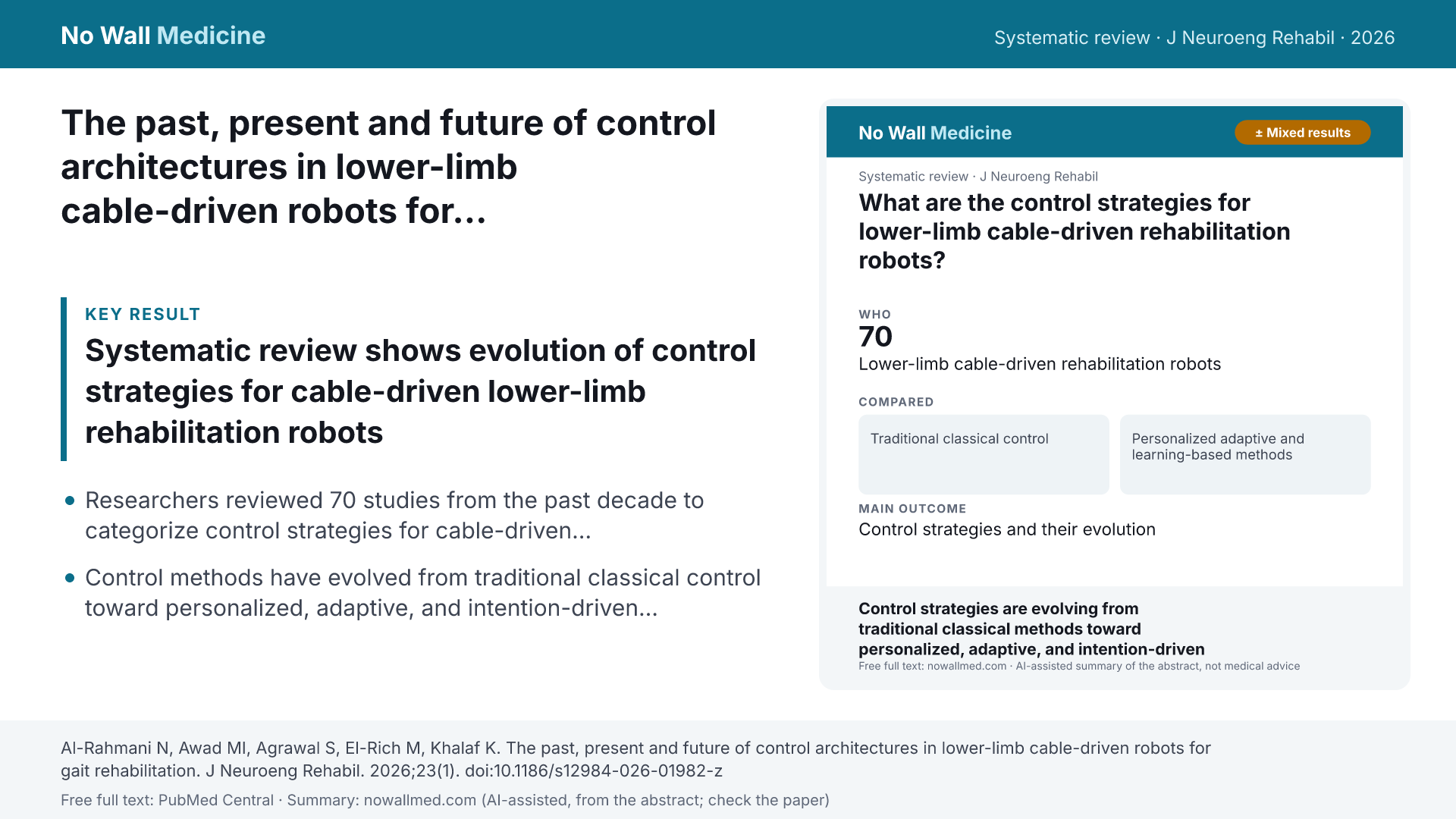
The past, present and future of control architectures in lower-limb cable-driven robots for gait rehabilitation
Systematic reviewMixed results
What are the control strategies for lower-limb cable-driven rehabilitation robots?
Who
70
Lower-limb cable-driven rehabilitation robots
Compared
Traditional classical control
Personalized adaptive and learning-based methods
Main outcome
Control strategies and their evolution
Bottom line: Control strategies are evolving from traditional classical methods toward personalized, adaptive, and intention-driven frameworks.
J Neuroeng Rehabil · 2026-04-27Download image
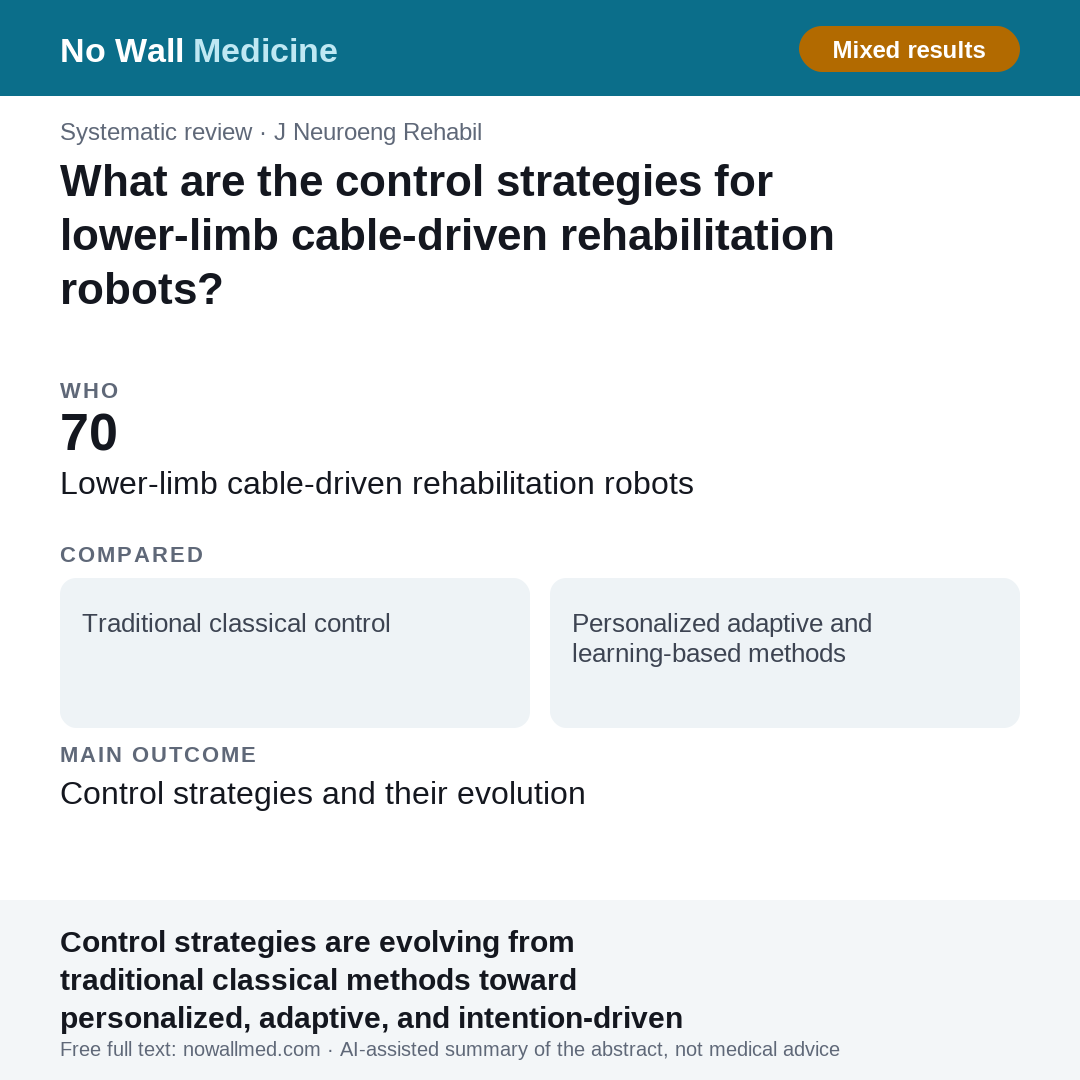
Clinical question: What are the control strategies for lower-limb cable-driven rehabilitation robots?
Why it matters: Cable-driven rehabilitation robots face unique control challenges caused by cable properties and variability in the users they assist.
Key points
- Researchers reviewed 70 studies from the past decade to categorize control strategies for cable-driven rehabilitation robots used in gait training.
- Control methods have evolved from traditional classical control toward personalized, adaptive, and intention-driven approaches that respond to the user.
- Impedance and admittance control, which manage how the robot reacts to external forces, remain fundamental for ensuring patient safety.
Headline and key points written with AI from the paper’s abstract, with every number checked against it. Read the paper before relying on them.
Was this summary helpful?
Subject terms
Cite this article
Al-Rahmani N, Awad MI, Agrawal S, El-Rich M, Khalaf K. The past, present and future of control architectures in lower-limb cable-driven robots for gait rehabilitation. J Neuroeng Rehabil. 2026. doi:10.1186/s12984-026-01982-z
Spotted a mistake? Suggest a correction