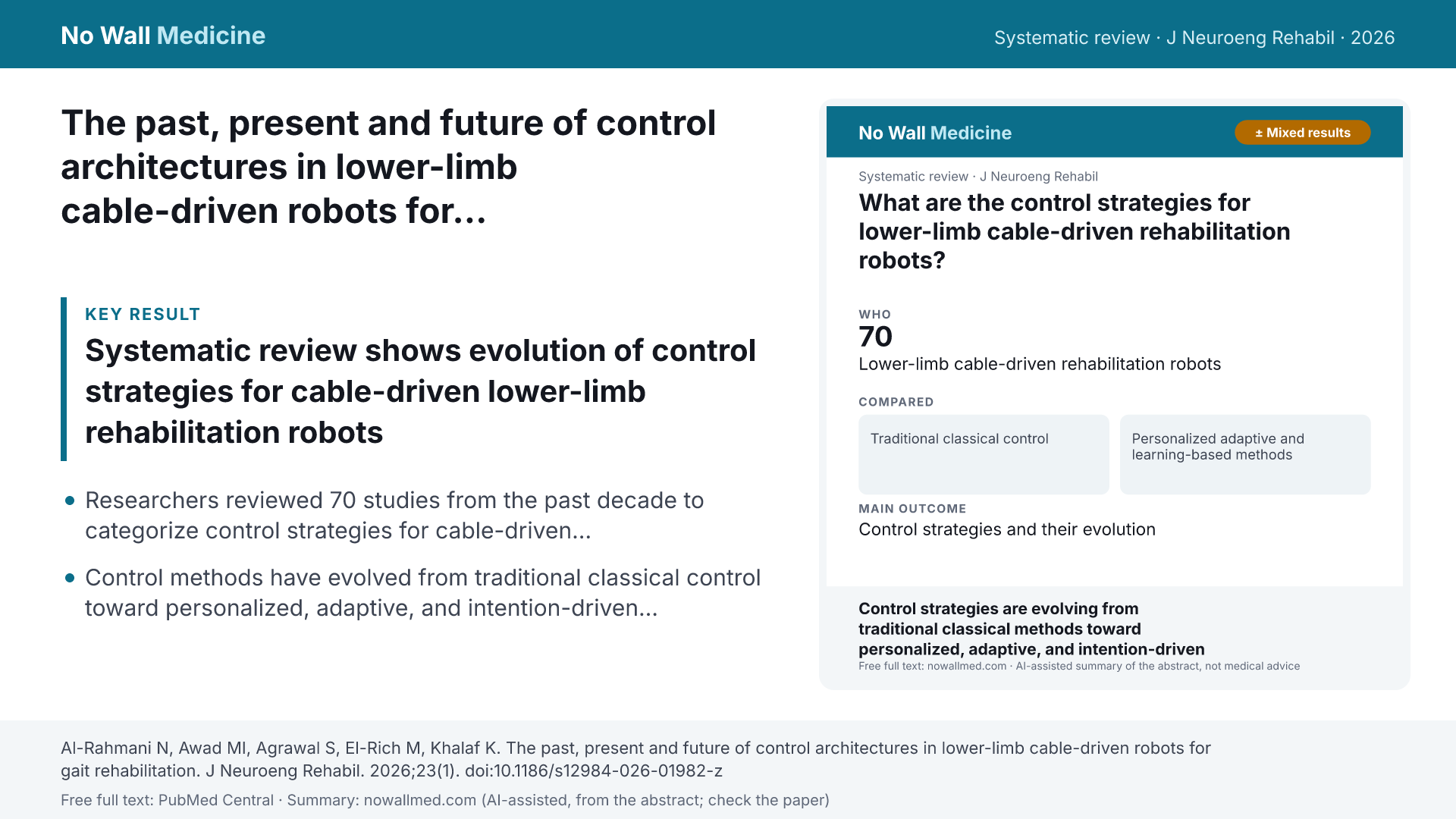
The past, present and future of control architectures in lower-limb cable-driven robots for gait rehabilitation
Key result: Systematic review shows evolution of control strategies for cable-driven lower-limb rehabilitation robots
Systematic reviewMixed results
What are the control strategies for lower-limb cable-driven rehabilitation robots?
Who
70
Lower-limb cable-driven rehabilitation robots
Compared
Traditional classical control
Personalized adaptive and learning-based methods
Main outcome
Control strategies and their evolution
Bottom line: Control strategies are evolving from traditional classical methods toward personalized, adaptive, and intention-driven frameworks.
J Neuroeng Rehabil · 2026-04-27
Key points
- Researchers reviewed 70 studies from the past decade to categorize control strategies for cable-driven rehabilitation robots used in gait training.
- Control methods have evolved from traditional classical control toward personalized, adaptive, and intention-driven approaches that respond to the user.
- Impedance and admittance control, which manage how the robot reacts to external forces, remain fundamental for ensuring patient safety.
Why it matters: Cable-driven rehabilitation robots face unique control challenges caused by cable properties and variability in the users they assist.
Discussion prompts
- Would these patients look like yours? Who was left out?
- Is the main outcome one that matters to patients?
- Is the difference large enough to change what you do?
Cite: Al-Rahmani N, Awad MI, Agrawal S, El-Rich M, Khalaf K. The past, present and future of control architectures in lower-limb cable-driven robots for gait rehabilitation. J Neuroeng Rehabil. 2026;23(1). doi:10.1186/s12984-026-01982-z
Free full text: PubMed Central · Summary and visual abstract: nowallmed.com/a/the-past-present-and-future-of-control-architectures-in-lower-limb-3hboj1/ (AI-assisted from the abstract; check the paper before relying on it).