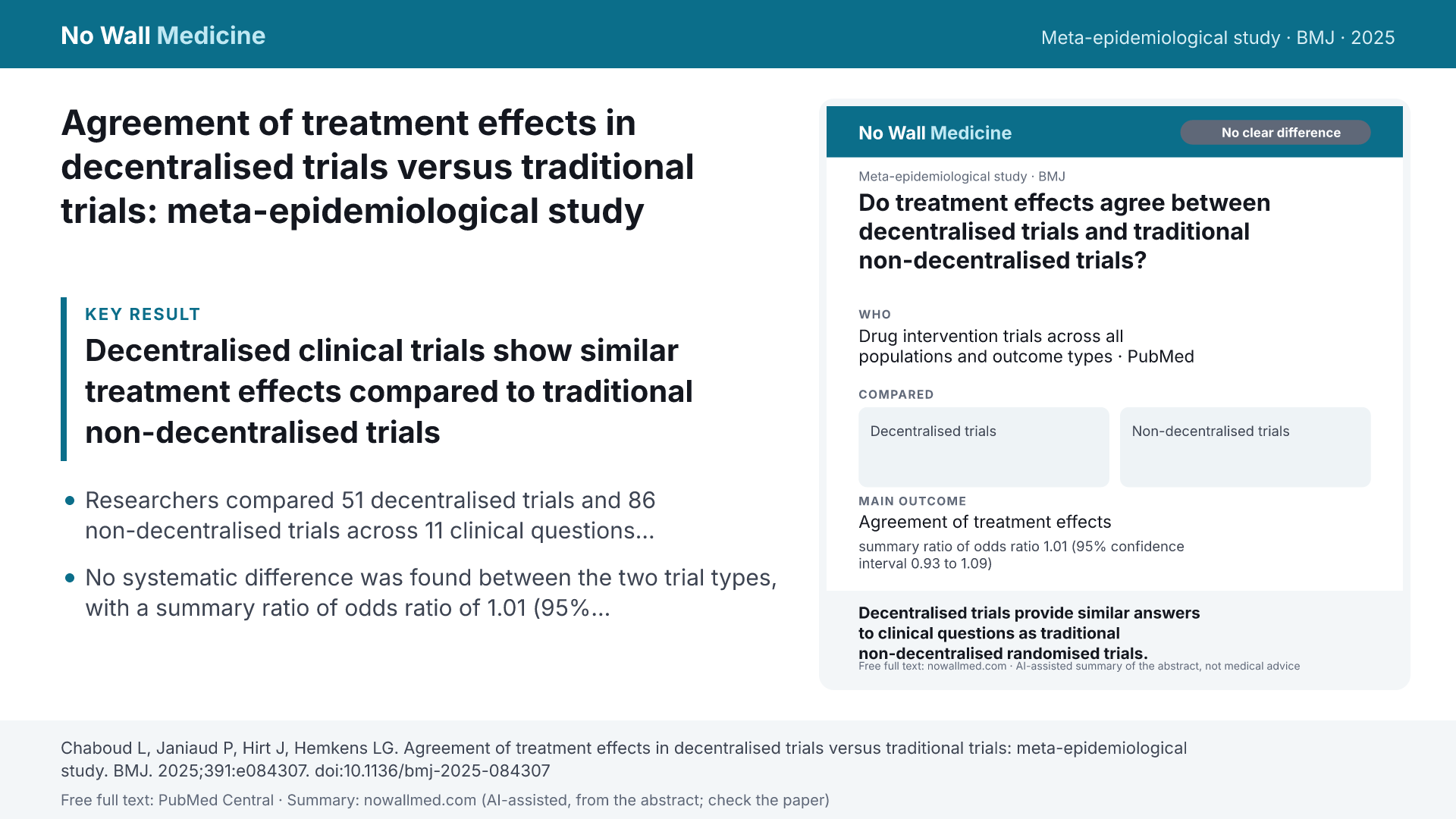
Decentralised clinical trials show similar treatment effects compared to traditional non-decentralised trials
Agreement of treatment effects in decentralised trials versus traditional trials: meta-epidemiological study
Meta-epidemiological studyNo clear difference
Do treatment effects agree between decentralised trials and traditional non-decentralised trials?
Who
Drug intervention trials across all populations and outcome types · PubMed database
Compared
Decentralised trials
Non-decentralised trials
Main outcome
Agreement of treatment effects
Result: summary ratio of odds ratio 1.01 (95% confidence interval 0.93 to 1.09)
Bottom line: Decentralised trials provide similar answers to clinical questions as traditional non-decentralised randomised trials.
BMJ · 2025-11-18 · Save PNG
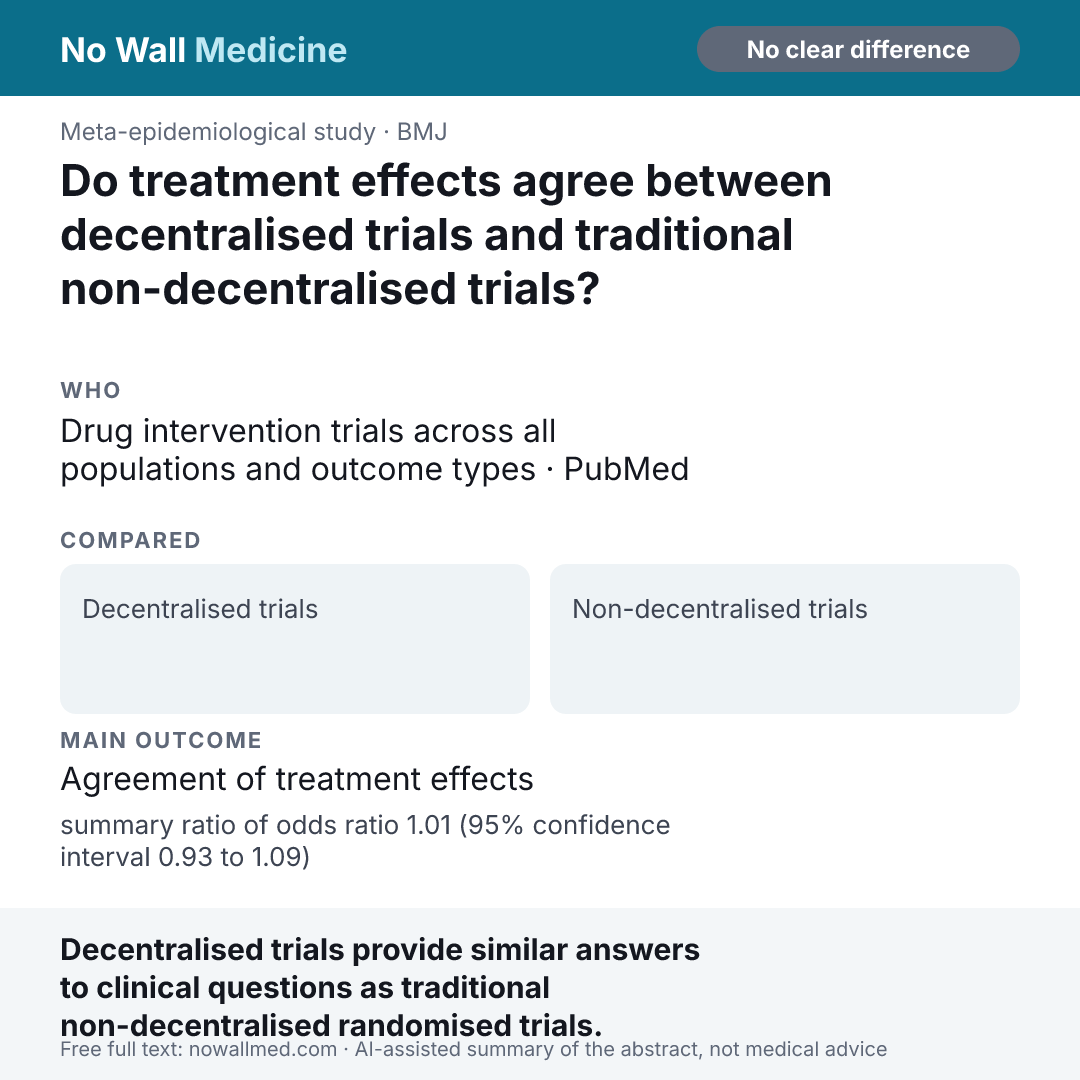
Clinical question: Do treatment effects agree between decentralised trials and traditional non-decentralised trials?
Key points
- Researchers compared 51 decentralised trials and 86 non-decentralised trials across 11 clinical questions using data from the PubMed database.
- No systematic difference was found between the two trial types, with a summary ratio of odds ratio of 1.01 (95% confidence interval 0.93 to 1.09).
- Decentralised trials were larger, with a median sample size of 1175 participants compared to 236 in non-decentralised trials.
Headline and key points written with AI from the paper’s abstract, with every number checked against it. Read the paper before relying on them.
Was this summary helpful?
Abstract
Objective
To compare treatment effects from trials designed as decentralised trials or as traditional non-decentralised trials. Design
Meta-epidemiological study. Data source
PubMed database. Eligibility criteria
Trials identified as decentralised and included in meta-analyses alongside corresponding non-decentralised trials, restricted to drug interventions across all populations and outcome types. Results
51 decentralised trials and 86 non-decentralised trials regarding 11 clinical questions were compared. Decentralised trials were larger than non-decentralised trials (median sample size 1175 v 236 participants) and more recent than non-decentralised trials (median year of publication 2012 v 2007). The level of significance agreed between decentralised and non-decentralised trials in nine of 11 clinical questions (82%). No systematic difference between effects from decentralised and non-decentralised trials was found (summary ratio of odds ratio 1.01; 95% confidence interval 0.93 to 1.09; heterogeneity I2=8.6%) with a median absolute deviation of 1.3-fold (absolute ratio of odds ratio 1.30; interquartile range 1.13-1.51). Conclusion
Decentralised trials provide similar answers to clinical questions as traditional, non-decentralised randomised trials. They do not systematically overestimate or underestimate effect estimates, but modest absolute deviations occur that may lead to different conclusions. Beyond direct benefits to participants, decentralisation opens new avenues for randomised trials, including the facilitation of larger trials.
Abstract reproduced under the article’s CC BY NC licence.
Subject terms
Headline, design, result, key points, caveat and citation as plain text.
Cite this article
Chaboud L, Janiaud P, Hirt J, Hemkens LG. Agreement of treatment effects in decentralised trials versus traditional trials: meta-epidemiological study. BMJ. 2025;391:e084307. doi:10.1136/bmj-2025-084307
Spotted a mistake? Suggest a correction