Artificial intelligence using multiple data types performed better at screening depression than single data types
AI-assisted multi-modal information for the screening of depression: a systematic review and meta-analysis
Systematic review and meta-analysisBenefit found
How effective is artificial intelligence assisted multi-modal information for depression screening?
Who
Patients being screened for depression
Compared
0.95Artificial intelligence assisted multi-modal methods (95% CI: 0.92-0.96)
Uni-modal methods: 0.84-0.92
Main outcome
Classification performance measured by area under the curve
Result: area under the curve 0.95 (95% CI: 0.92-0.96)
Bottom line: Artificial intelligence assisted multi-modal methods outperform uni-modal methods for screening depression.
NPJ Digit Med · 2025-08-16Download image
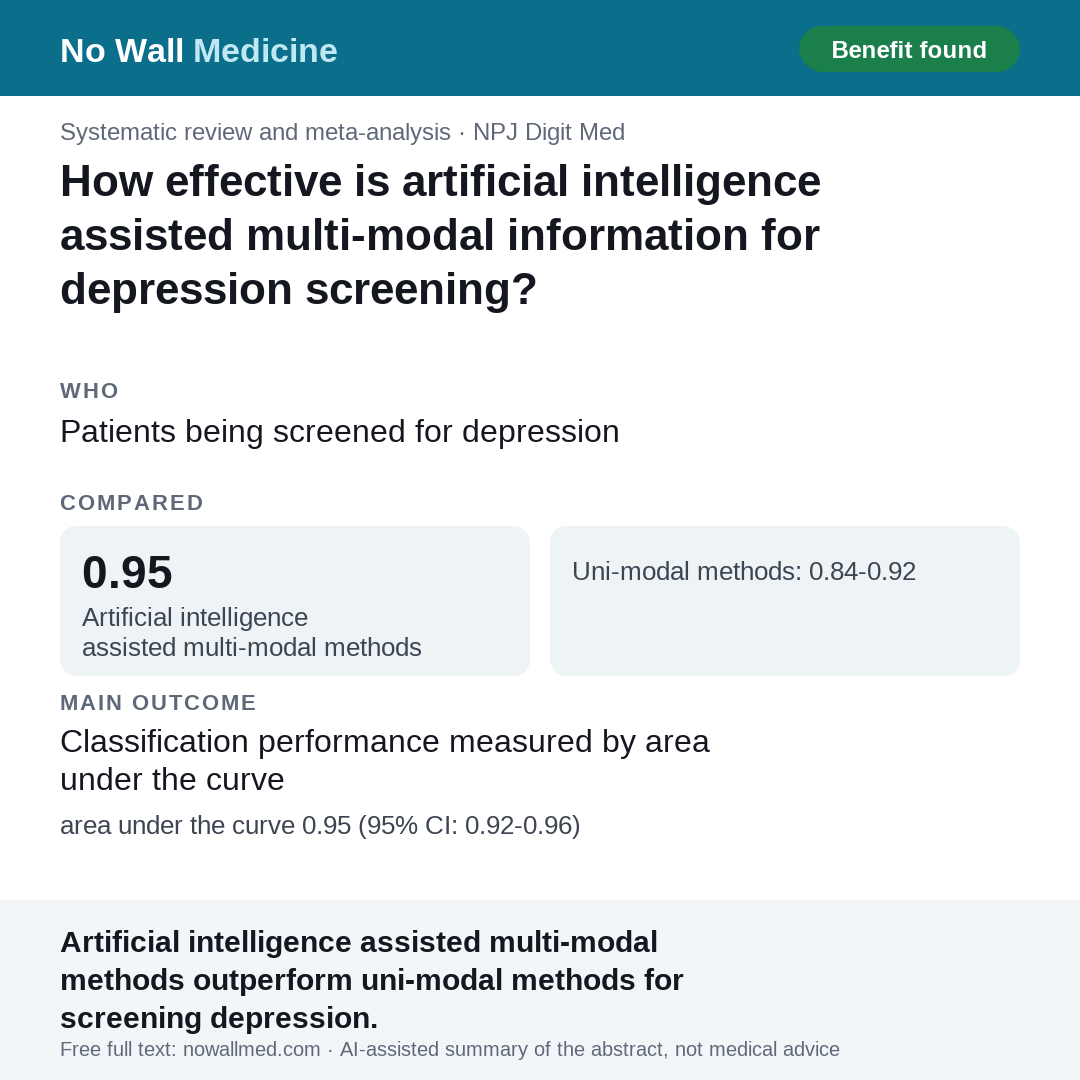
Clinical question: How effective is artificial intelligence assisted multi-modal information for depression screening?
Why it matters: It is unclear how effectively artificial intelligence can screen for depression using different combinations of physiological and behavioral information.
Key points
- Researchers conducted a systematic review and meta-analysis of studies using artificial intelligence to screen for depression using physiological and behavioral data.
- Multi-modal methods, which use several types of data, achieved a pooled area under the curve (a measure of accuracy) of 0.95 (95% CI: 0.92-0.96).
- These multi-modal methods performed better than uni-modal methods, which had a pooled area under the curve of 0.84-0.92.
Headline and key points written with AI from the paper’s abstract, with every number checked against it. Read the paper before relying on them.
Was this summary helpful?
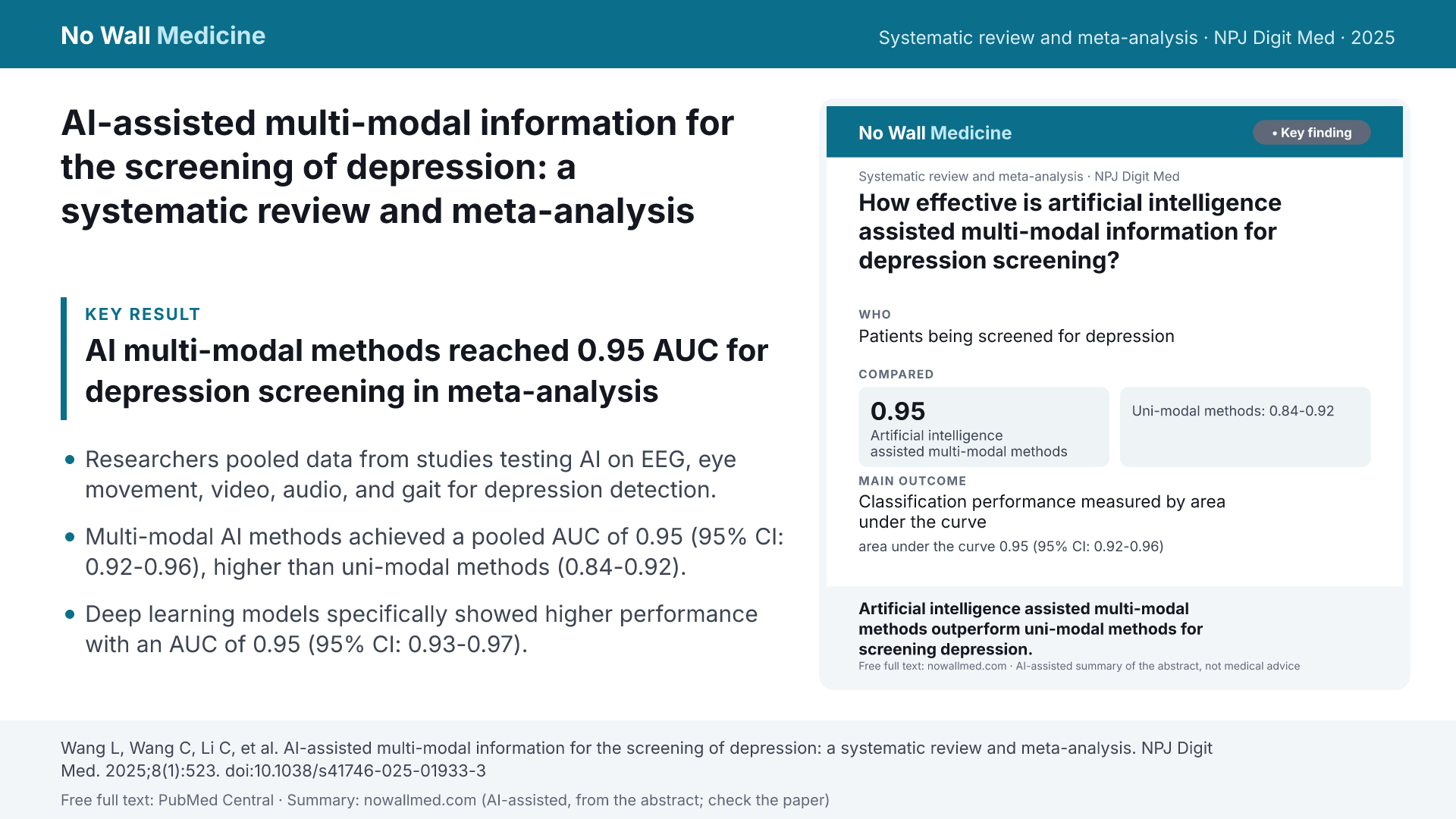
Cite this article
Wang L, Wang C, Li C, Murai T, Bai Y, Song Z. AI-assisted multi-modal information for the screening of depression: a systematic review and meta-analysis. NPJ Digit Med. 2025. doi:10.1038/s41746-025-01933-3
Spotted a mistake? Suggest a correction
Top studies every Monday
The week’s key trials and guidelines in your specialties, plus any topics you follow. By email, free.
Get the weekly digest