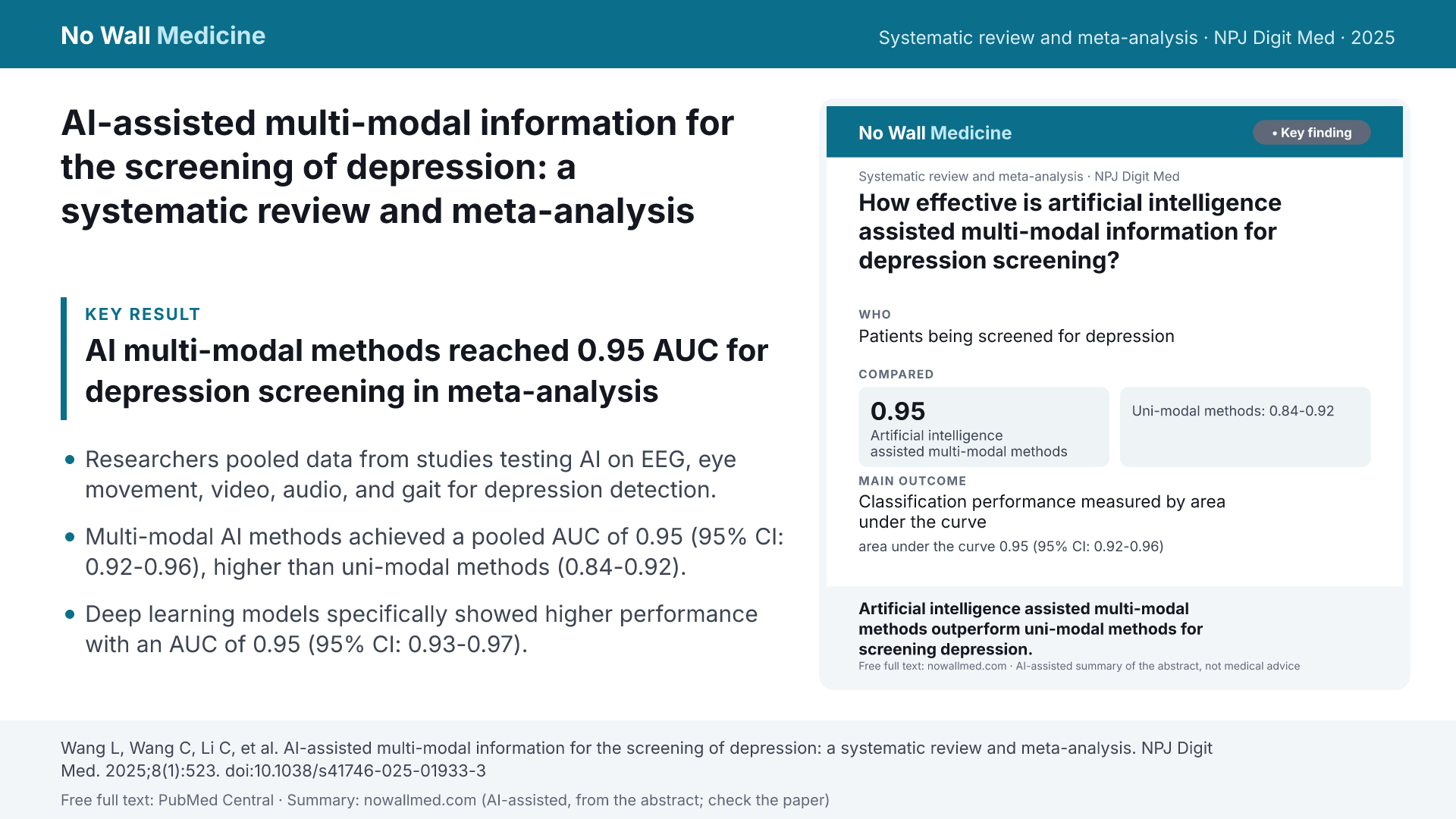
AI-assisted multi-modal information for the screening of depression: a systematic review and meta-analysis
Key result: AI multi-modal methods reached 0.95 AUC for depression screening in meta-analysis
Systematic review and meta-analysisKey finding
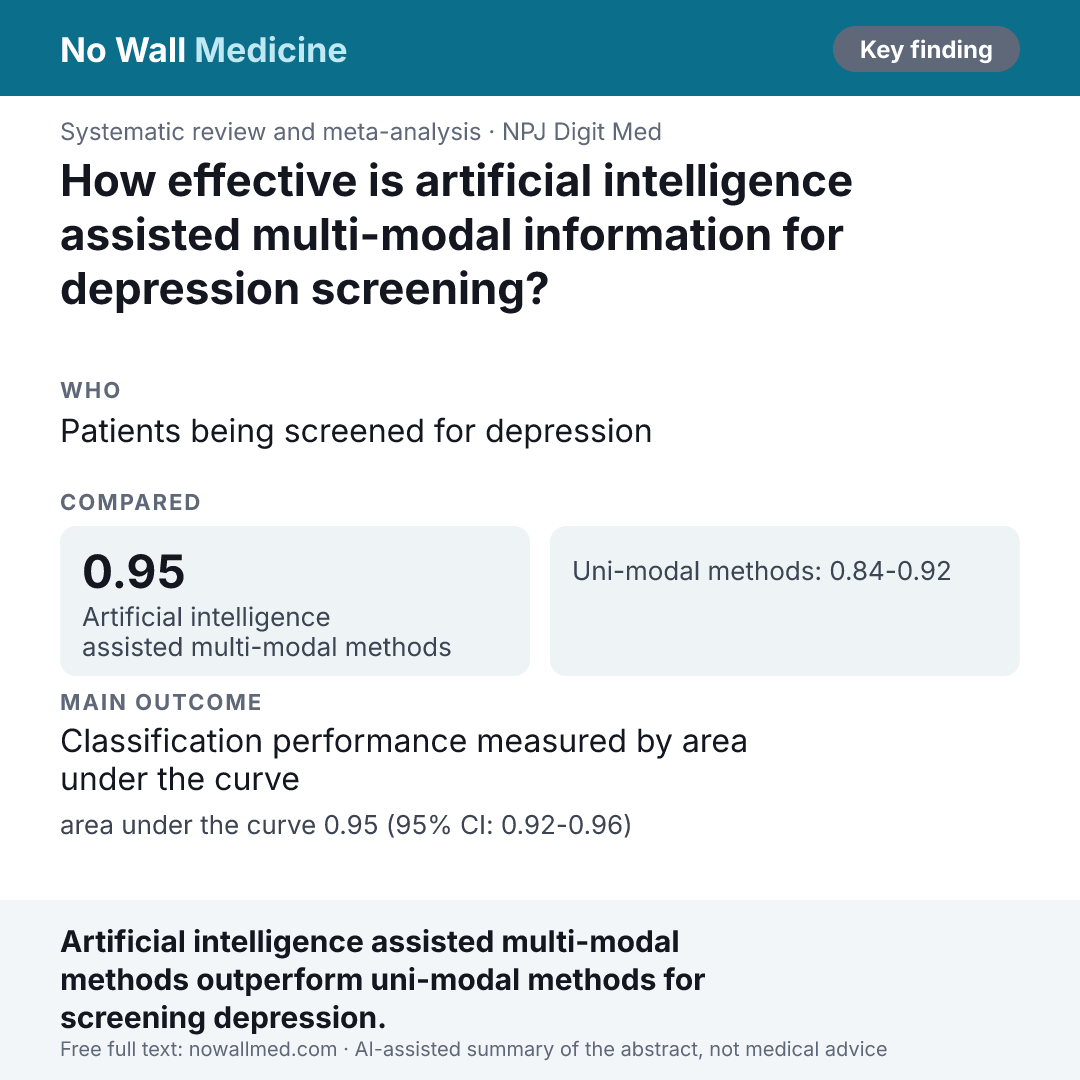
How effective is artificial intelligence assisted multi-modal information for depression screening?
Who
Patients being screened for depression
Compared
0.95Artificial intelligence assisted multi-modal methods (95% CI: 0.92-0.96)
Uni-modal methods: 0.84-0.92
Main outcome
Classification performance measured by area under the curve
Result: area under the curve 0.95 (95% CI: 0.92-0.96)
Bottom line: Artificial intelligence assisted multi-modal methods outperform uni-modal methods for screening depression.
NPJ Digit Med · 2025-08-16 · Save PNG
Key points
- Researchers pooled data from studies testing AI on EEG, eye movement, video, audio, and gait for depression detection.
- Multi-modal AI methods achieved a pooled AUC of 0.95 (95% CI: 0.92-0.96), higher than uni-modal methods (0.84-0.92).
- Deep learning models specifically showed higher performance with an AUC of 0.95 (95% CI: 0.93-0.97).
Discussion prompts
- Would these patients look like yours? Who was left out?
- Is the main outcome one that matters to patients?
- Is the difference large enough to change what you do?
Cite: Wang L, Wang C, Li C, et al. AI-assisted multi-modal information for the screening of depression: a systematic review and meta-analysis. NPJ Digit Med. 2025;8(1):523. doi:10.1038/s41746-025-01933-3
Free full text: PubMed Central · Summary and visual abstract: nowallmed.com/a/ai-assisted-multi-modal-information-for-the-screening-of-depression-a-yk7vpl/ (AI-assisted from the abstract; check the paper before relying on it).