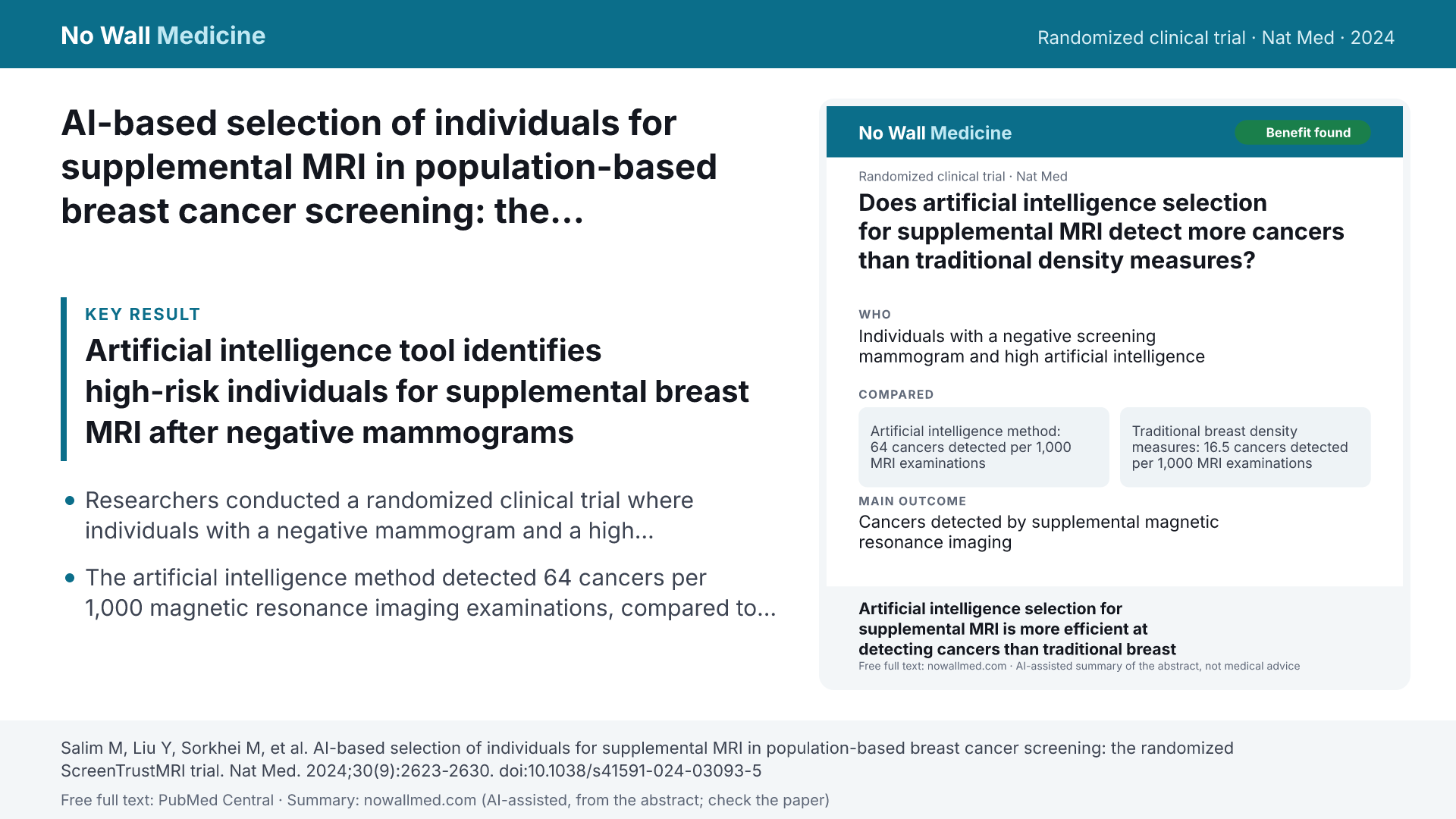
Artificial intelligence tool identifies high-risk individuals for supplemental breast MRI after negative mammograms
AI-based selection of individuals for supplemental MRI in population-based breast cancer screening: the randomized ScreenTrustMRI trial
Randomized clinical trialBenefit found
Does artificial intelligence selection for supplemental MRI detect more cancers than traditional density measures?
Who
Individuals with a negative screening mammogram and high artificial intelligence score
Compared
Artificial intelligence method: 64 cancers detected per 1,000 MRI examinations
Traditional breast density measures: 16.5 cancers detected per 1,000 MRI examinations
Main outcome
Cancers detected by supplemental magnetic resonance imaging
Bottom line: Artificial intelligence selection for supplemental MRI is more efficient at detecting cancers than traditional breast density measures.
Nat Med · 2024-07-08Download image
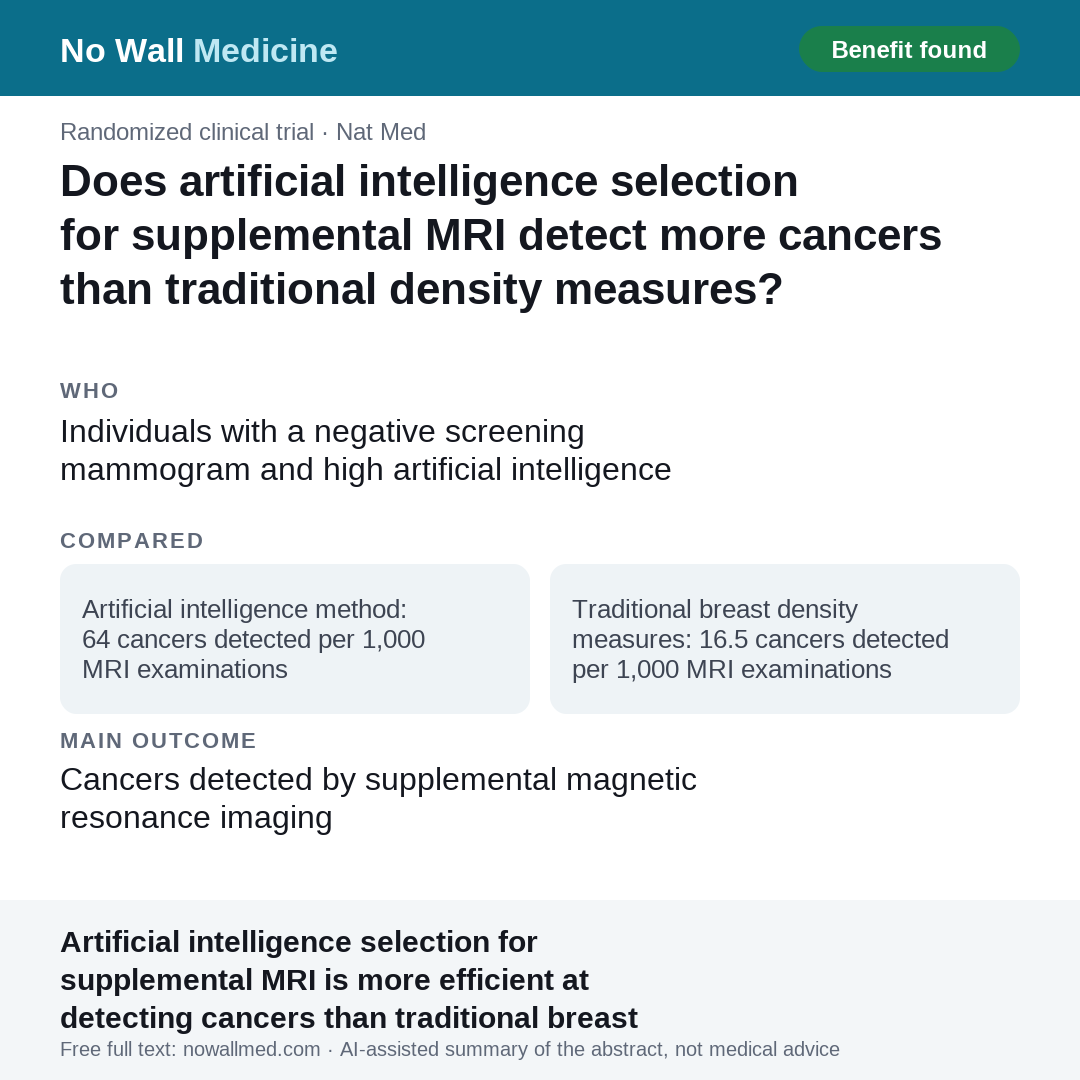
Clinical question: Does artificial intelligence selection for supplemental MRI detect more cancers than traditional density measures?
Why it matters: Current limitations in MRI staff and equipment costs make it difficult to use supplemental magnetic resonance imaging for all women, creating a need for effective triage methods.
Key points
- Researchers conducted a randomized clinical trial where individuals with a negative mammogram and a high artificial intelligence score were assigned to receive either supplemental magnetic resonance imaging or no imaging.
- The artificial intelligence method detected 64 cancers per 1,000 magnetic resonance imaging examinations, compared to 16.5 cancers per 1,000 examinations using traditional breast density measures.
- Most additional cancers detected by the artificial intelligence method were invasive and several were multifocal.
Headline and key points written with AI from the paper’s abstract, with every number checked against it. Read the paper before relying on them.
Was this summary helpful?
Subject terms
Headline, design, result, key points, caveat and citation as plain text.
Cite this article
Salim M, Liu Y, Sorkhei M, et al. AI-based selection of individuals for supplemental MRI in population-based breast cancer screening: the randomized ScreenTrustMRI trial. Nat Med. 2024. doi:10.1038/s41591-024-03093-5
Spotted a mistake? Suggest a correction