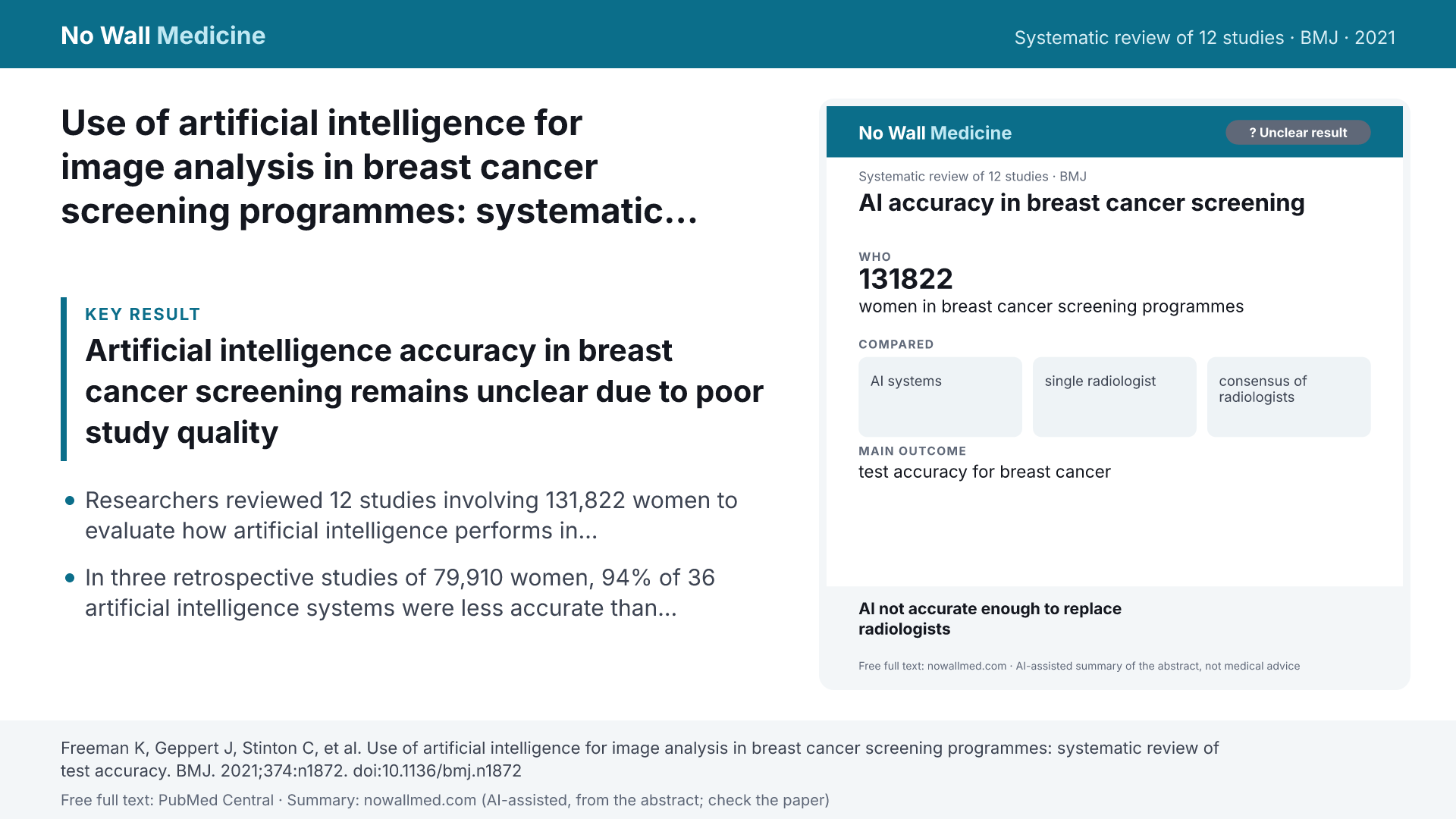
Artificial intelligence accuracy in breast cancer screening remains unclear due to poor study quality
Use of artificial intelligence for image analysis in breast cancer screening programmes: systematic review of test accuracy
Systematic review of 12 studiesUnclear result
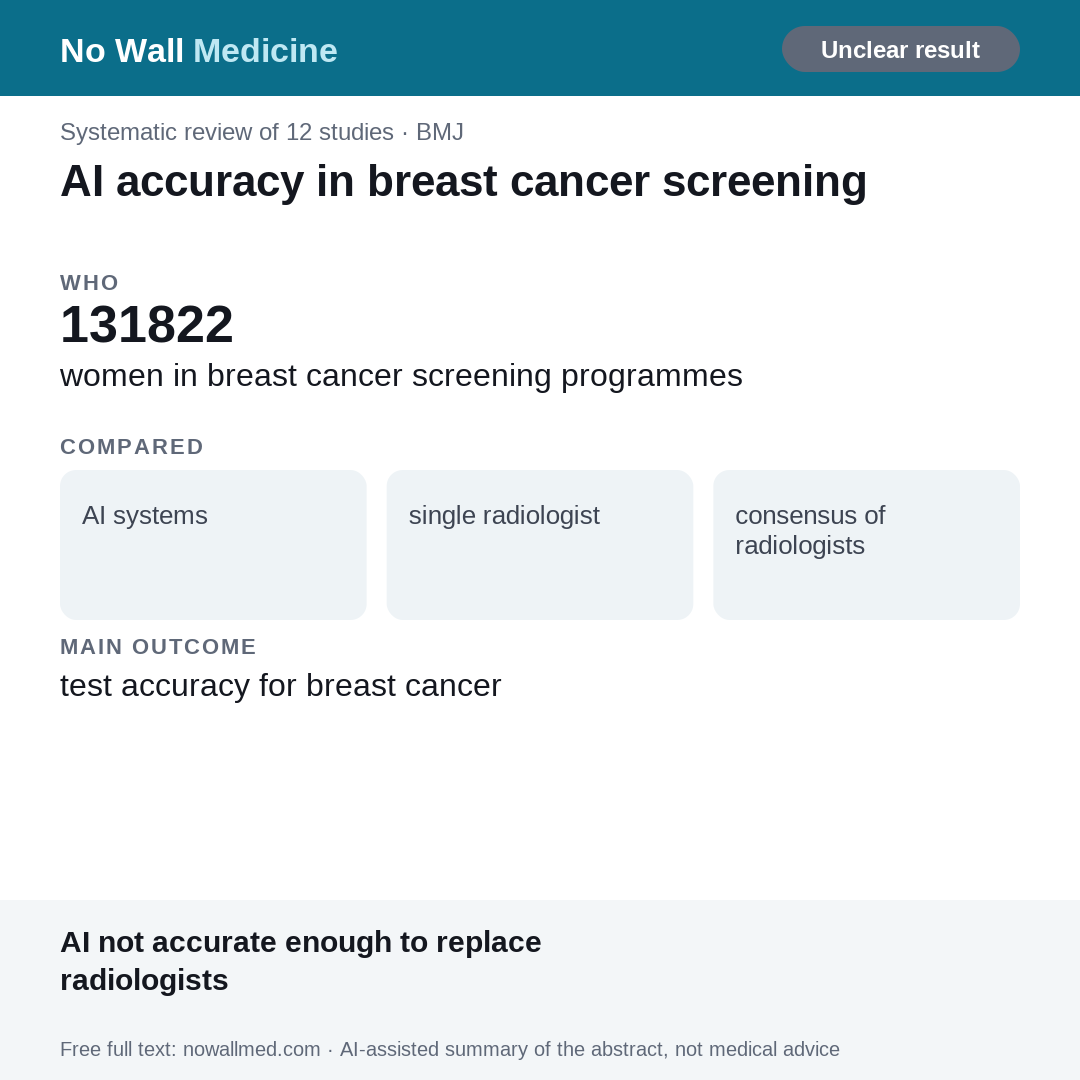
AI accuracy in breast cancer screening
Who
131822
women in breast cancer screening programmes
Compared
AI systems
single radiologist
consensus of radiologists
Main outcome
test accuracy for breast cancer
Bottom line: AI not accurate enough to replace radiologists
Limitation: poor methodological quality of studies
BMJ · 2021-09-01Download image
Why it matters: It is unknown how accurate artificial intelligence is for detecting breast cancer in actual mammography screening practice.
Key points
- Researchers reviewed 12 studies involving 131,822 women to evaluate how artificial intelligence performs in detecting breast cancer on mammograms.
- In three retrospective studies of 79,910 women, 94% of 36 artificial intelligence systems were less accurate than a single radiologist.
- While five small studies reported artificial intelligence was more accurate than a single radiologist, these findings were not replicated in larger studies.
Limitation the authors note: The included studies were of poor methodological quality and no prospective studies measuring test accuracy in screening practice were found.
Headline and key points written with AI from the paper’s abstract, with every number checked against it. Read the paper before relying on them.
Was this summary helpful?
Abstract
Objective
To examine the accuracy of artificial intelligence (AI) for the detection of breast cancer in mammography screening practice. Design
Systematic review of test accuracy studies. Data sources
Medline, Embase, Web of Science, and Cochrane Database of Systematic Reviews from 1 January 2010 to 17 May 2021. Eligibility criteria
Studies reporting test accuracy of AI algorithms, alone or in combination with radiologists, to detect cancer in women's digital mammograms in screening practice, or in test sets. Reference standard was biopsy with histology or follow-up (for screen negative women). Outcomes included test accuracy and cancer type detected. Study selection and synthesis
Two reviewers independently assessed articles for inclusion and assessed the methodological quality of included studies using the QUality Assessment of Diagnostic Accuracy Studies-2 (QUADAS-2) tool. A single reviewer extracted data, which were checked by a second reviewer. Narrative data synthesis was performed. Results
Twelve studies totalling 131 822 screened women were included. No prospective studies measuring test accuracy of AI in screening practice were found. Studies were of poor methodological quality. Three retrospective studies compared AI systems with the clinical decisions of the original radiologist, including 79 910 women, of whom 1878 had screen detected cancer or interval cancer within 12 months of screening. Thirty four (94%) of 36 AI systems evaluated in these studies were less accurate than a single radiologist, and all were less accurate than consensus of two or more radiologists. Five smaller studies (1086 women, 520 cancers) at high risk of bias and low generalisability to the clinical context reported that all five evaluated AI systems (as standalone to replace radiologist or as a reader aid) were more accurate than a single radiologist reading a test set in the laboratory. In three studies, AI used for triage screened out 53%, 45%, and 50% of women at low risk but also 10%, 4%, and 0% of cancers detected by radiologists. Conclusions
Current evidence for AI does not yet allow judgement of its accuracy in breast cancer screening programmes, and it is unclear where on the clinical pathway AI might be of most benefit. AI systems are not sufficiently specific to replace radiologist double reading in screening programmes. Promising results in smaller studies are not replicated in larger studies. Prospective studies are required to measure the effect of AI in clinical practice. Such studies will require clear stopping rules to ensure that AI does not reduce programme specificity. Study registration
Protocol registered as PROSPERO CRD42020213590.
Abstract reproduced under the article’s CC BY NC licence.
Subject terms
Cite this article
Freeman K, Geppert J, Stinton C, et al. Use of artificial intelligence for image analysis in breast cancer screening programmes: systematic review of test accuracy. BMJ. 2021. doi:10.1136/bmj.n1872
Spotted a mistake? Suggest a correction