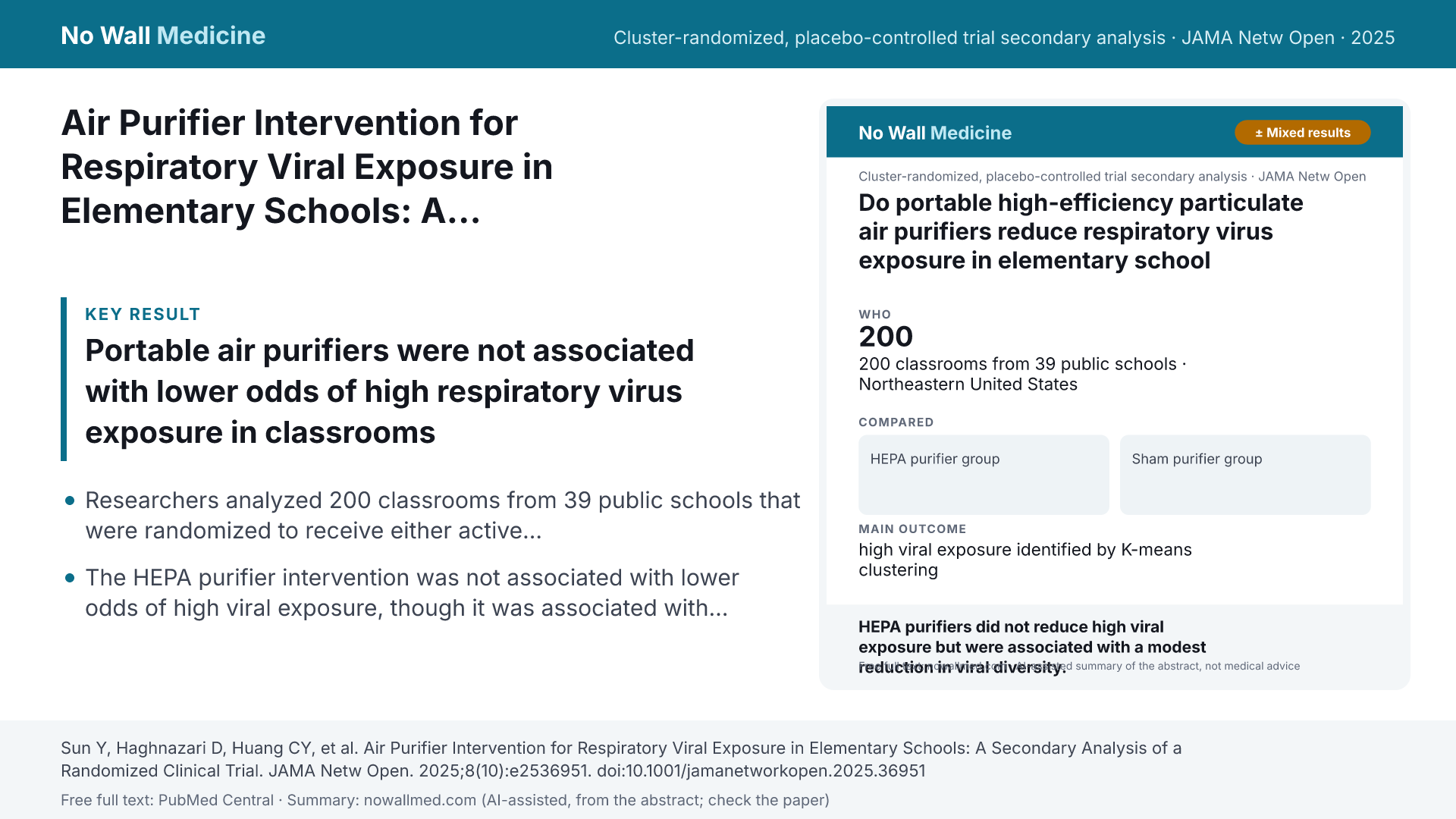
Portable air purifiers were not associated with lower odds of high respiratory virus exposure in classrooms
Air Purifier Intervention for Respiratory Viral Exposure in Elementary Schools: A Secondary Analysis of a Randomized Clinical Trial
Cluster-randomized, placebo-controlled trial secondary analysisMixed results
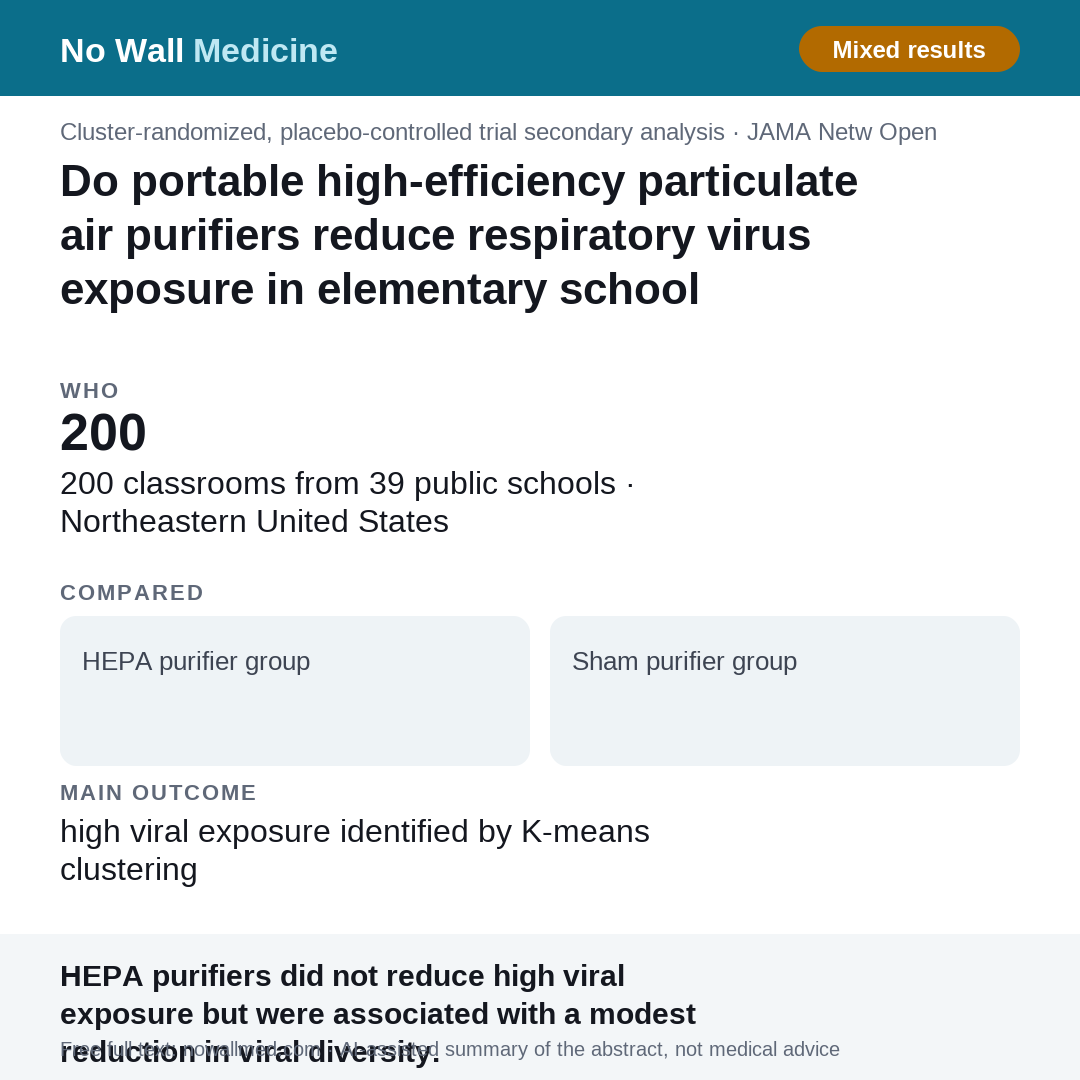
Do portable high-efficiency particulate air purifiers reduce respiratory virus exposure in elementary school classrooms?
Who
200
200 classrooms from 39 public schools · Northeastern United States
Compared
HEPA purifier group
Sham purifier group
Main outcome
high viral exposure identified by K-means clustering
Result: odds ratio 0.50 (95% CI 0.08-3.25)
Bottom line: HEPA purifiers did not reduce high viral exposure but were associated with a modest reduction in viral diversity.
JAMA Netw Open · 2025-10-01Download image
Clinical question: Do portable high-efficiency particulate air purifiers reduce respiratory virus exposure in elementary school classrooms?
Why it matters: The effectiveness of environmental mitigation measures for reducing respiratory virus exposure in elementary school classrooms remains unclear.
Key points
- Researchers analyzed 200 classrooms from 39 public schools that were randomized to receive either active high-efficiency particulate air (HEPA) purifiers or sham units.
- The HEPA purifier intervention was not associated with lower odds of high viral exposure, though it was associated with a modest reduction in viral diversity.
- Viruses were detected in 98.5% of the 532 bioaerosol samples collected, with rhinovirus being the most prevalent at 89.5%.
Headline and key points written with AI from the paper’s abstract, with every number checked against it. Read the paper before relying on them.
Was this summary helpful?
Subject terms
Cite this article
Sun Y, Haghnazari D, Huang CY, Baig A, Kim M, Cunningham A. Air Purifier Intervention for Respiratory Viral Exposure in Elementary Schools: A Secondary Analysis of a Randomized Clinical Trial. JAMA Netw Open. 2025. doi:10.1001/jamanetworkopen.2025.36951
Spotted a mistake? Suggest a correction