Drug-induced sedation endoscopy shows different airway changes depending on the type of sleep apnea surgery
Airway Changes After Sleep Apnea Surgery Using Drug-Induced Sedation Endoscopy: A Systematic Review and Meta-analysis
Systematic review and meta-analysisBenefit found
How does drug-induced sedation endoscopy characterize airway changes after sleep apnea surgery?
Who
320
Patients undergoing sleep apnea surgical procedures
Compared
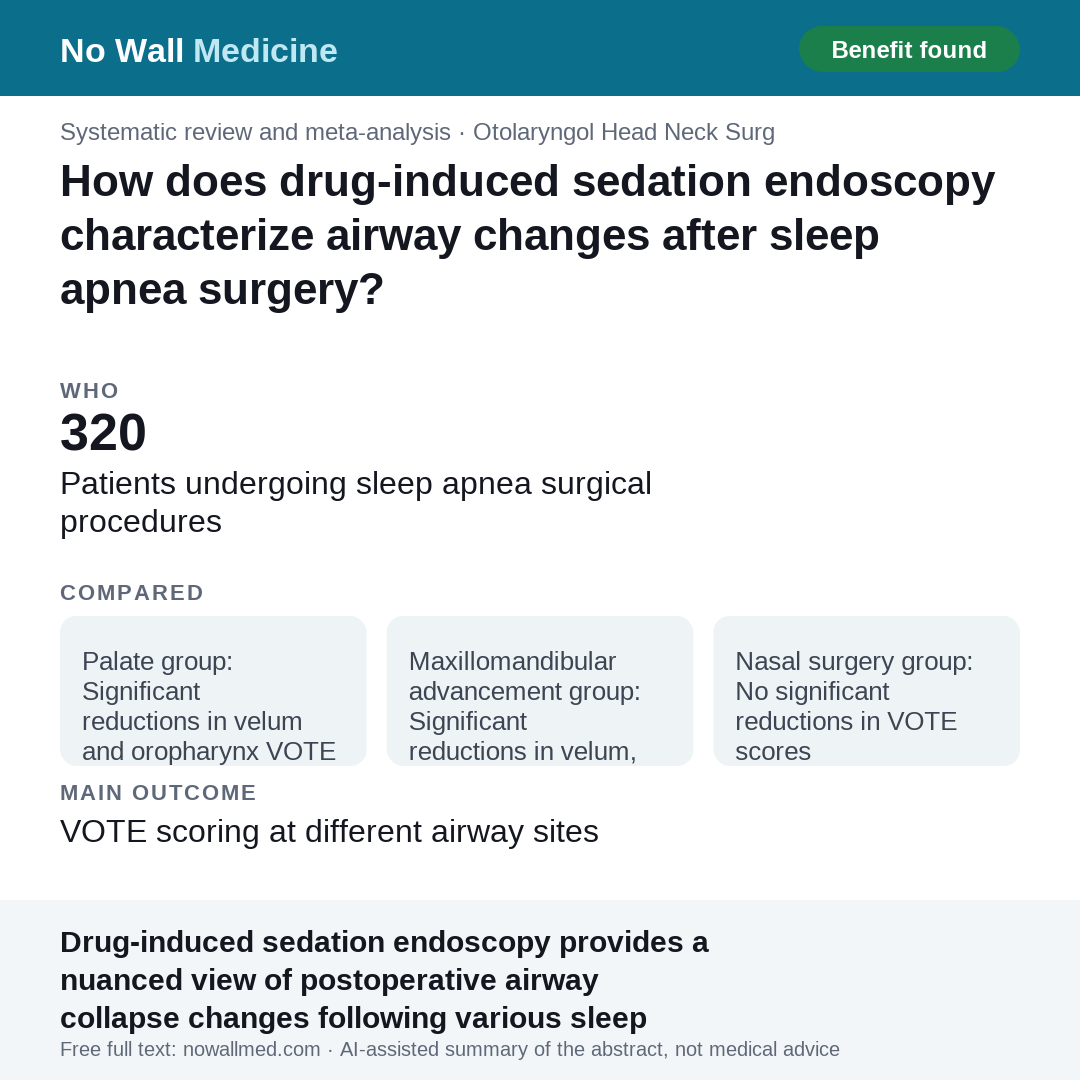
Palate group: Significant reductions in velum and oropharynx VOTE scoring
Maxillomandibular advancement group: Significant reductions in velum, oropharynx, and tongue VOTE scoring
Nasal surgery group: No significant reductions in VOTE scores
Main outcome
VOTE scoring at different airway sites
Bottom line: Drug-induced sedation endoscopy provides a nuanced view of postoperative airway collapse changes following various sleep apnea surgeries.
Limitation: Further research is needed to correlate these findings to existing outcome measures.
Otolaryngol Head Neck Surg · 2025-11-12Download image
Clinical question: How does drug-induced sedation endoscopy characterize airway changes after sleep apnea surgery?
Why it matters: Clinicians need to understand how drug-induced sedation endoscopy, a method of looking at the airway while sedated, characterizes the efficacy of different surgical procedures for sleep apnea.
Key points
- Researchers analyzed 10 studies involving 320 patients, with 81.2% being male and an average age of 46.8, to evaluate airway changes after surgery.
- Palate surgery was associated with lower VOTE scores—a scale measuring the velum, oropharynx, tongue, and epiglottis—at the velum and oropharynx levels.
- Maxillomandibular advancement, or jaw surgery, was associated with lower VOTE scores at the velum, oropharynx, and tongue levels.
Headline and key points written with AI from the paper’s abstract, with every number checked against it. Read the paper before relying on them.
Topics
Cite this article
Patel PA, Munhall CC, Smith CD, Kassir MF, Brennan EA, Ibrahim B. Airway Changes After Sleep Apnea Surgery Using Drug-Induced Sedation Endoscopy: A Systematic Review and Meta-analysis. Otolaryngol Head Neck Surg. 2025. doi:10.1002/ohn.70028
Spotted a mistake? Suggest a correction
Top studies every Monday
The week’s key trials and guidelines in your specialties, plus any topics you follow. By email, free.
Get the weekly digest