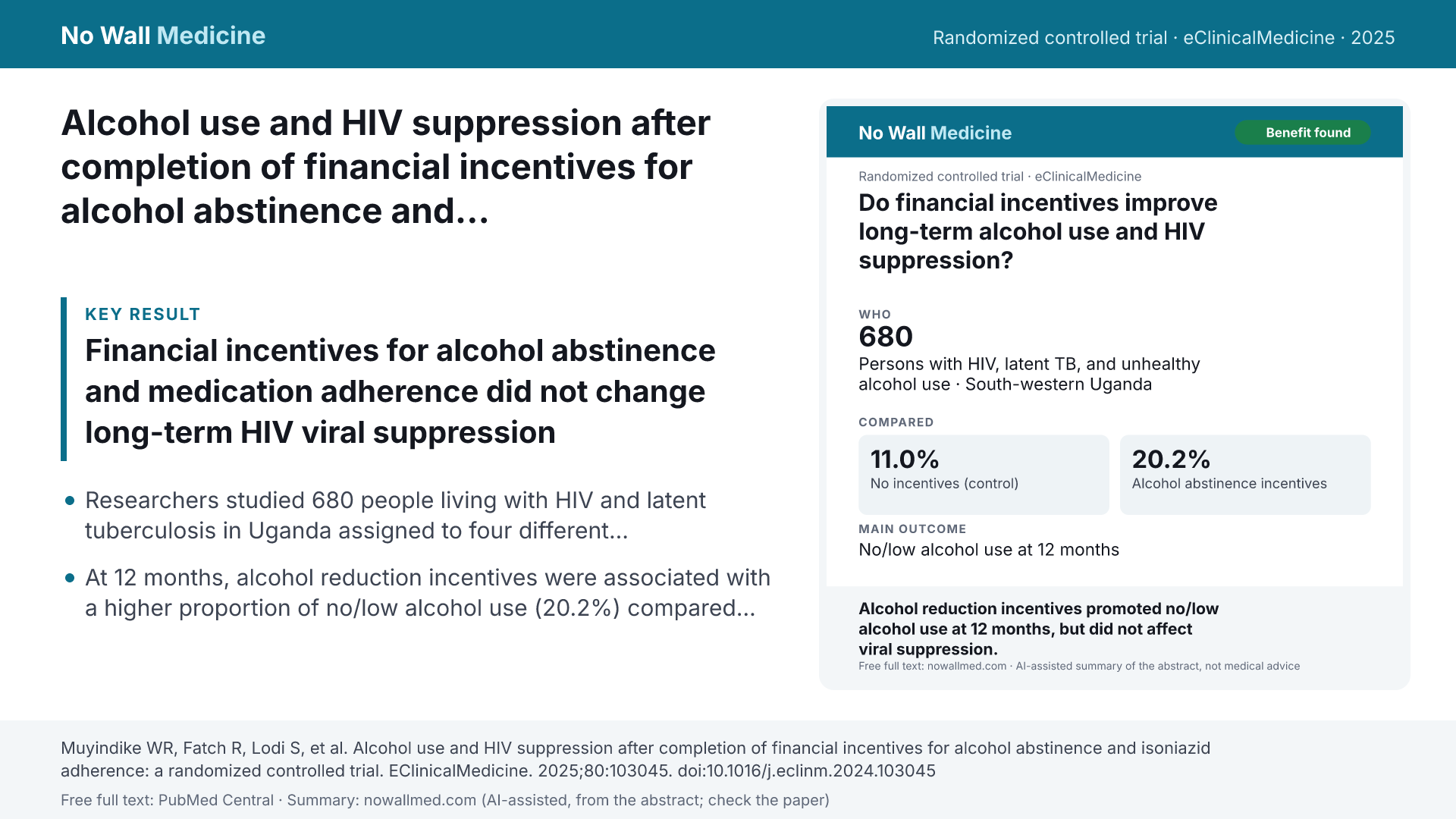
Financial incentives for alcohol abstinence and medication adherence did not change long-term HIV viral suppression
Alcohol use and HIV suppression after completion of financial incentives for alcohol abstinence and isoniazid adherence: a randomized controlled trial
Randomized controlled trialBenefit found
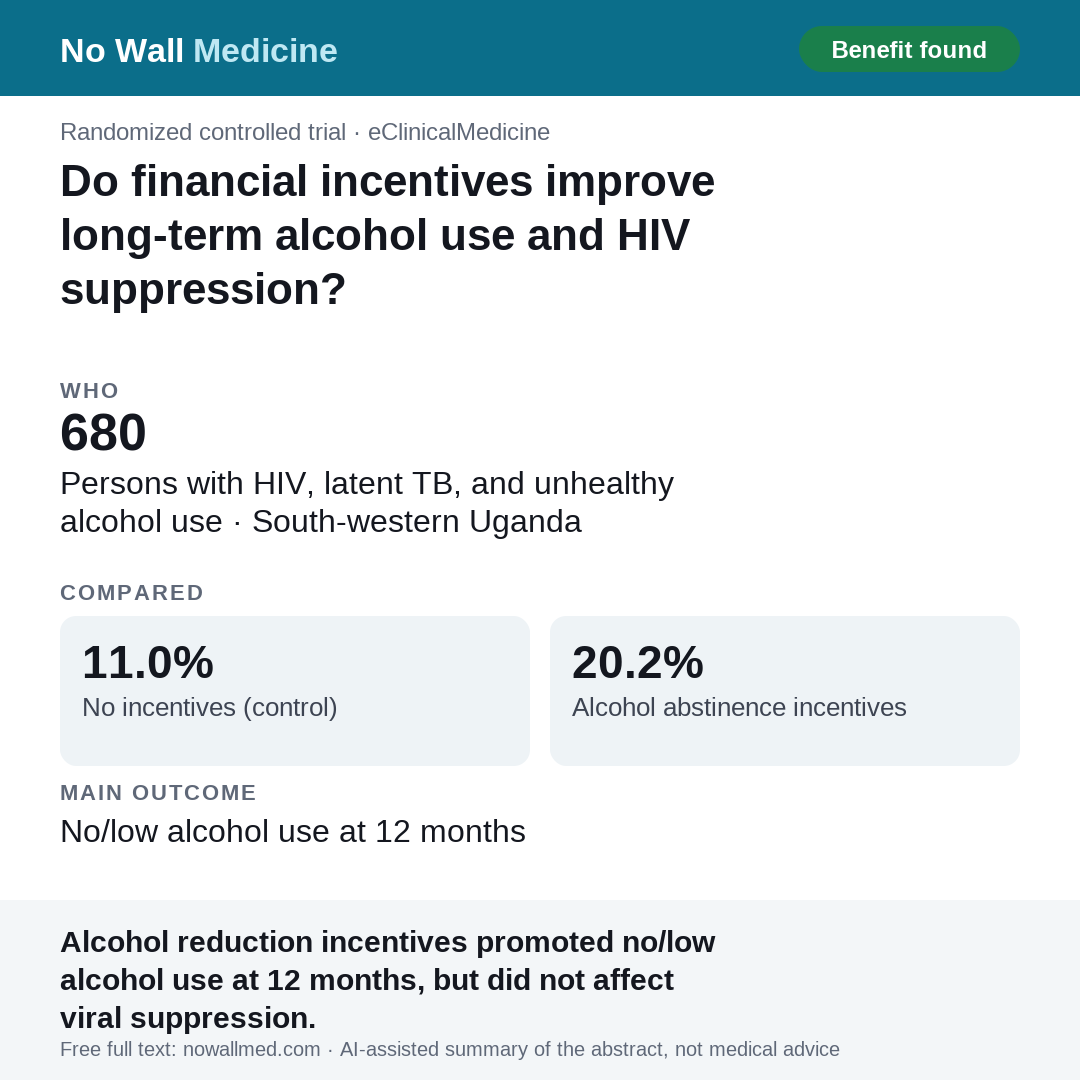
Do financial incentives improve long-term alcohol use and HIV suppression?
Who
680
Persons with HIV, latent TB, and unhealthy alcohol use · South-western Uganda
Compared
11.0%No incentives (control) (33/300)
20.2%Alcohol abstinence incentives (64/317)
Main outcome
No/low alcohol use at 12 months
Result: adjusted risk difference 8.4% (95% CI: 3.3-13.4)
Bottom line: Alcohol reduction incentives promoted no/low alcohol use at 12 months, but did not affect viral suppression.
Funded by: National Institutes of Health (NIH/NIAAA)
eClinicalMedicine · 2025-01-08Download image
Same trial (NCT03492216)
Papers we list that report this registered trial, oldest first. Read a secondary analysis alongside the main results.
- Main results Mixed results
Financial incentives reduced alcohol use but did not improve isoniazid adherence in HIV patients Lancet Glob Health 2023-11 - Related analysis Benefit found
This paper eClinicalMedicine 2025-01
Clinical question: Do financial incentives improve long-term alcohol use and HIV suppression?
Key points
- Researchers studied 680 people living with HIV and latent tuberculosis in Uganda assigned to four different incentive groups.
- At 12 months, alcohol reduction incentives were associated with a higher proportion of no/low alcohol use (20.2%) compared to no incentives (11.0%).
- Twelve-month HIV viral suppression, defined as less than 200 copies/mL, did not differ significantly between the intervention groups and the control group.
Headline and key points written with AI from the paper’s abstract, with every number checked against it. Read the paper before relying on them.
Was this summary helpful?
Headline, design, result, key points, caveat and citation as plain text.
Cite this article
Muyindike WR, Fatch R, Lodi S, et al. Alcohol use and HIV suppression after completion of financial incentives for alcohol abstinence and isoniazid adherence: a randomized controlled trial. eClinicalMedicine. 2025. doi:10.1016/j.eclinm.2024.103045
Spotted a mistake? Suggest a correction