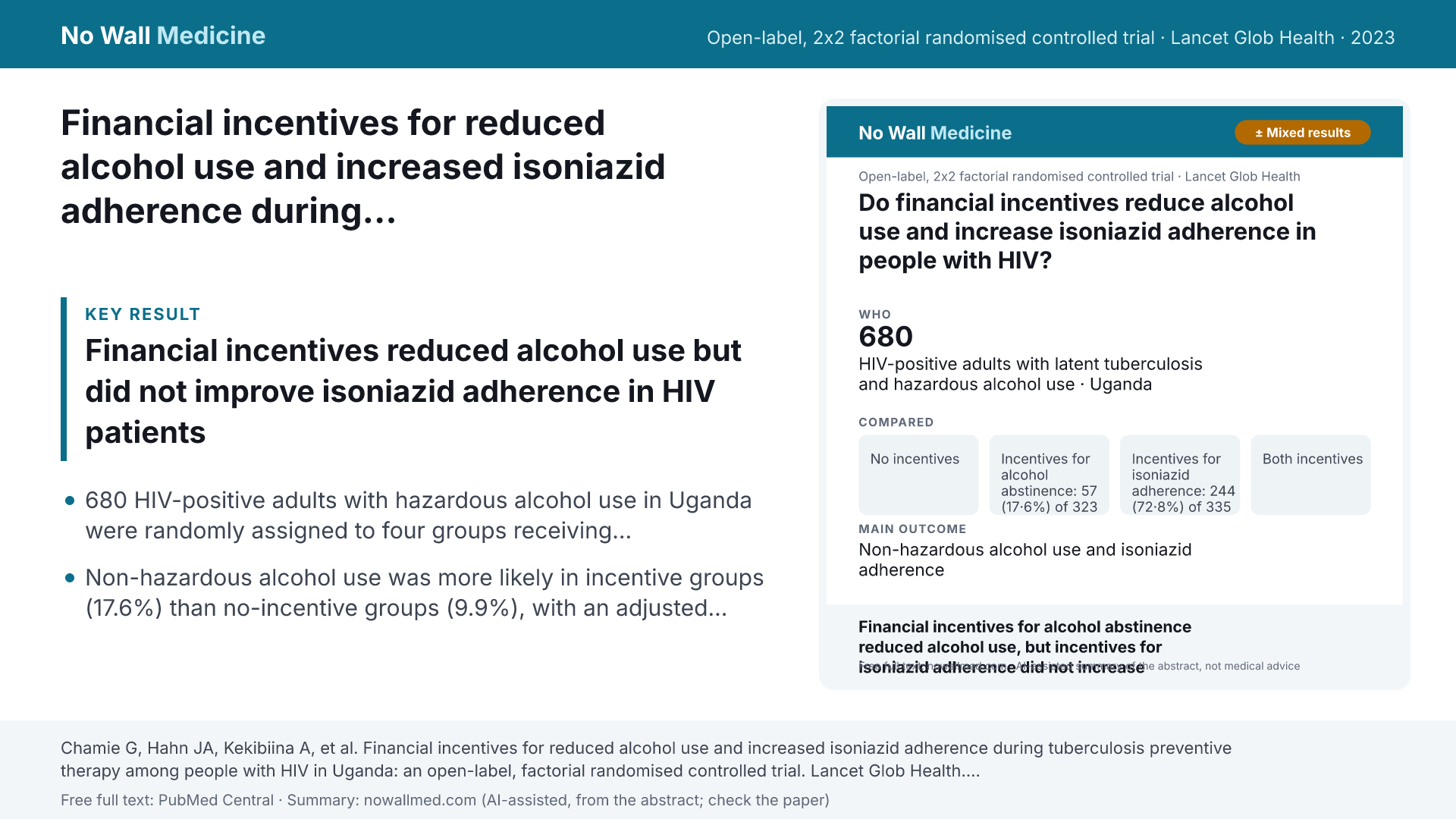
Financial incentives reduced alcohol use but did not improve isoniazid adherence in HIV patients
Financial incentives for reduced alcohol use and increased isoniazid adherence during tuberculosis preventive therapy among people with HIV in Uganda: an open-label, factorial randomised controlled trial
Open-label, 2x2 factorial randomised controlled trialMixed results
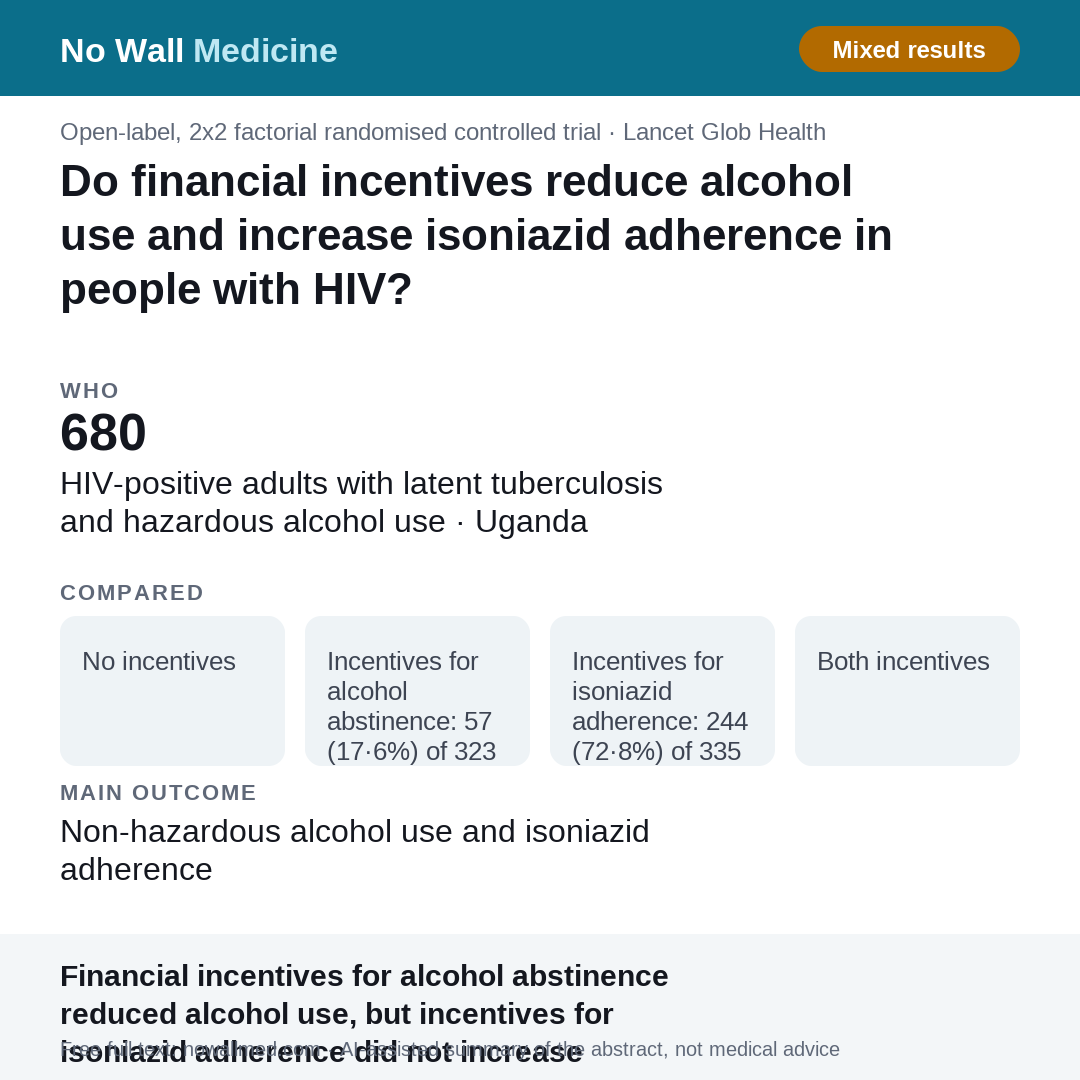
Do financial incentives reduce alcohol use and increase isoniazid adherence in people with HIV?
Who
680
HIV-positive adults with latent tuberculosis and hazardous alcohol use · Uganda
Compared
No incentives
Incentives for alcohol abstinence: 57 (17·6%) of 323
Incentives for isoniazid adherence: 244 (72·8%) of 335
Both incentives
Main outcome
Non-hazardous alcohol use and isoniazid adherence
Result: adjusted risk difference 7·6% (95% CI 2·7 to 12·5) for alcohol
Bottom line: Financial incentives for alcohol abstinence reduced alcohol use, but incentives for isoniazid adherence did not increase adherence.
Lancet Glob Health · 2023-11-17Download image
Same trial (NCT03492216)
Papers we list that report this registered trial, oldest first. Read a secondary analysis alongside the main results.
- Main results Mixed results
This paper Lancet Glob Health 2023-11 - Related analysis Benefit found
Financial incentives for alcohol abstinence and medication adherence did not change long-term HIV viral suppression eClinicalMedicine 2025-01
Clinical question: Do financial incentives reduce alcohol use and increase isoniazid adherence in people with HIV?
Why it matters: Few interventions exist to reduce alcohol use and increase isoniazid preventive therapy adherence in sub-Saharan Africa.
Key points
- 680 HIV-positive adults with hazardous alcohol use in Uganda were randomly assigned to four groups receiving financial incentives for alcohol abstinence, isoniazid adherence, both, or neither.
- Non-hazardous alcohol use was more likely in incentive groups (17.6%) than no-incentive groups (9.9%), with an adjusted risk difference of 7.6% (95% CI 2.7 to 12.5).
- Isoniazid adherence did not differ between incentive and no-incentive groups (72.8% vs 72.9%), with an adjusted risk difference of -0.2% (95% CI -7.0 to 6.5).
Limitation the authors note: The study was open-label, meaning participants knew which incentives they were receiving.
Headline and key points written with AI from the paper’s abstract, with every number checked against it. Read the paper before relying on them.
Was this summary helpful?
Abstract
Background
Alcohol use is common among people with HIV and is a risk factor for tuberculosis disease and non-adherence to isoniazid preventive therapy (IPT). Few interventions exist to reduce alcohol use and increase IPT adherence in sub-Saharan Africa. The aim of this study was to test the hypothesis that financial incentives conditional on point-of-care negative urine alcohol biomarker testing and positive urine isoniazid testing would reduce alcohol use and increase isoniazid adherence, respectively, in people with HIV who have latent tuberculosis infection and hazardous alcohol use. Methods
We conducted an open-label, 2×2 factorial randomised controlled trial in Uganda. Eligible for the study were non-pregnant HIV-positive adults (aged ≥18 years) prescribed antiretroviral therapy for at least 6 months, with current heavy alcohol use confirmed by urine ethyl glucuronide (biomarker of recent alcohol use) and a positive Alcohol Use Disorders Identification Test-Consumption (AUDIT-C; ≥3 for women, ≥4 for men) for the past 3 months' drinking, no history of active tuberculosis, tuberculosis treatment, or tuberculosis preventive therapy, and a positive tuberculin skin test. We randomly assigned participants (1:1:1:1) initiating 6 months of IPT to: no incentives (group 1); or incentives for recent alcohol abstinence (group 2), isoniazid adherence (group 3), or both (group 4). Escalating incentives were contingent on monthly point-of-care urine tests negative for ethyl glucuronide (groups 2 and 4), or positive on IsoScreen (biomarker of recent isoniazid use; groups 3 and 4). The primary alcohol outcome was non-hazardous use by self-report (AUDIT-C <3 for women, <4 for men) and phosphatidylethanol (PEth; past-month alcohol biomarker) <35 ng/mL at 3 months and 6 months. The primary isoniazid adherence outcome was more than 90% bottle opening of days prescribed. We performed intention-to-treat analyses. This trial is registered with ClinicalTrials.gov (NCT03492216), and is complete. Findings
From April 16, 2018, to Aug 2, 2021, 5508 people were screened, of whom 680 were randomly assigned: 169 to group 1, 169 to group 2, 170 to group 3, and 172 to group 4. The median age of participants was 39 years (IQR 32-47), 470 (69%) were male, 598 (90%) of 663 had HIV RNA viral loads of less than 40 copies per mL, median AUDIT-C score was 6 (IQR 4-8), and median PEth was 252 ng/mL (IQR 87-579). Among 636 participants who completed the trial with alcohol use endpoint measures (group 1: 152, group 2: 159, group 3: 161, group 4: 164), non-hazardous alcohol use was more likely in the groups with incentives for alcohol abstinence (groups 2 and 4) versus no alcohol incentives (groups 1 and 3): 57 (17·6%) of 323 versus 31 (9·9%) of 313, respectively; adjusted risk difference (aRD) 7·6% (95% CI 2·7 to 12·5, p=0·0025). Among 656 participants who completed the trial with isoniazid adherence endpoint measures (group 1: 158, group 2: 163, group 3: 168, group 4: 167), incentives for isoniazid adherence did not increase adherence: 244 (72·8%) of 335 in the isoniazid incentive groups (groups 3 and 4) versus 234 (72·9%) of 321 in the no isoniazid incentive groups (groups 1 and 2); aRD -0·2% (95% CI -7·0 to 6·5, p=0·94). Overall, 53 (8%) of 680 participants discontinued isoniazid due to grade 3 or higher adverse events. There was no significant association between randomisation group and hepatotoxicity resulting in isoniazid discontinuation, after adjusting for sex and site. Interpretation
Escalating financial incentives contingent on recent alcohol abstinence led to significantly lower biomarker-confirmed alcohol use versus control, but incentives for recent isoniazid adherence did not lead to changes in adherence. The alcohol intervention was efficacious despite less intensive frequency of incentives and clinic visits than traditional programmes for substance use, suggesting that pragmatic modifications of contingency management for resource-limited settings can have efficacy and that further evaluation of implementation is merited. Funding
National Institute on Alcohol Abuse and Alcoholism. Translation
For the Runyankole translation of the abstract see Supplementary Materials section.
Abstract reproduced under the article’s CC BY NC ND licence.
Subject terms
Headline, design, result, key points, caveat and citation as plain text.
Cite this article
Chamie G, Hahn JA, Kekibiina A, et al. Financial incentives for reduced alcohol use and increased isoniazid adherence during tuberculosis preventive therapy among people with HIV in Uganda: an open-label, factorial randomised controlled trial. Lancet Glob Health. 2023. doi:10.1016/S2214-109X(23)00436-9
Spotted a mistake? Suggest a correction