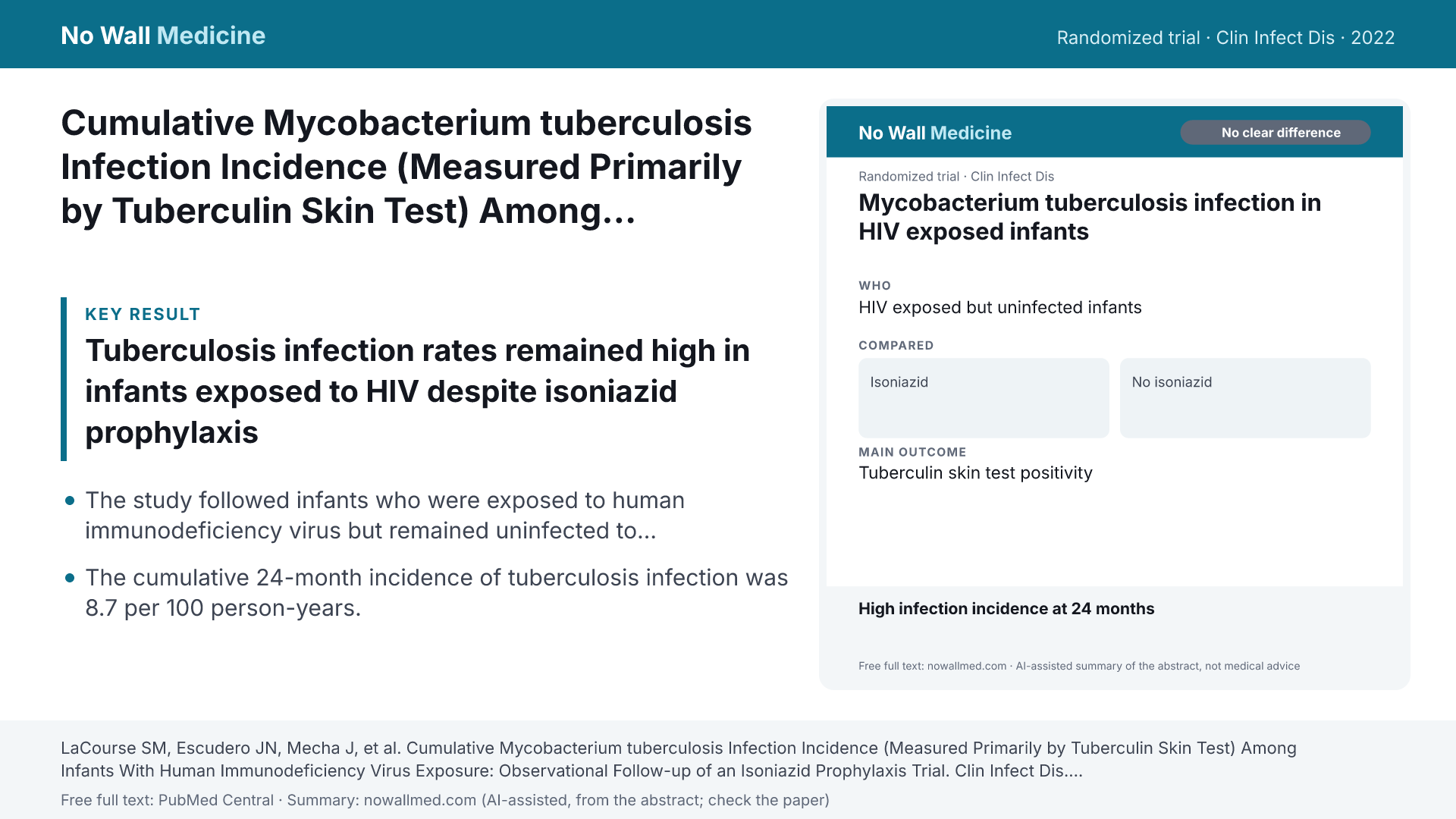
Tuberculosis infection rates remained high in infants exposed to HIV despite isoniazid prophylaxis
Cumulative Mycobacterium tuberculosis Infection Incidence (Measured Primarily by Tuberculin Skin Test) Among Infants With Human Immunodeficiency Virus Exposure: Observational Follow-up of an Isoniazid Prophylaxis Trial
Randomized trialNo clear difference
Mycobacterium tuberculosis infection in HIV exposed infants
Who
HIV exposed but uninfected infants
Compared
Isoniazid
No isoniazid
Main outcome
Tuberculin skin test positivity
Bottom line: High infection incidence at 24 months
Clin Infect Dis · 2022-05-25Download image

Why it matters: It was unknown if the trend of decreased tuberculosis skin test positivity seen at 12 months would continue through 24 months of age.
Key points
- The study followed infants who were exposed to human immunodeficiency virus but remained uninfected to measure tuberculosis infection rates via skin tests.
- The cumulative 24-month incidence of tuberculosis infection was 8.7 per 100 person-years.
- A trend for decreased skin test positivity in infants randomized to isoniazid at 6 weeks of age was not sustained through 24 months of age.
Headline and key points written with AI from the paper’s abstract, with every number checked against it. Read the paper before relying on them.
Was this summary helpful?
Subject terms
Cite this article
LaCourse SM, Escudero JN, Mecha J, Warr AJ, Richardson BA, Carimo N. Cumulative Mycobacterium tuberculosis Infection Incidence (Measured Primarily by Tuberculin Skin Test) Among Infants With Human Immunodeficiency Virus Exposure: Observational Follow-up of an Isoniazid Prophylaxis Trial. Clin Infect Dis. 2022. doi:10.1093/cid/ciac393
Spotted a mistake? Suggest a correction