Alert-Triggered Patient Education Versus Nurse Feedback for Nonadministered Venous Thromboembolism Prophylaxis Doses: A Cluster-Randomized Controlled Trial
Cluster-randomized controlled trialBenefit found
Do alert-triggered education or nurse feedback reduce nonadministered venous thromboembolism prophylaxis doses?
Who
11098
Adult patients in non-intensive care units · 1 academic hospital
Compared
Patient-centered education bundle: 7.4% postintervention
Nurse feedback: 11.2% postintervention
Main outcome
Proportion of nonadministered doses of prescribed pharmacologic prophylaxis
Result: OR 1.28 (95% CI 1.0-1.61)
Bottom line: Both interventions reduced nonadministered doses, but patient-centered education was more effective than nurse feedback.
J Am Heart Assoc · 2022-09-01Download image
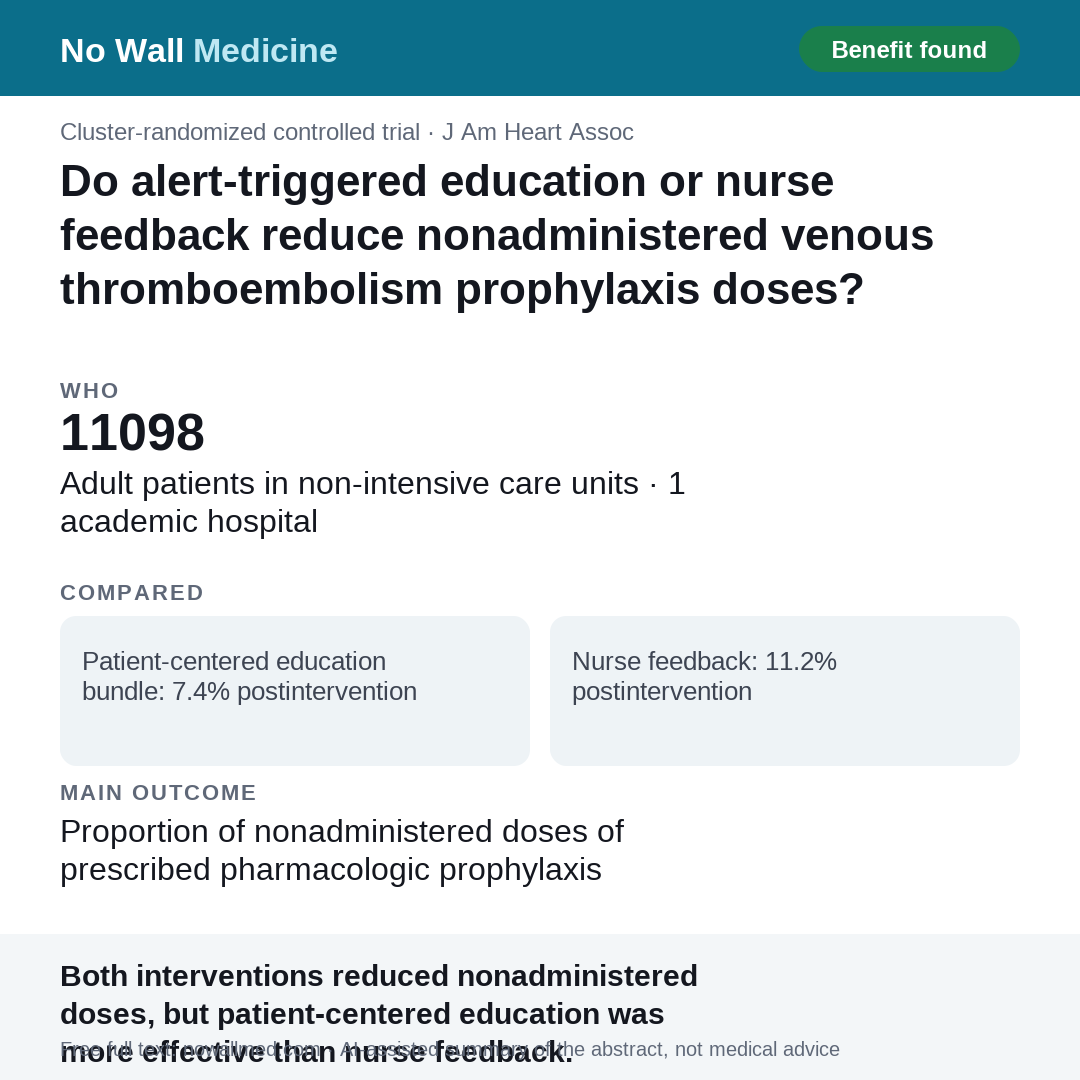
Clinical question: Do alert-triggered education or nurse feedback reduce nonadministered venous thromboembolism prophylaxis doses?
Abstract
Background Many hospitalized patients are not administered prescribed doses of pharmacologic venous thromboembolism prophylaxis. Methods and Results In this cluster-randomized controlled trial, all adult non-intensive care units (10 medical, 6 surgical) in 1 academic hospital were randomized to either a real-time, electronic alert-triggered, patient-centered education bundle intervention or nurse feedback intervention to evaluate their effectiveness for reducing nonadministration of venous thromboembolism prophylaxis. Primary outcome was the proportion of nonadministered doses of prescribed pharmacologic prophylaxis. Secondary outcomes were proportions of nonadministered doses stratified by nonadministration reasons (patient refusal, other). To test our primary hypothesis that both interventions would reduce nonadministration, we compared outcomes pre- versus postintervention within each cohort. Secondary hypotheses were tested comparing the effectiveness between cohorts. Of 11 098 patient visits, overall dose nonadministration declined significantly after the interventions (13.4% versus 9.2%; odds ratio [OR], 0.64 [95% CI, 0.57-0.71]). Nonadministration decreased significantly (P<0.001) in both arms: patient-centered education bundle, 12.2% versus 7.4% (OR, 0.56 [95% CI, 0.48-0.66]), and nurse feedback, 14.7% versus 11.2% (OR, 0.72 [95% CI, 0.62-0.84]). Patient refusal decreased significantly in both arms: patient-centered education bundle, 7.3% versus 3.7% (OR, 0.46 [95% CI, 0.37-0.58]), and nurse feedback, 9.5% versus 7.1% (OR, 0.71 [95% CI, 0.59-0.86]). No differential effect occurred on medical versus surgical units. The patient-centered education bundle was significantly more effective in reducing all nonadministered (P=0.03) and refused doses (P=0.003) compared with nurse feedback (OR, 1.28 [95% CI, 1.0-1.61]; P=0.03 for interaction). Conclusions Information technology strategies like the alert-triggered, targeted patient-centered education bundle, and nurse-focused audit and feedback can improve venous thromboembolism prophylaxis administration. Registration URL: https://www.clinicaltrials.gov; Unique identifier: NCT03367364.
Subject terms
Cite this article
Haut ER, Owodunni OP, Wang J, Shaffer DL, Hobson DB, Yenokyan G. Alert-Triggered Patient Education Versus Nurse Feedback for Nonadministered Venous Thromboembolism Prophylaxis Doses: A Cluster-Randomized Controlled Trial. J Am Heart Assoc. 2022. doi:10.1161/JAHA.122.027119
Spotted a mistake? Suggest a correction
Top studies every Monday
The week’s key trials and guidelines in your specialties, plus any topics you follow. By email, free.
Get the weekly digest