Using a risk model and hematologist review did not change hospital-acquired blood clot rates in children
Model-Guided Decision-Making for Thromboprophylaxis and Hospital-Acquired Thromboembolic Events Among Hospitalized Children and Adolescents: The CLOT Randomized Clinical Trial
Pragmatic randomized clinical trialNo clear difference
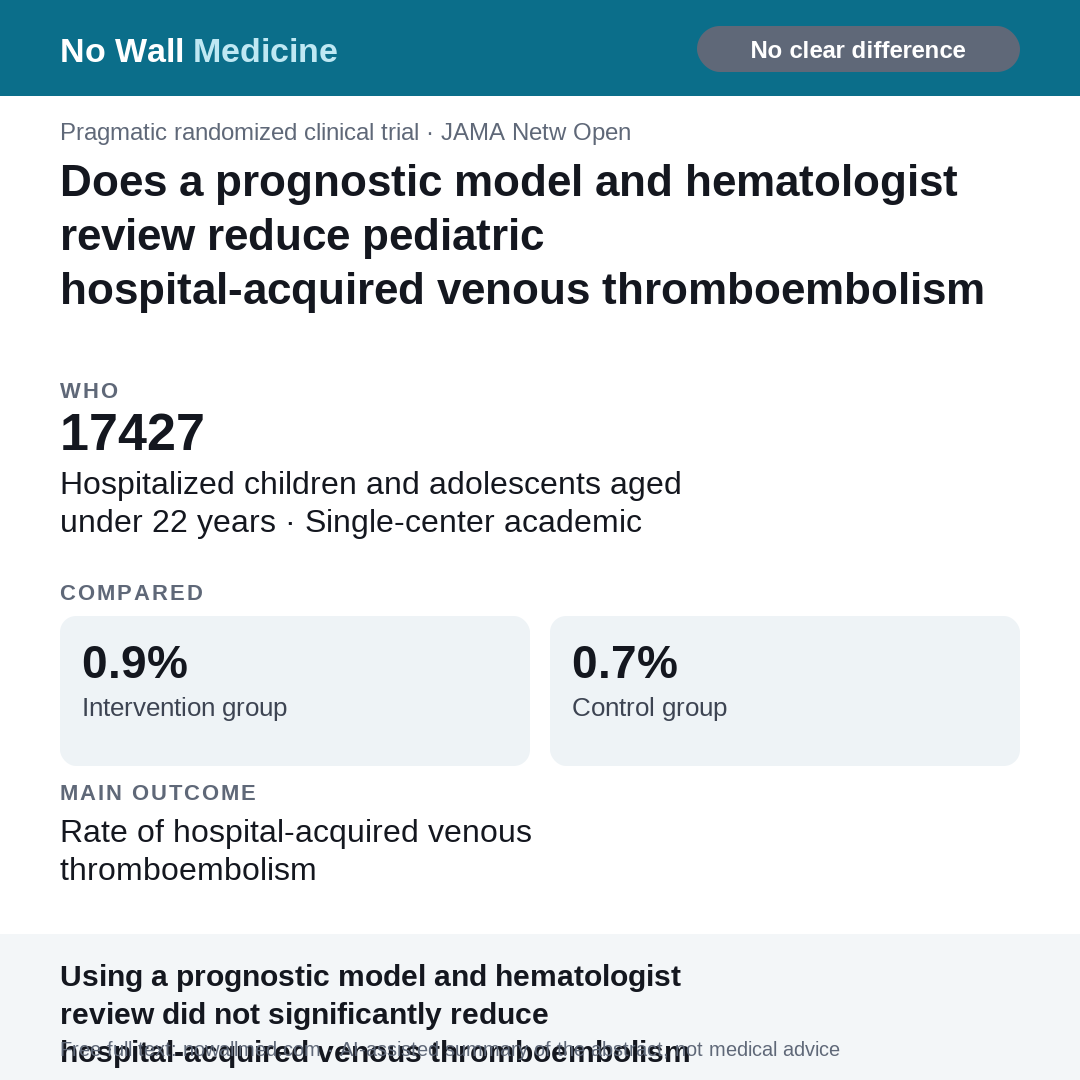
Does a prognostic model and hematologist review reduce pediatric hospital-acquired venous thromboembolism rates?
Who
17427
Hospitalized children and adolescents aged under 22 years · Single-center academic children's hospital
Compared
0.9%Intervention group
0.7%Control group
Main outcome
Rate of hospital-acquired venous thromboembolism
Result: risk difference: 2.2 per 1000 patients; 95% CI, -0.4 to 4.8 per 1000 patients
Bottom line: Using a prognostic model and hematologist review did not significantly reduce hospital-acquired venous thromboembolism rates in pediatric patients.
JAMA Netw Open · 2023-10-02Download image
Clinical question: Does a prognostic model and hematologist review reduce pediatric hospital-acquired venous thromboembolism rates?
Why it matters: It is difficult to identify which pediatric patients are at risk for hospital-acquired venous thromboembolism to decide if they need preventative blood-thinning medication.
Key points
- Researchers randomized 17,427 pediatric hospitalizations to either a model-guided intervention group or a control group to measure hospital-acquired venous thromboembolism rates.
- The rate of hospital-acquired venous thromboembolism was 0.9% in the intervention group and 0.7% in the control group, which was not a statistically significant difference.
- Primary clinical teams accepted recommendations to start blood-thinning medication 25.8% of the time, and no major bleeding events were observed.
Headline and key points written with AI from the paper’s abstract, with every number checked against it. Read the paper before relying on them.
Was this summary helpful?
Subject terms
Cite this article
Walker SC, French B, Moore RP, Domenico HJ, Wanderer JP, Mixon AS. Model-Guided Decision-Making for Thromboprophylaxis and Hospital-Acquired Thromboembolic Events Among Hospitalized Children and Adolescents: The CLOT Randomized Clinical Trial. JAMA Netw Open. 2023. doi:10.1001/jamanetworkopen.2023.37789
Spotted a mistake? Suggest a correction
Top studies every Monday
The week’s key trials and guidelines in your specialties, plus any topics you follow. By email, free.
Get the weekly digest