Alfentanil and fentanyl showed similar blood pressure and heart rate changes during emergency airway induction
Alfentanil versus fentanyl for emergency department rapid sequence induction with ketamine: A-FAKT, a pilot randomized trial
Double-blind pilot randomized controlled trialNo clear difference
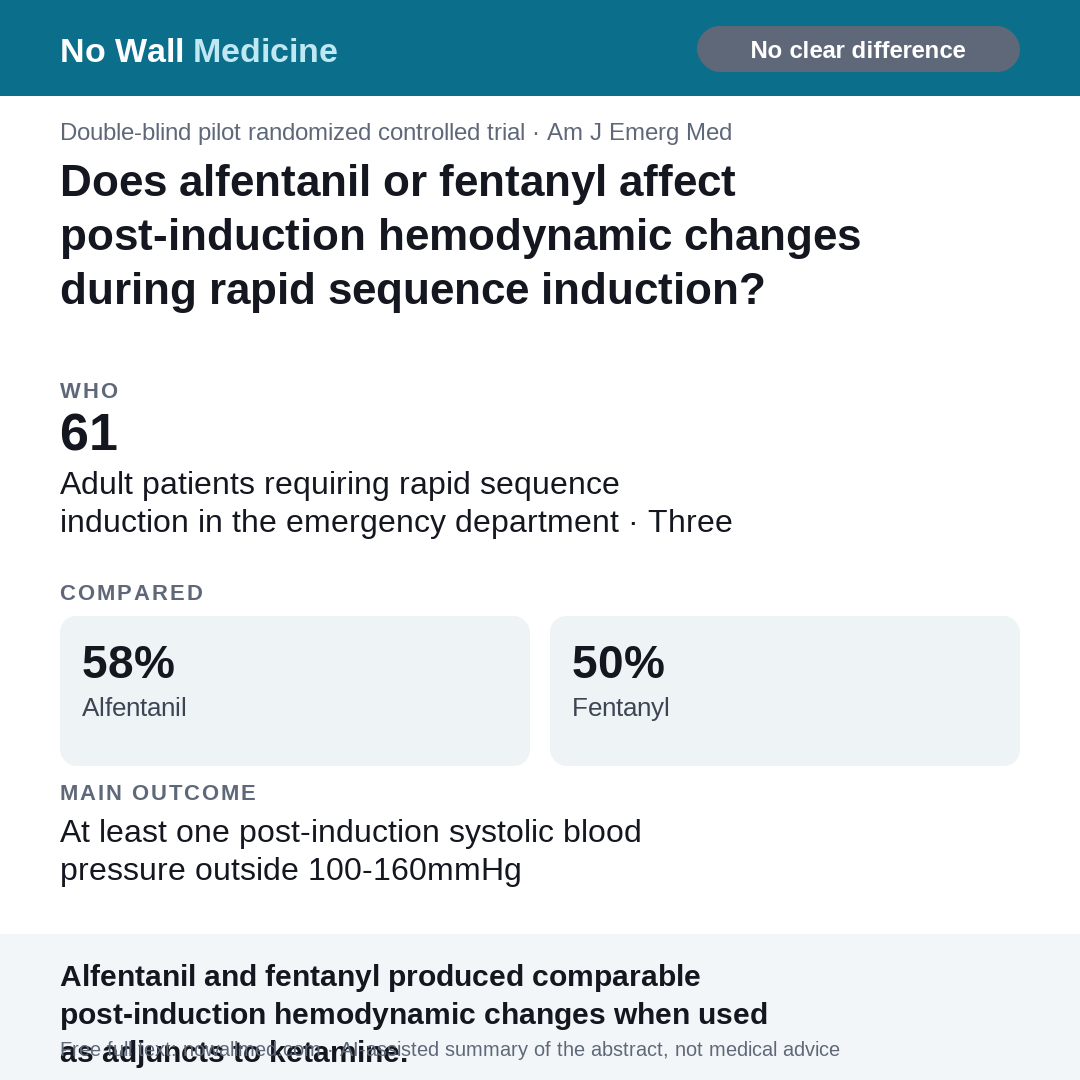
Does alfentanil or fentanyl affect post-induction hemodynamic changes during rapid sequence induction?
Who
61
Adult patients requiring rapid sequence induction in the emergency department · Three urban Australian hospitals
Compared
58%Alfentanil
50%Fentanyl
Main outcome
At least one post-induction systolic blood pressure outside 100-160mmHg
Result: difference 8%, 95% confidence interval: -17% to 33%
Bottom line: Alfentanil and fentanyl produced comparable post-induction hemodynamic changes when used as adjuncts to ketamine.
Am J Emerg Med · 2024-07-18Download image
Clinical question: Does alfentanil or fentanyl affect post-induction hemodynamic changes during rapid sequence induction?
Why it matters: It is unknown if the faster onset of alfentanil provides better hemodynamic stability compared to fentanyl when used during emergency airway induction with ketamine.
Key points
- Researchers studied 61 adult patients in three Australian emergency departments who received either alfentanil or fentanyl alongside ketamine and rocuronium for rapid sequence induction, a method used to quickly secure an airway.
- The primary outcome of systolic blood pressure outside the 100-160mmHg range occurred in 58% of the alfentanil group and 50% of the fentanyl group, a difference of 8% with a 95% confidence interval of -17% to 33%.
- There were no significant differences in systolic blood pressure or heart rate between the two groups at any measured time-points, and 30-day mortality and first-pass intubation success rates were similar.
Headline and key points written with AI from the paper’s abstract, with every number checked against it. Read the paper before relying on them.
Topics
Cite this article
Zhang Y, Miller M, Buttfield A, Burns B, Lawrie K, Gaston J. Alfentanil versus fentanyl for emergency department rapid sequence induction with ketamine: A-FAKT, a pilot randomized trial. Am J Emerg Med. 2024. doi:10.1016/j.ajem.2024.07.027
Spotted a mistake? Suggest a correction
Top studies every Monday
The week’s key trials and guidelines in your specialties, plus any topics you follow. By email, free.
Get the weekly digest