ALG-055009 reduced liver fat in adults with metabolic dysfunction-associated steatohepatitis
ALG-055009 in non-cirrhotic adults with metabolic dysfunction-associated steatohepatitis (HERALD): a randomised, double-blind, placebo-controlled, phase 2a trial
Randomised, double-blind, placebo-controlled, phase 2a trialBenefit found
Does ALG-055009 reduce liver fat in non-cirrhotic adults with MASH?
Who
102
Non-cirrhotic adults with presumed MASH and F1-F3 liver fibrosis
Compared
-6.9%ALG-055009 0.3 mg (95% CI -19.2 to 5.3)
-11.2%ALG-055009 0.5 mg (-22.9 to 0.4)
-25.9%ALG-055009 0.7 mg (-37.7 to -14.1)
-24.3%ALG-055009 0.9 mg (-37.9 to -10.6)
Main outcome
Percentage relative change from baseline in liver fat by MRI-PDFF
Bottom line: ALG-055009 showed statistically significant reductions in liver fat compared to placebo in patients with MASH.
Funded by: Aligos Therapeutics
Lancet Gastroenterol Hepatol · 2026-08-26Download image
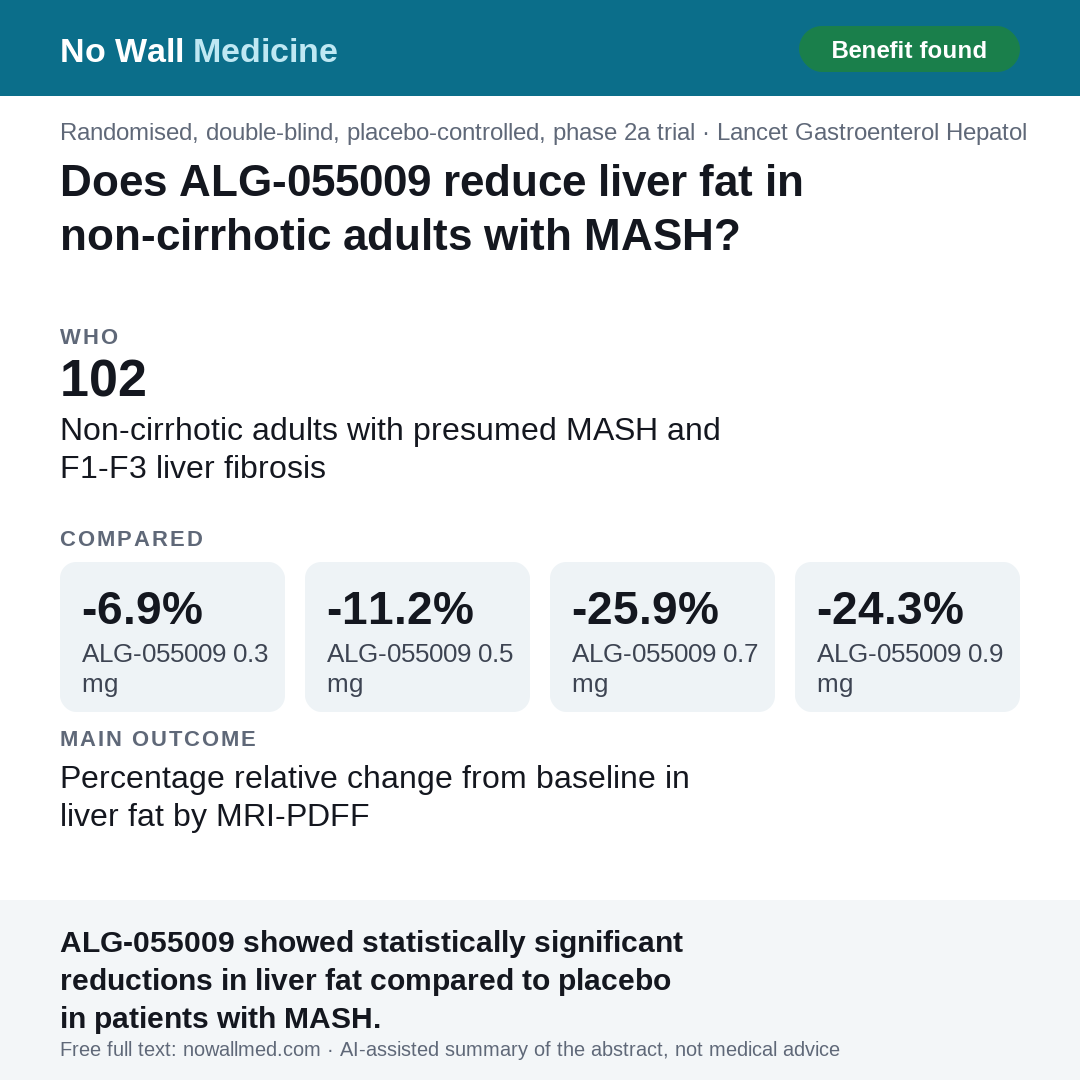
Clinical question: Does ALG-055009 reduce liver fat in non-cirrhotic adults with MASH?
Why it matters: Doctors have had limited treatment options for metabolic dysfunction-associated steatohepatitis
Key points
- 102 adults with presumed non-alcoholic steatohepatitis or metabolic dysfunction-associated steatohepatitis were studied.
- Liver fat decreased by 25.9% with 0.7 mg ALG-055009 and 24.3% with 0.9 mg ALG-055009 at 12 weeks.
- Placebo group had a 7.3% increase in liver fat at 12 weeks.
Limitation the authors note: The trial was a phase 2a study with a short duration of 12 weeks
Headline and key points written with AI from the paper’s abstract, with every number checked against it. Read the paper before relying on them.
Abstract
Background
Thyroid hormone receptor β (THR-β) agonists reduce atherogenic lipids, hepatic fat, and improve histology in metabolic dysfunction-associated steatohepatitis (MASH). The phase 2a HERALD study evaluated the efficacy, safety, pharmacokinetics, and pharmacodynamics of the selective and potent THR-β agonist ALG-055009 in non-cirrhotic adult patients with presumed MASH. Methods
In this double-blind, placebo-controlled, phase 2a trial, participants aged 18-75 years with a BMI of at least 25 kg/m2 and a diagnosis of presumed non-alcoholic steatohepatitis (NASH) or MASH with F1-F3 liver fibrosis were randomly assigned to receive oral ALG-055009 (0·3 mg, 0·5 mg, 0·7 mg, or 0·9 mg) or placebo once daily for 12 weeks. Enrolment in the 0·9 mg group was limited to participants with bodyweight of more than 85 kg. The primary endpoint was percentage relative change from baseline in liver fat by MRI-proton density fat fraction (MRI-PDFF) at week 12 in the MRI-PDFF analysis population. The trial is registered at ClinicalTrials.gov, NCT06342947, and is now completed. Findings
102 participants (39 [38%] males and 63 [62%] females) were randomly assigned to receive ALG-055009 0·3 mg (n=20), ALG-055009 0·5 mg (n=22), ALG-055009 0·7 mg (n=20), ALG-055009 0·9 mg (n=18), or placebo (n=22); five participants (two in the 0·3 mg group, one in the 0·5 mg group, one in the 0·9 mg group, and one in the placebo group) did not have baseline and week 12 MRI-PDFF data and were thus not included in the analysis of the primary endpoint. Least-squares mean relative change in liver fat at week 12 was -6·9% (95% CI -19·2 to 5·3) with 0·3 mg ALG-055009, -11·2% (-22·9 to 0·4) with 0·5 mg ALG-055009, -25·9% (-37·7 to -14·1) with 0·7 mg ALG-055009, -24·3% (-37·9 to -10·6) with 0·9 mg ALG-055009, and 7·3% (-4·0 to 18·6) with placebo. Placebo-adjusted least-squares mean relative changes in liver fat at week 12 were therefore -14·3% (95% CI -29·6 to 1·0; p=0·067) for 0·3 mg ALG-055009, -18·5% (-33·3 to -3·8; p=0·014) for 0·5 mg ALG-055009, -33·2% (-48·1 to -18·3; pInterpretation
Statistically significant reductions in liver fat with ALG-055009 and no relevant safety issues suggest that ALG-055009 could offer a promising treatment approach for patients with MASH. Results support evaluating extended ALG-055009 dosing on liver histology in participants with MASH. Funding
Aligos Therapeutics.
Abstract reproduced under the article’s CC BY licence.
Topics
Spotted a mistake? Suggest a correction