Altered IL-6 signalling and risk of tuberculosis: a multi-ancestry mendelian randomisation study
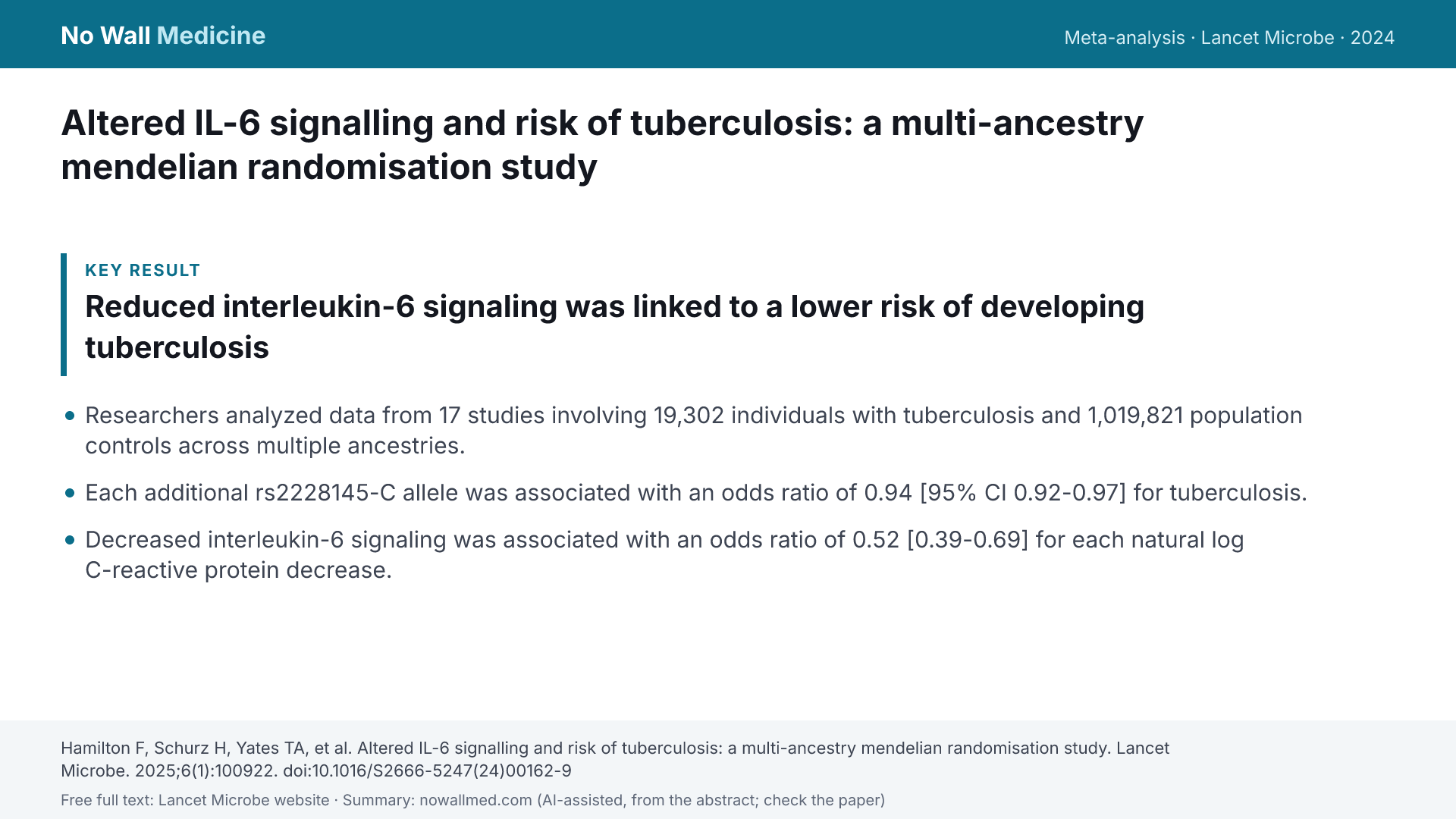
Key result: Reduced interleukin-6 signaling was linked to a lower risk of developing tuberculosis
Key points
- Researchers analyzed data from 17 studies involving 19,302 individuals with tuberculosis and 1,019,821 population controls across multiple ancestries.
- Each additional rs2228145-C allele was associated with an odds ratio of 0.94 [95% CI 0.92-0.97] for tuberculosis.
- Decreased interleukin-6 signaling was associated with an odds ratio of 0.52 [0.39-0.69] for each natural log C-reactive protein decrease.
Why it matters: The role of interleukin-6 signaling responses in human tuberculosis risk is unknown, particularly regarding whether interleukin-6 inhibitors increase the risk of disease progression.
Discussion prompts
- Would these patients look like yours? Who was left out?
- Is the main outcome one that matters to patients?
- Is the difference large enough to change what you do?
Cite: Hamilton F, Schurz H, Yates TA, et al. Altered IL-6 signalling and risk of tuberculosis: a multi-ancestry mendelian randomisation study. Lancet Microbe. 2025;6(1):100922. doi:10.1016/S2666-5247(24)00162-9
Free full text: Lancet Microbe website · Summary and visual abstract: nowallmed.com/a/altered-il-6-signalling-and-risk-of-tuberculosis-a-multi-ancestry-fps7e3/ (AI-assisted from the abstract; check the paper before relying on it).