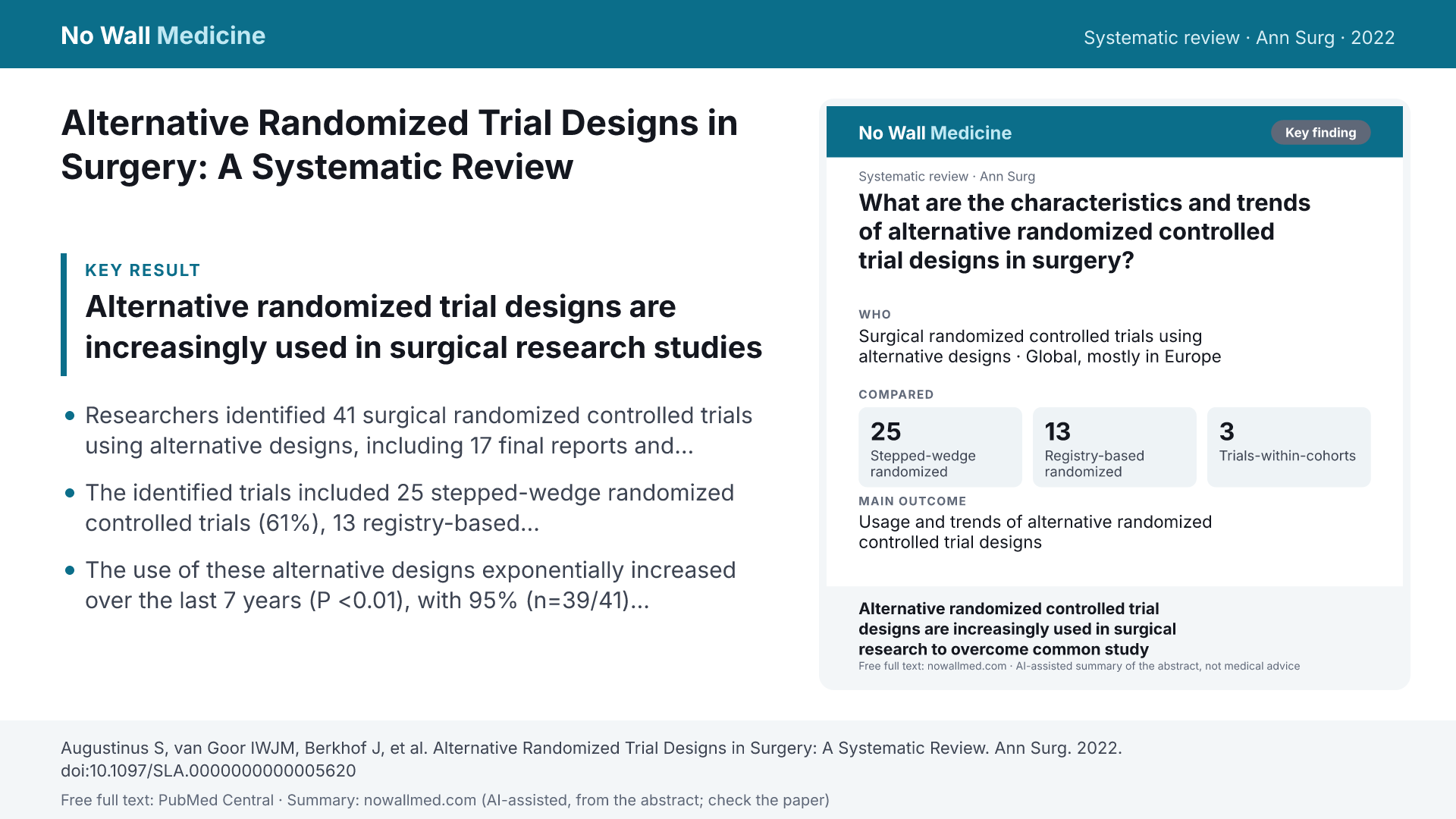
Alternative randomized trial designs are increasingly used in surgical research studies
Alternative Randomized Trial Designs in Surgery: A Systematic Review
Systematic reviewKey finding
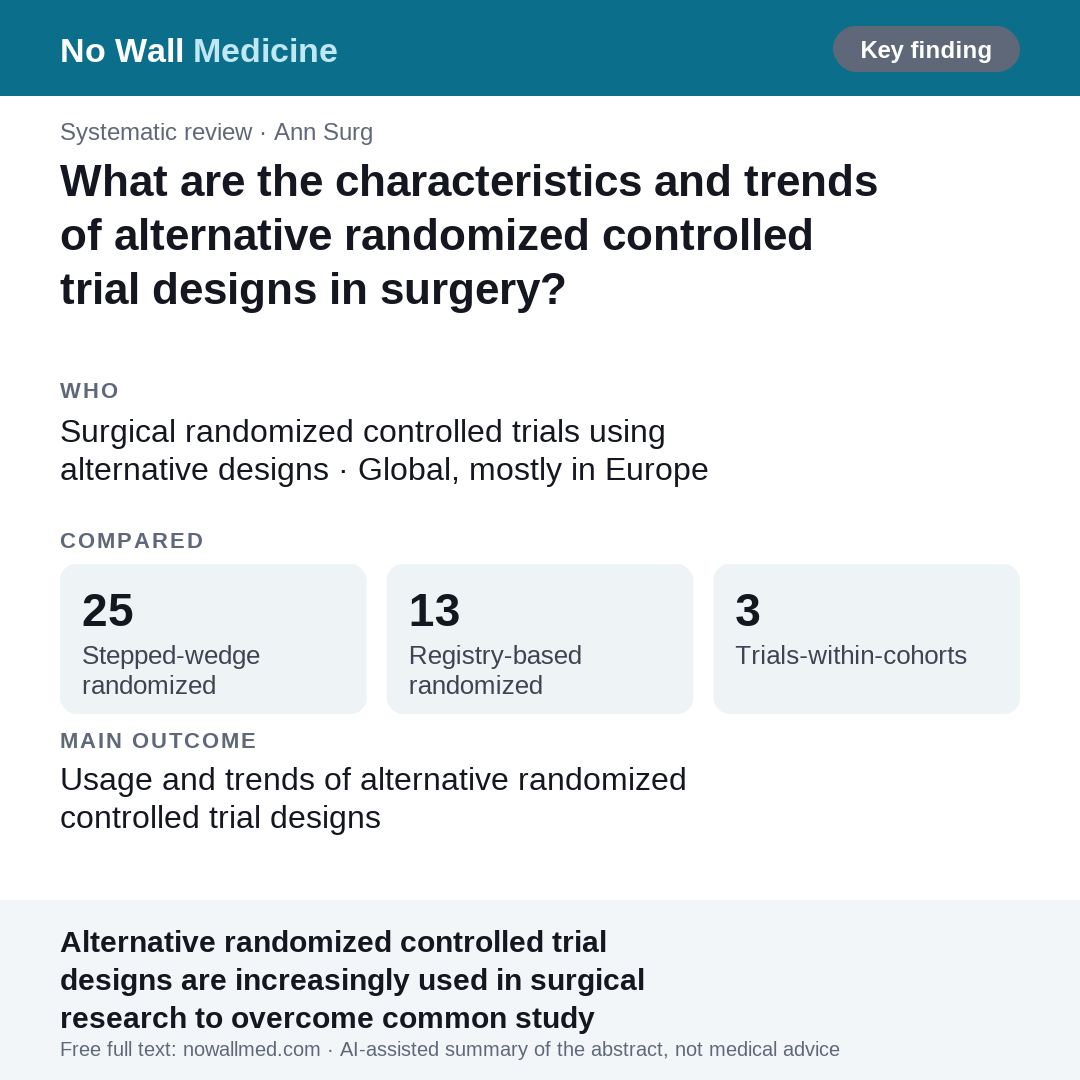
What are the characteristics and trends of alternative randomized controlled trial designs in surgery?
Who
Surgical randomized controlled trials using alternative designs · Global, mostly in Europe
Compared
25Stepped-wedge randomized controlled trials (61%)
13Registry-based randomized controlled trials (32%)
3Trials-within-cohorts (7%)
Main outcome
Usage and trends of alternative randomized controlled trial designs
Bottom line: Alternative randomized controlled trial designs are increasingly used in surgical research to overcome common study difficulties.
Ann Surg · 2022-07-22Download image
Clinical question: What are the characteristics and trends of alternative randomized controlled trial designs in surgery?
Why it matters: Standard randomized controlled trials are difficult to perform in surgery due to slow patient accrual, the surgical learning curve, and lack of financial support.
Key points
- Researchers identified 41 surgical randomized controlled trials using alternative designs, including 17 final reports and 24 protocols of ongoing studies.
- The identified trials included 25 stepped-wedge randomized controlled trials (61%), 13 registry-based randomized controlled trials (32%), and 3 trials-within-cohorts (7%).
- The use of these alternative designs exponentially increased over the last 7 years (P <0.01), with 95% (n=39/41) published in that period.
Headline and key points written with AI from the paper’s abstract, with every number checked against it. Read the paper before relying on them.
Was this summary helpful?
Subject terms
Headline, design, result, key points, caveat and citation as plain text.
Cite this article
Augustinus S, van Goor IWJM, Berkhof J, et al. Alternative Randomized Trial Designs in Surgery: A Systematic Review. Ann Surg. 2022. doi:10.1097/SLA.0000000000005620
Spotted a mistake? Suggest a correction