Alternative Randomized Trial Designs in Surgery: A Systematic Review
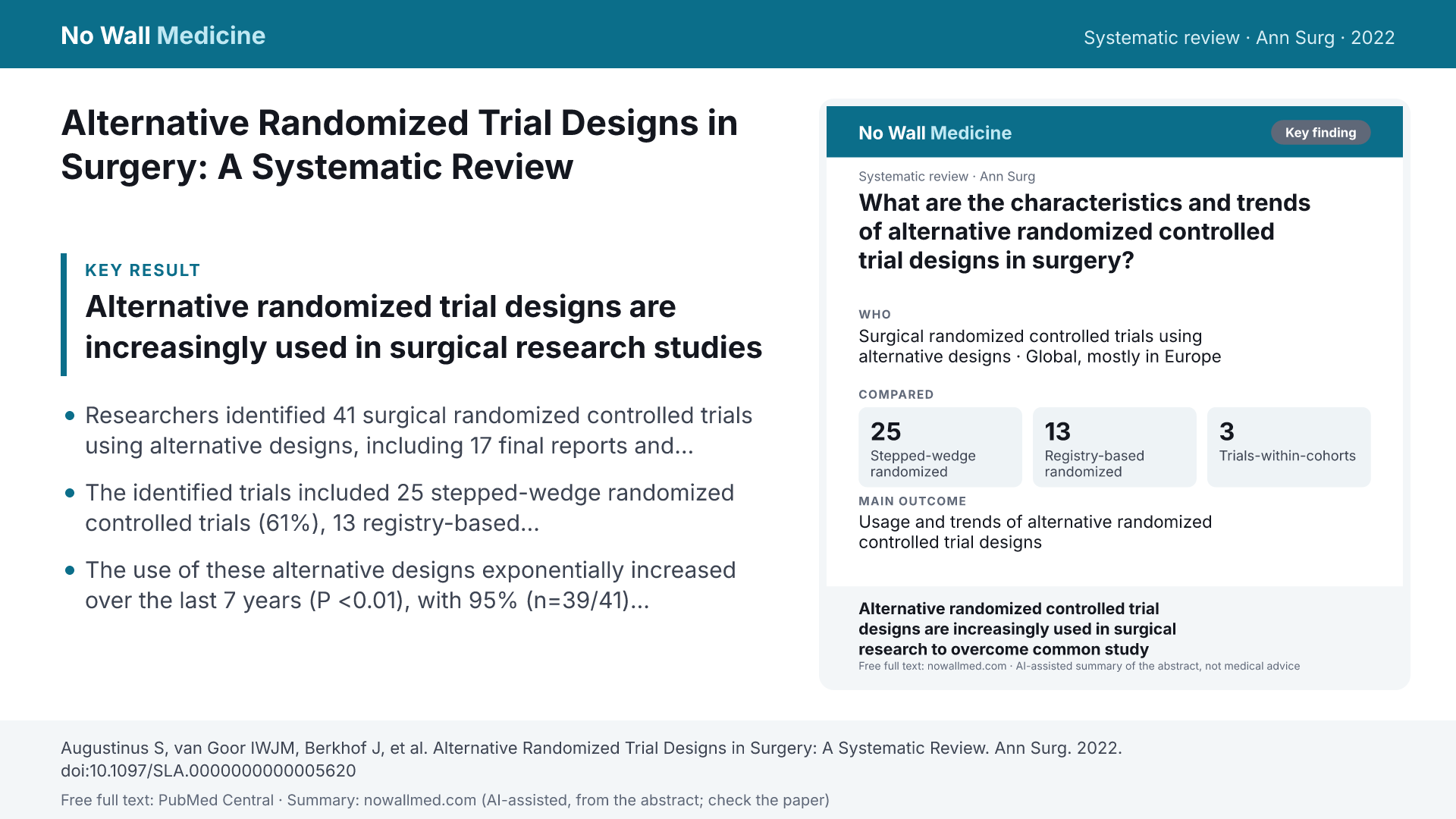
Key result: Alternative randomized trial designs are increasingly used in surgical research studies
Systematic reviewKey finding
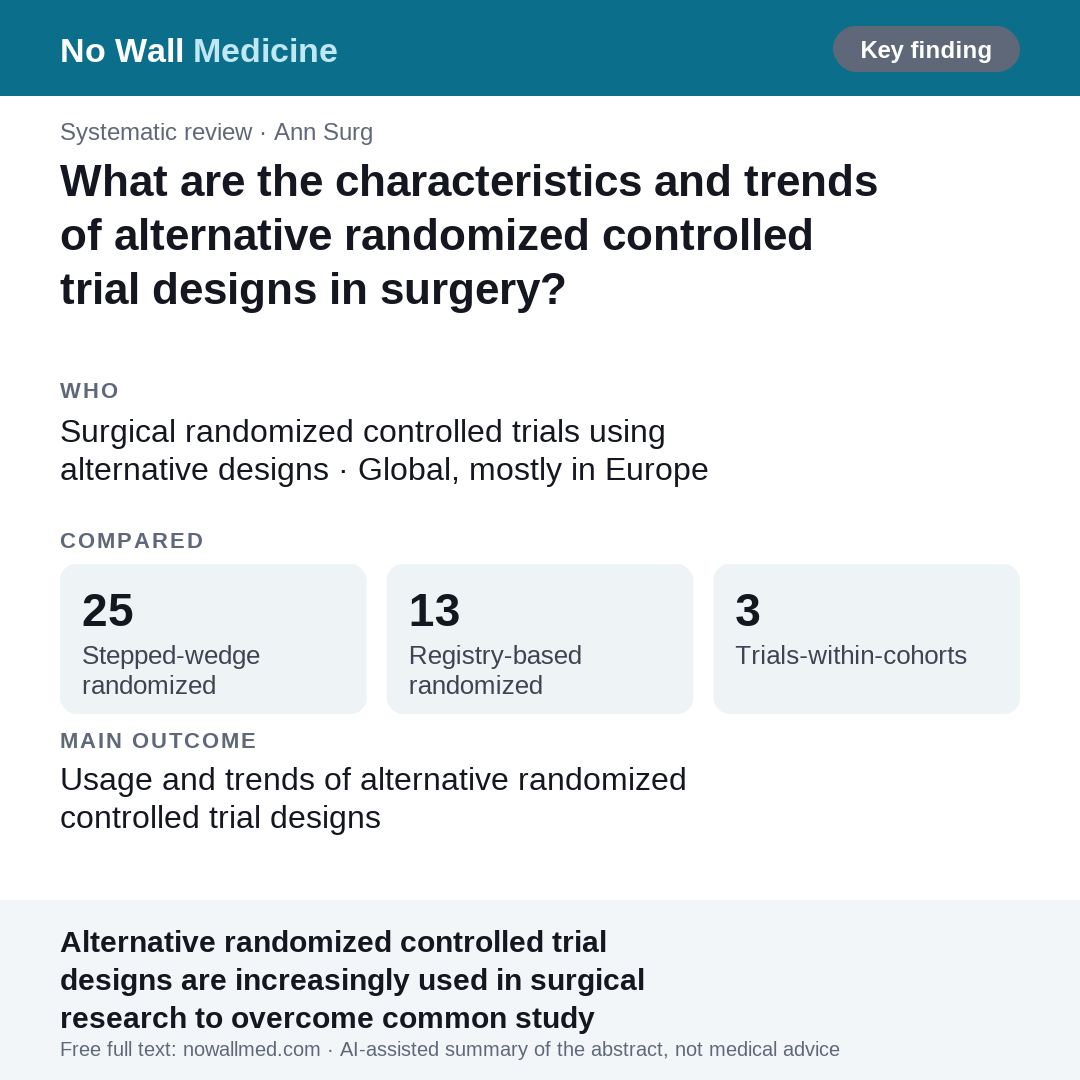
What are the characteristics and trends of alternative randomized controlled trial designs in surgery?
Who
Surgical randomized controlled trials using alternative designs · Global, mostly in Europe
Compared
25Stepped-wedge randomized controlled trials (61%)
13Registry-based randomized controlled trials (32%)
3Trials-within-cohorts (7%)
Main outcome
Usage and trends of alternative randomized controlled trial designs
Bottom line: Alternative randomized controlled trial designs are increasingly used in surgical research to overcome common study difficulties.
Ann Surg · 2022-07-22Download image
Key points
- Researchers identified 41 surgical randomized controlled trials using alternative designs, including 17 final reports and 24 protocols of ongoing studies.
- The identified trials included 25 stepped-wedge randomized controlled trials (61%), 13 registry-based randomized controlled trials (32%), and 3 trials-within-cohorts (7%).
- The use of these alternative designs exponentially increased over the last 7 years (P <0.01), with 95% (n=39/41) published in that period.
Why it matters: Standard randomized controlled trials are difficult to perform in surgery due to slow patient accrual, the surgical learning curve, and lack of financial support.
Discussion prompts
- Would these patients look like yours? Who was left out?
- Is the main outcome one that matters to patients?
- Is the difference large enough to change what you do?
Cite: Augustinus S, van Goor IWJM, Berkhof J, et al. Alternative Randomized Trial Designs in Surgery: A Systematic Review. Ann Surg. 2022. doi:10.1097/SLA.0000000000005620
Free full text: PubMed Central · Summary and visual abstract: nowallmed.com/a/alternative-randomized-trial-designs-in-surgery-a-systematic-15r12v9/ (AI-assisted from the abstract; check the paper before relying on it).