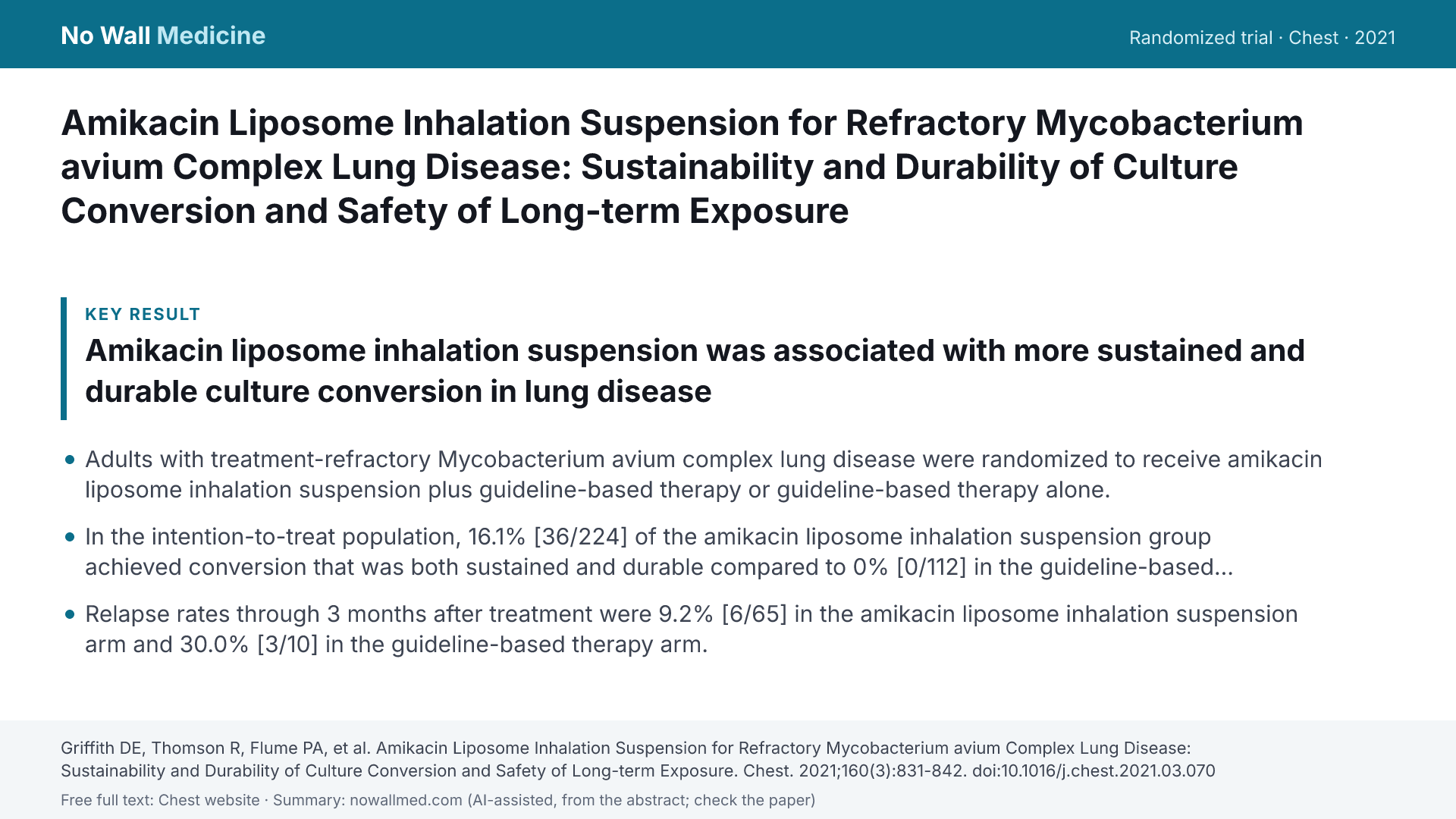
Amikacin liposome inhalation suspension was associated with more sustained and durable culture conversion in lung disease
Amikacin Liposome Inhalation Suspension for Refractory Mycobacterium avium Complex Lung Disease: Sustainability and Durability of Culture Conversion and Safety of Long-term Exposure
Why it matters: It was unknown if culture conversion achieved by month 6 in the CONVERT study remained sustained and durable or if long-term exposure presented new safety signals.
Key points
- Adults with treatment-refractory Mycobacterium avium complex lung disease were randomized to receive amikacin liposome inhalation suspension plus guideline-based therapy or guideline-based therapy alone.
- In the intention-to-treat population, 16.1% [36/224] of the amikacin liposome inhalation suspension group achieved conversion that was both sustained and durable compared to 0% [0/112] in the guideline-based therapy group.
- Relapse rates through 3 months after treatment were 9.2% [6/65] in the amikacin liposome inhalation suspension arm and 30.0% [3/10] in the guideline-based therapy arm.
Headline and key points written with AI from the paper’s abstract, with every number checked against it. Read the paper before relying on them.
Was this summary helpful?
Subject terms
Cite this article
Griffith DE, Thomson R, Flume PA, et al. Amikacin Liposome Inhalation Suspension for Refractory Mycobacterium avium Complex Lung Disease: Sustainability and Durability of Culture Conversion and Safety of Long-term Exposure. Chest. 2021. doi:10.1016/j.chest.2021.03.070
Spotted a mistake? Suggest a correction