Amikacin Liposome Inhalation Suspension for Refractory Mycobacterium avium Complex Lung Disease: Sustainability and Durability of Culture Conversion and Safety of Long-term Exposure
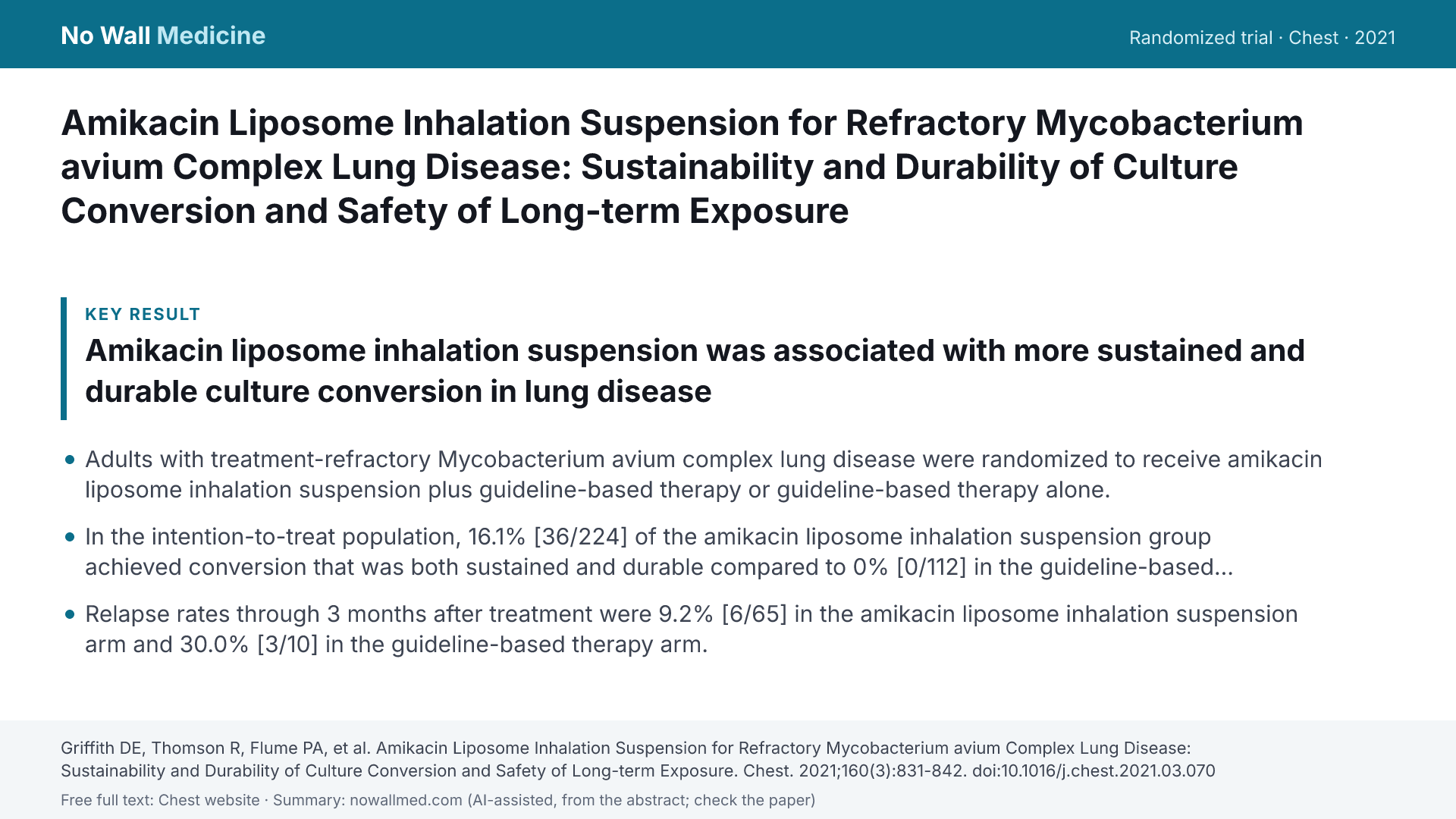
Key result: Amikacin liposome inhalation suspension was associated with more sustained and durable culture conversion in lung disease
Key points
- Adults with treatment-refractory Mycobacterium avium complex lung disease were randomized to receive amikacin liposome inhalation suspension plus guideline-based therapy or guideline-based therapy alone.
- In the intention-to-treat population, 16.1% [36/224] of the amikacin liposome inhalation suspension group achieved conversion that was both sustained and durable compared to 0% [0/112] in the guideline-based therapy group.
- Relapse rates through 3 months after treatment were 9.2% [6/65] in the amikacin liposome inhalation suspension arm and 30.0% [3/10] in the guideline-based therapy arm.
Discussion prompts
- Would these patients look like yours? Who was left out?
- Is the main outcome one that matters to patients?
- Is the difference large enough to change what you do?
Cite: Griffith DE, Thomson R, Flume PA, et al. Amikacin Liposome Inhalation Suspension for Refractory Mycobacterium avium Complex Lung Disease: Sustainability and Durability of Culture Conversion and Safety of Long-term Exposure. Chest. 2021;160(3):831-842. doi:10.1016/j.chest.2021.03.070
Free full text: Chest website · Summary and visual abstract: nowallmed.com/a/amikacin-liposome-inhalation-suspension-for-refractory-mycobacterium-1mwh2kr/ (AI-assisted from the abstract; check the paper before relying on it).