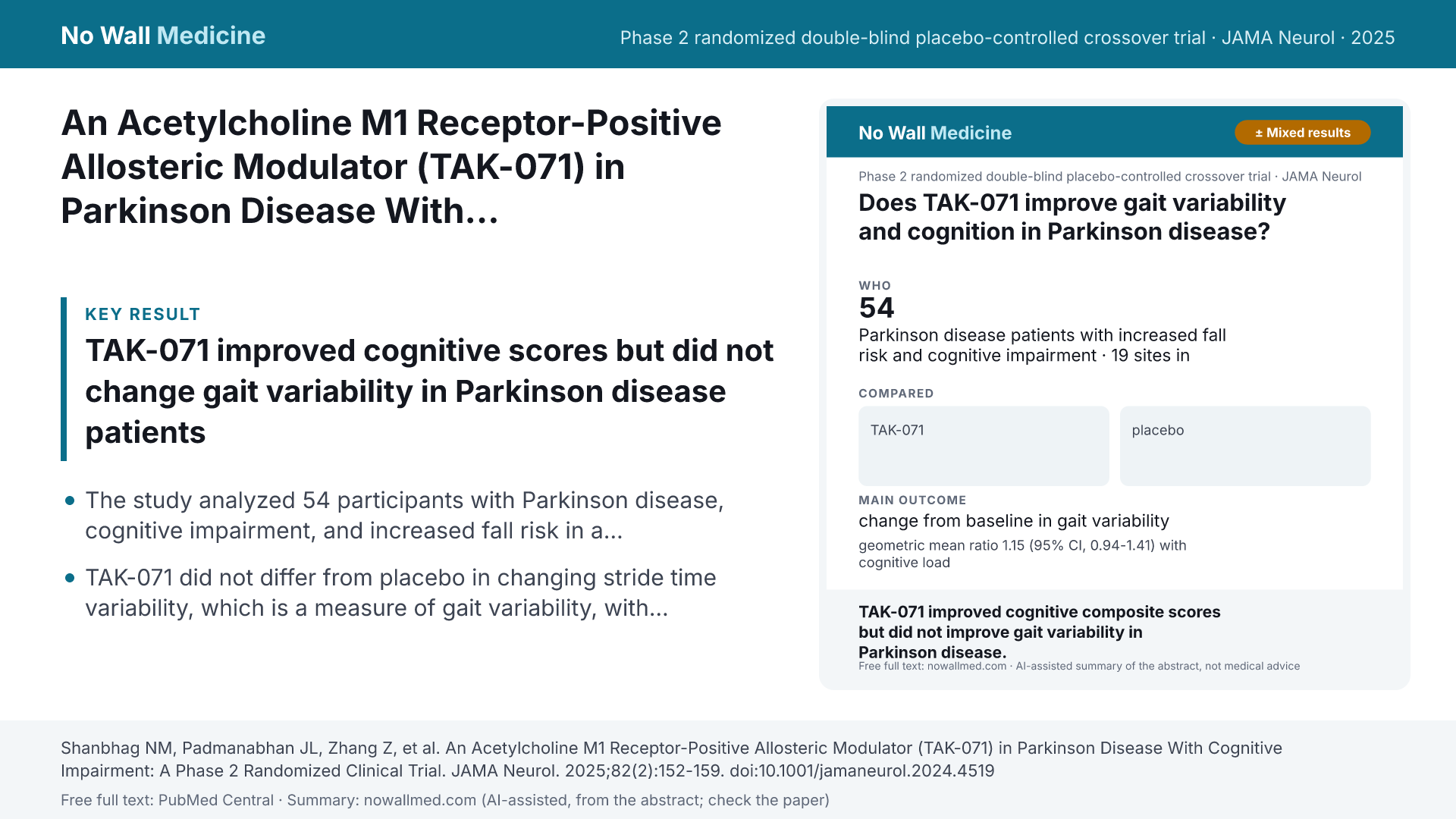
TAK-071 improved cognitive scores but did not change gait variability in Parkinson disease patients
An Acetylcholine M1 Receptor-Positive Allosteric Modulator (TAK-071) in Parkinson Disease With Cognitive Impairment: A Phase 2 Randomized Clinical Trial
Phase 2 randomized double-blind placebo-controlled crossover trialMixed results
Does TAK-071 improve gait variability and cognition in Parkinson disease?
Who
54
Parkinson disease patients with increased fall risk and cognitive impairment · 19 sites in the US
Compared
TAK-071
placebo
Main outcome
change from baseline in gait variability
Result: geometric mean ratio 1.15 (95% CI, 0.94-1.41) with cognitive load
Bottom line: TAK-071 improved cognitive composite scores but did not improve gait variability in Parkinson disease.
JAMA Neurol · 2025-01-06 · Save PNG

Clinical question: Does TAK-071 improve gait variability and cognition in Parkinson disease?
Key points
- The study analyzed 54 participants with Parkinson disease, cognitive impairment, and increased fall risk in a randomized crossover trial.
- TAK-071 did not differ from placebo in changing stride time variability, which is a measure of gait variability, with or without cognitive load.
- TAK-071 was associated with an improvement in a cognitive composite score of attention, memory, and executive function compared to placebo.
Headline and key points written with AI from the paper’s abstract, with every number checked against it. Read the paper before relying on them.
Was this summary helpful?
Subject terms
Headline, design, result, key points, caveat and citation as plain text.
Cite this article
Shanbhag NM, Padmanabhan JL, Zhang Z, et al. An Acetylcholine M1 Receptor-Positive Allosteric Modulator (TAK-071) in Parkinson Disease With Cognitive Impairment: A Phase 2 Randomized Clinical Trial. JAMA Neurol. 2025;82(2):152-159. doi:10.1001/jamaneurol.2024.4519
Spotted a mistake? Suggest a correction