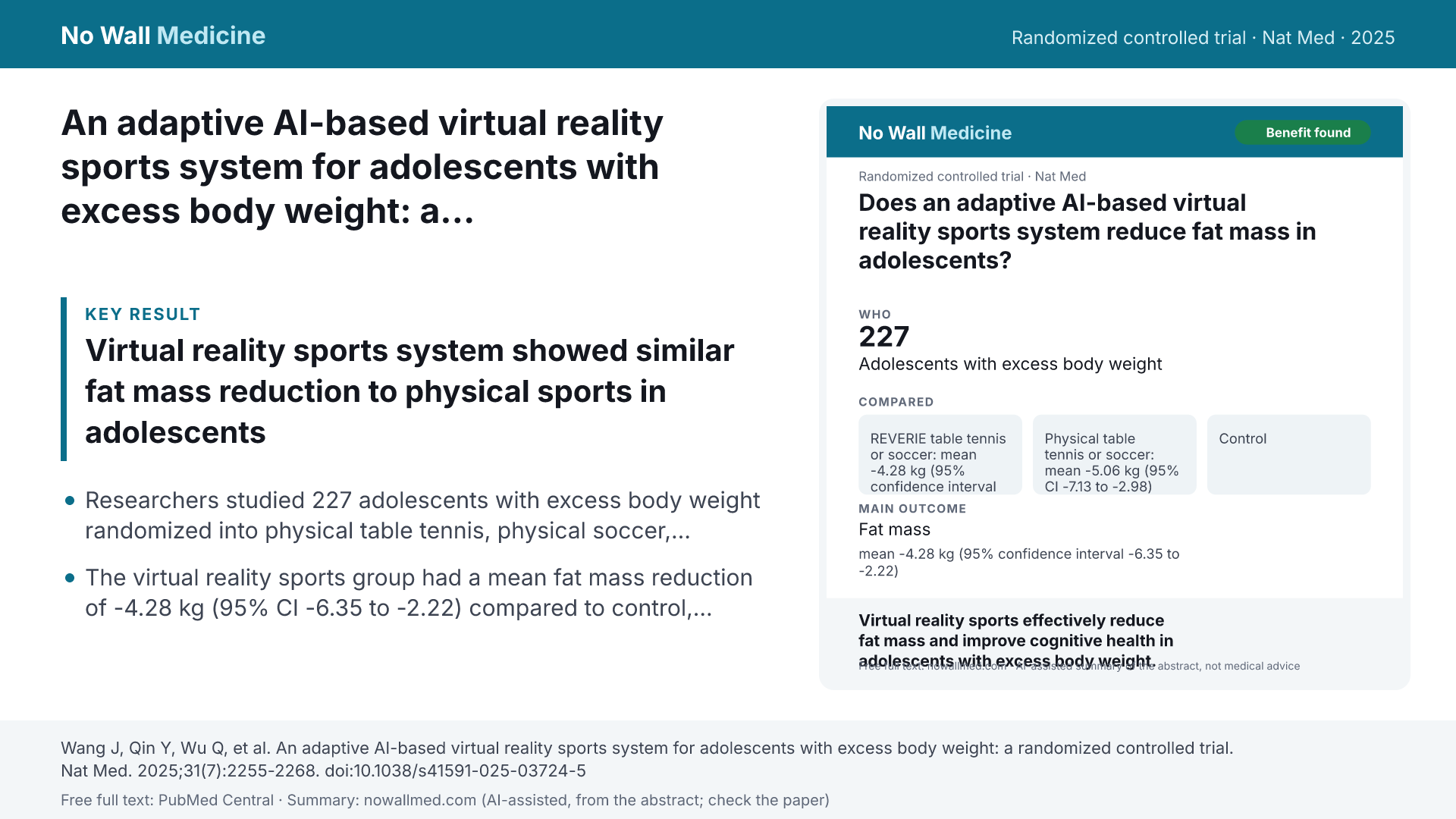
Virtual reality sports system showed similar fat mass reduction to physical sports in adolescents
An adaptive AI-based virtual reality sports system for adolescents with excess body weight: a randomized controlled trial
Randomized controlled trialBenefit found
Does an adaptive AI-based virtual reality sports system reduce fat mass in adolescents?
Who
227
Adolescents with excess body weight
Compared
REVERIE table tennis or soccer: mean -4.28 kg (95% confidence interval -6.35 to -2.22)
Physical table tennis or soccer: mean -5.06 kg (95% CI -7.13 to -2.98)
Control
Main outcome
Fat mass
Result: mean -4.28 kg (95% confidence interval -6.35 to -2.22)
Bottom line: Virtual reality sports effectively reduce fat mass and improve cognitive health in adolescents with excess body weight.
Nat Med · 2025-06-23Download image
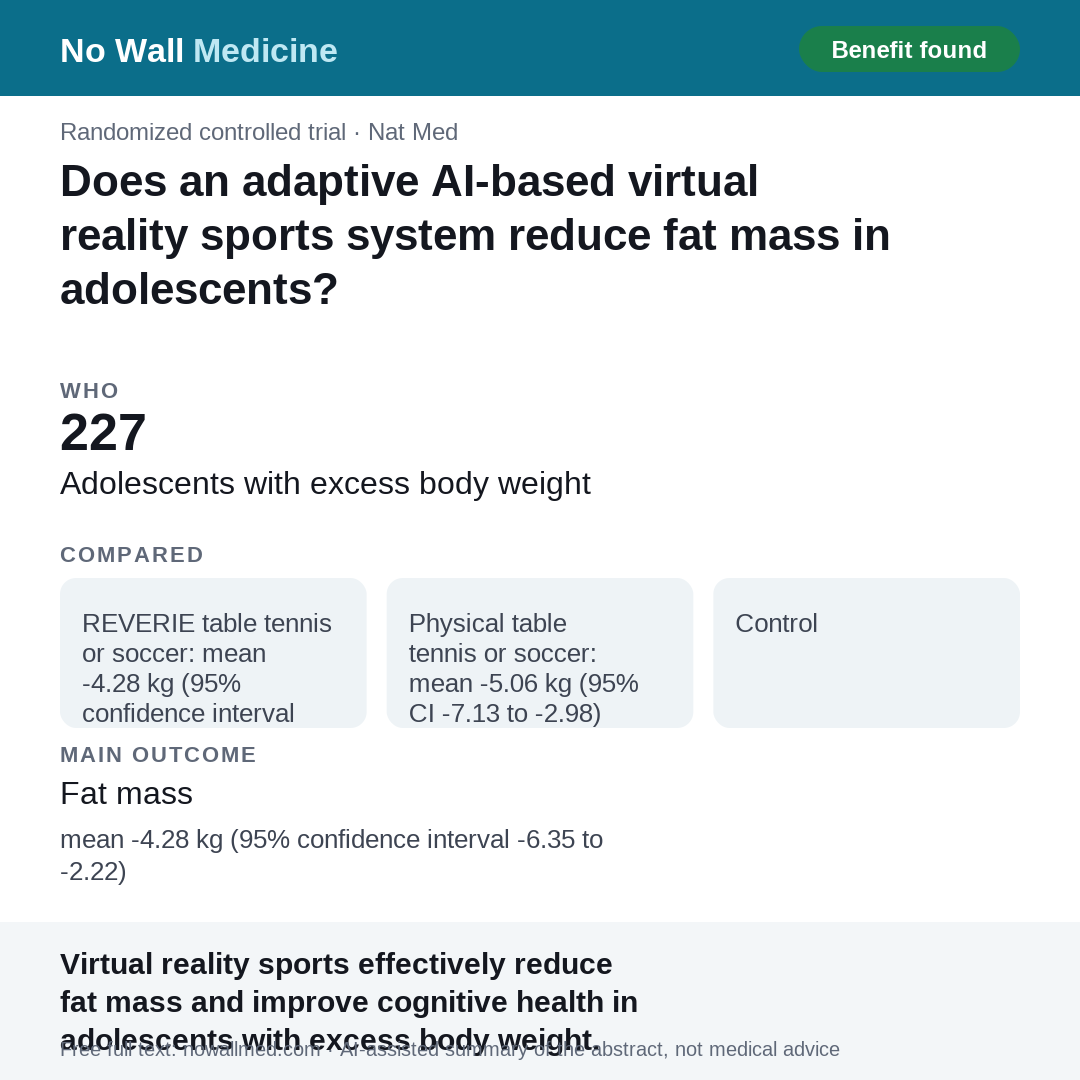
Clinical question: Does an adaptive AI-based virtual reality sports system reduce fat mass in adolescents?
Why it matters: Adolescents with obesity face health risks and barriers to physical activity, necessitating new ways to encourage movement.
Key points
- Researchers studied 227 adolescents with excess body weight randomized into physical table tennis, physical soccer, virtual reality sports, virtual reality soccer, or a control group.
- The virtual reality sports group had a mean fat mass reduction of -4.28 kg (95% CI -6.35 to -2.22) compared to control, while physical sports showed -5.06 kg (95% CI -7.13 to -2.98).
- Virtual reality sports were associated with higher olfactory test scores and working memory accuracy compared to physical sports in exploratory analyses.
Headline and key points written with AI from the paper’s abstract, with every number checked against it. Read the paper before relying on them.
Was this summary helpful?
Subject terms
Cite this article
Wang J, Qin Y, Wu Q, et al. An adaptive AI-based virtual reality sports system for adolescents with excess body weight: a randomized controlled trial. Nat Med. 2025. doi:10.1038/s41591-025-03724-5
Spotted a mistake? Suggest a correction