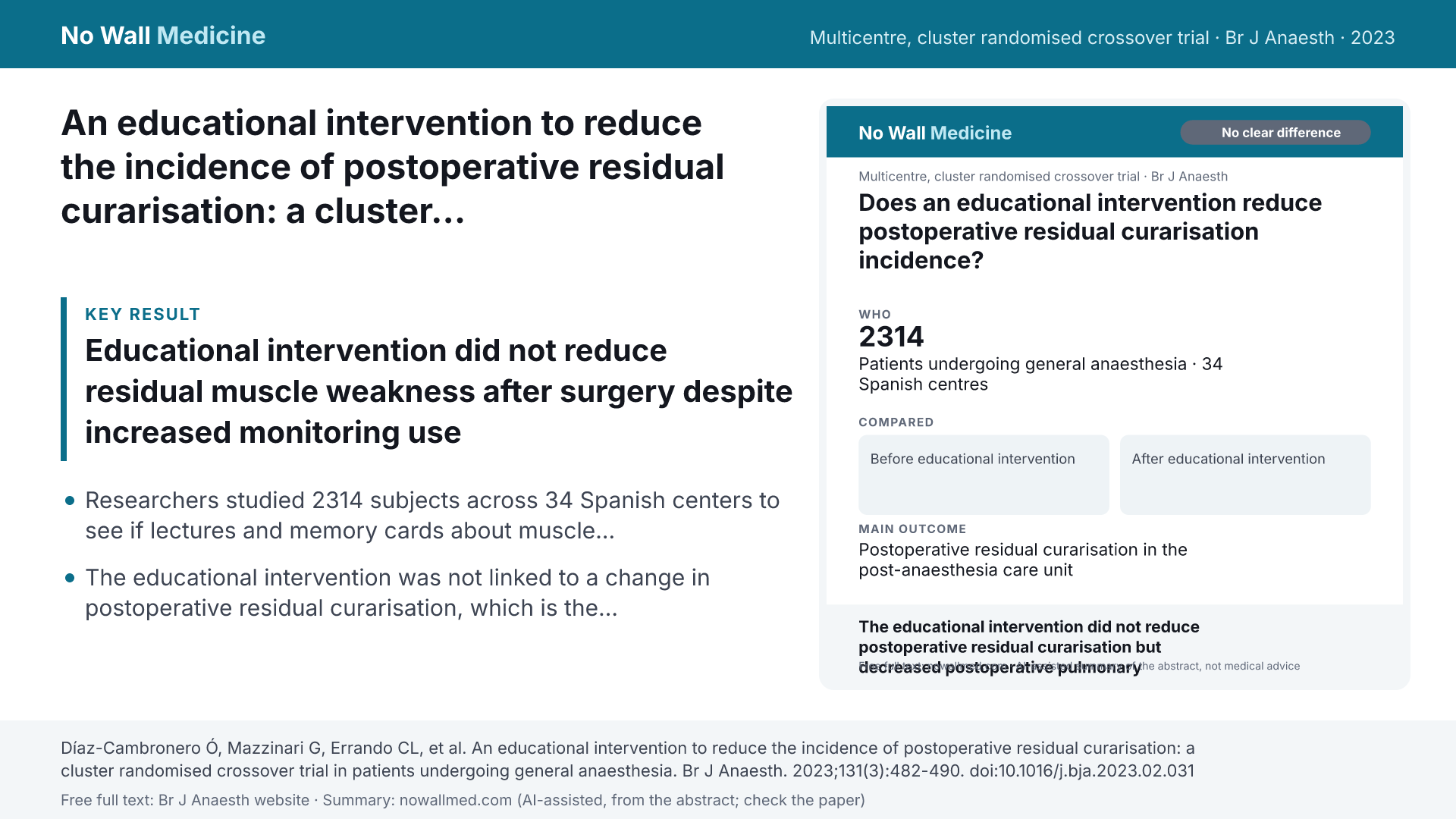
Educational intervention did not reduce residual muscle weakness after surgery despite increased monitoring use
An educational intervention to reduce the incidence of postoperative residual curarisation: a cluster randomised crossover trial in patients undergoing general anaesthesia
Multicentre, cluster randomised crossover trialNo clear difference
Does an educational intervention reduce postoperative residual curarisation incidence?
Who
2314
Patients undergoing general anaesthesia · 34 Spanish centres
Compared
Before educational intervention
After educational intervention
Main outcome
Postoperative residual curarisation in the post-anaesthesia care unit
Result: odds ratio 0.90 (95% confidence interval 0.51-1.58)
Bottom line: The educational intervention did not reduce postoperative residual curarisation but decreased postoperative pulmonary complications.
Br J Anaesth · 2023-04-20 · Save PNG
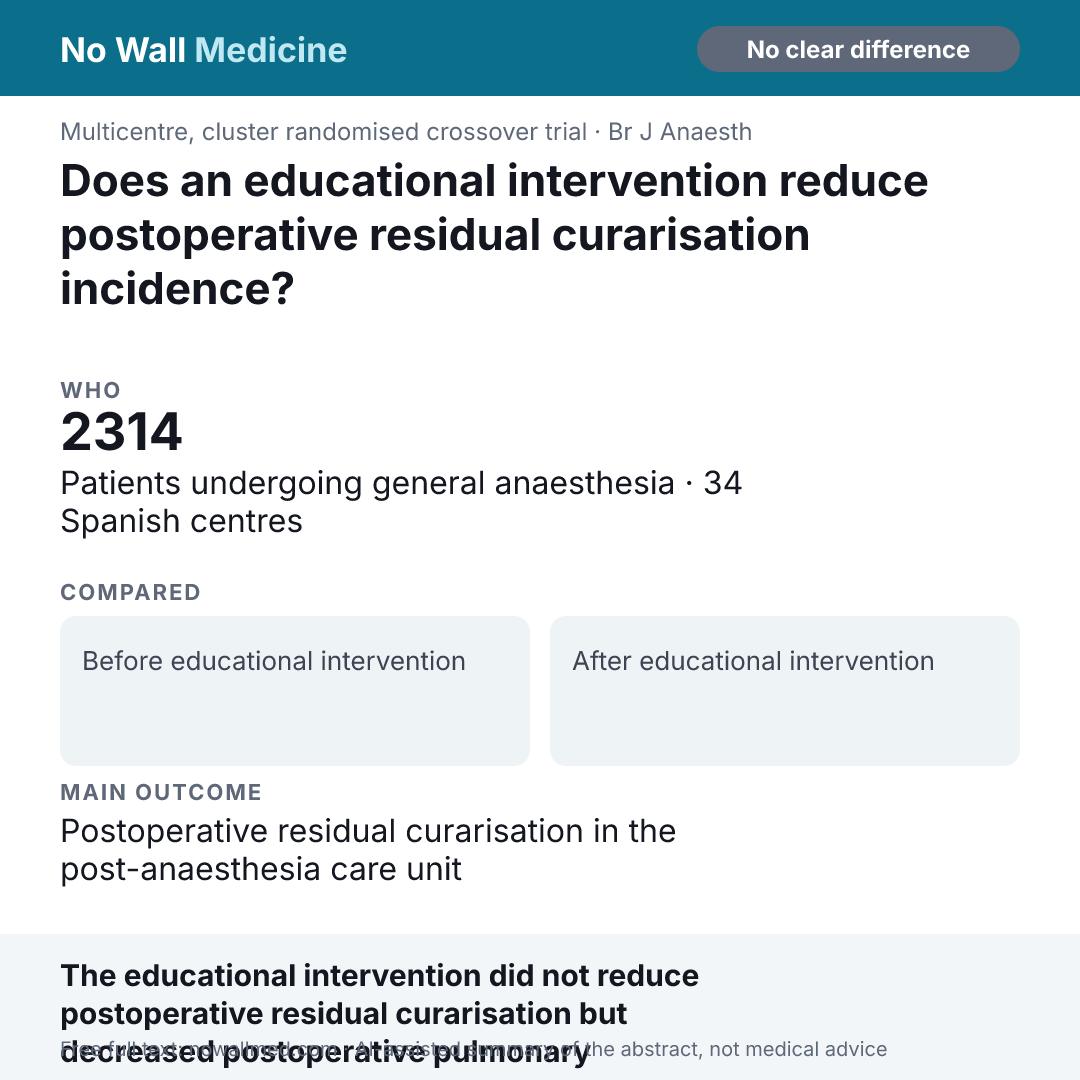
Clinical question: Does an educational intervention reduce postoperative residual curarisation incidence?
Why it matters: The incidence of postoperative residual curarisation, where muscles remain partially paralyzed after surgery, remains unacceptably high.
Key points
- Researchers studied 2314 subjects across 34 Spanish centers to see if lectures and memory cards about muscle relaxation management changed patient outcomes.
- The educational intervention was not linked to a change in postoperative residual curarisation, which is the lingering effect of muscle-relaxing drugs.
- The intervention was associated with increased use of quantitative neuromuscular monitoring and a decrease in postoperative pulmonary complications during hospital stays.
Headline and key points written with AI from the paper’s abstract, with every number checked against it. Read the paper before relying on them.
Was this summary helpful?
Subject terms
Headline, design, result, key points, caveat and citation as plain text.
Cite this article
Díaz-Cambronero Ó, Mazzinari G, Errando CL, et al. An educational intervention to reduce the incidence of postoperative residual curarisation: a cluster randomised crossover trial in patients undergoing general anaesthesia. Br J Anaesth. 2023;131(3):482-490. doi:10.1016/j.bja.2023.02.031
Spotted a mistake? Suggest a correction