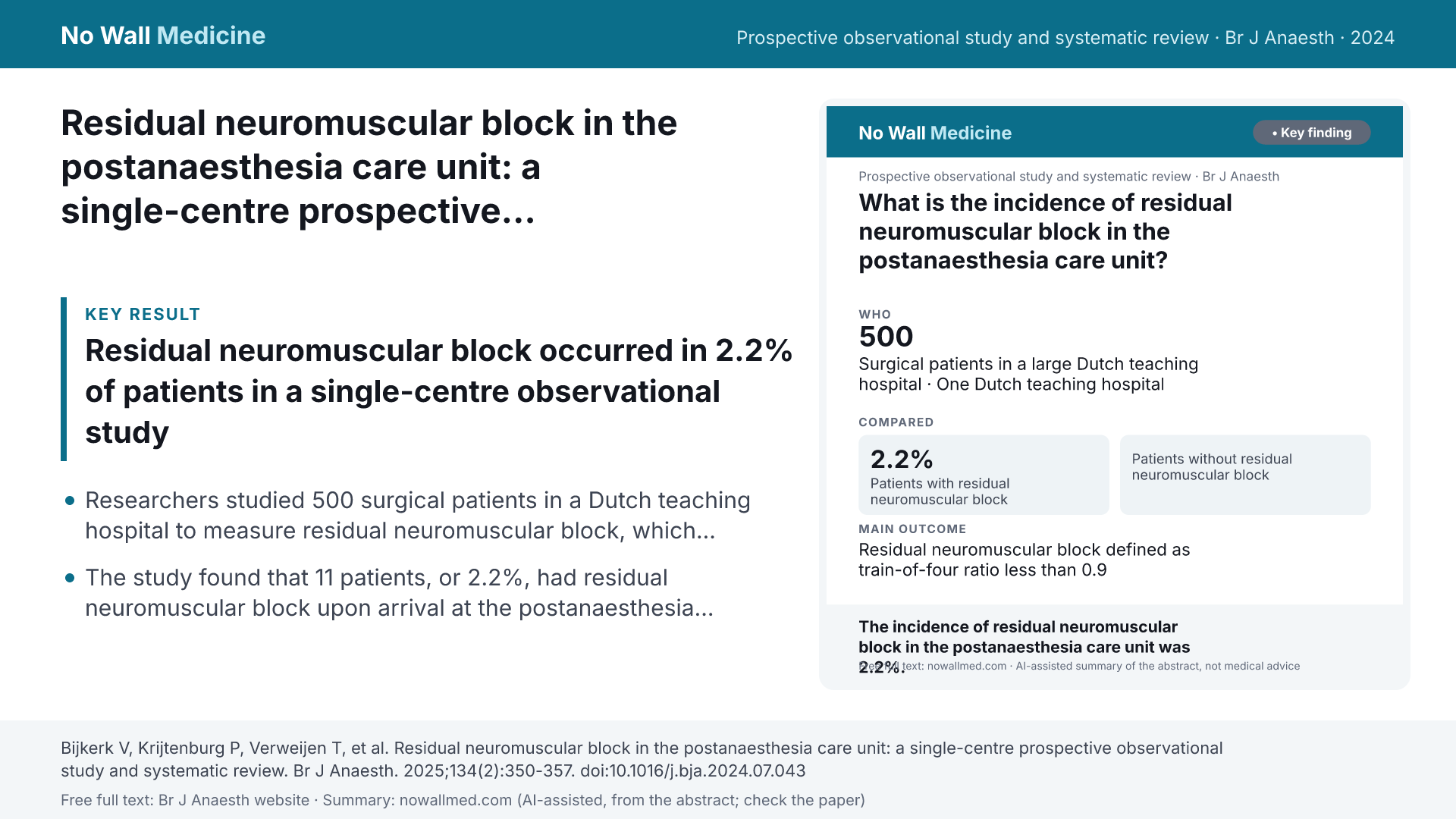
Residual neuromuscular block occurred in 2.2% of patients in a single-centre observational study
Residual neuromuscular block in the postanaesthesia care unit: a single-centre prospective observational study and systematic review
Prospective observational study and systematic reviewKey finding
What is the incidence of residual neuromuscular block in the postanaesthesia care unit?
Who
500
Surgical patients in a large Dutch teaching hospital · One Dutch teaching hospital
Compared
2.2%Patients with residual neuromuscular block
Patients without residual neuromuscular block
Main outcome
Residual neuromuscular block defined as train-of-four ratio less than 0.9
Bottom line: The incidence of residual neuromuscular block in the postanaesthesia care unit was 2.2%.
Br J Anaesth · 2024-10-23 · Save PNG

Clinical question: What is the incidence of residual neuromuscular block in the postanaesthesia care unit?
Key points
- Researchers studied 500 surgical patients in a Dutch teaching hospital to measure residual neuromuscular block, which is defined as a train-of-four ratio below 0.9.
- The study found that 11 patients, or 2.2%, had residual neuromuscular block upon arrival at the postanaesthesia care unit.
- A systematic review of contemporary practice showed residual neuromuscular block incidences ranging from 3.5% to 53.3% since 2000.
Limitation the authors note: The study was a single-centre prospective observational study.
Headline and key points written with AI from the paper’s abstract, with every number checked against it. Read the paper before relying on them.
Was this summary helpful?
Subject terms
Headline, design, result, key points, caveat and citation as plain text.
Cite this article
Bijkerk V, Krijtenburg P, Verweijen T, et al. Residual neuromuscular block in the postanaesthesia care unit: a single-centre prospective observational study and systematic review. Br J Anaesth. 2025;134(2):350-357. doi:10.1016/j.bja.2024.07.043
Spotted a mistake? Suggest a correction