Magnetic resonance elastography shows high accuracy for staging liver fibrosis in patients with fatty liver disease
An individual patient data meta-analysis to determine cut-offs for and confounders of NAFLD-fibrosis staging with magnetic resonance elastography
Individual patient data meta-analysisBenefit found
What are the stiffness cut-off values and confounders of magnetic resonance elastography for staging NAFLD fibrosis?
Who
798
Patients with non-alcoholic fatty liver disease · Eight international cohorts
Compared
Significant fibrosis: AUROC 0.92
Advanced fibrosis: AUROC 0.92
Cirrhosis: AUROC 0.94
Main outcome
Diagnostic accuracy of magnetic resonance elastography for liver fibrosis staging
Bottom line: Magnetic resonance elastography shows excellent accuracy for staging liver fibrosis in non-alcoholic fatty liver disease patients.
J Hepatol · 2023-04-29Download image
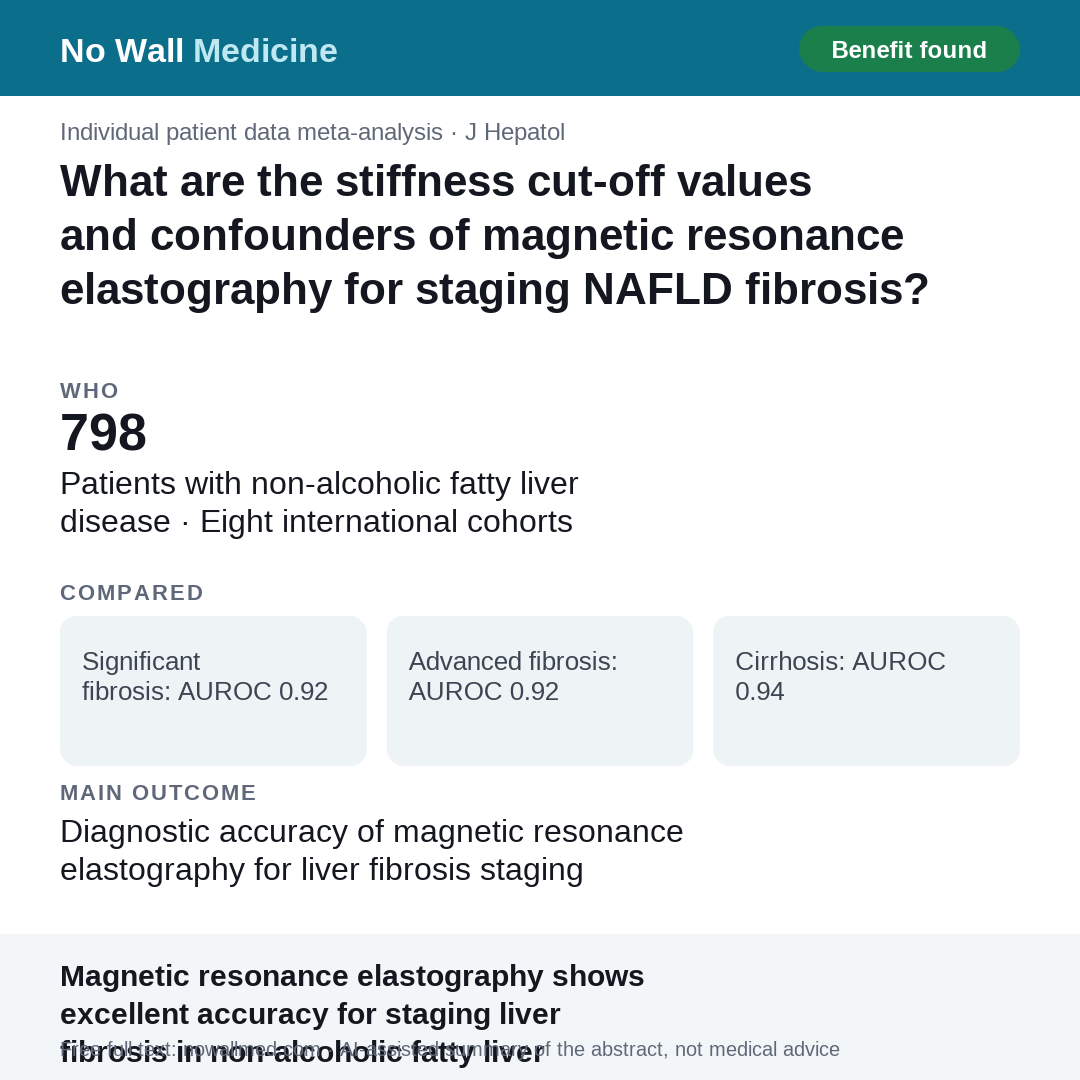
Clinical question: What are the stiffness cut-off values and confounders of magnetic resonance elastography for staging NAFLD fibrosis?
Why it matters: The specific stiffness cut-off values and potential factors that might interfere with the accuracy of magnetic resonance elastography for staging liver fibrosis were unknown.
Key points
- Researchers analyzed data from 798 patients across eight independent cohorts to determine stiffness cut-off values for magnetic resonance elastography, a non-invasive imaging technique.
- The imaging method showed an area under the receiver operating characteristic curve of 0.92 for significant fibrosis and 0.94 for cirrhosis.
- High inflammatory activity and gamma-glutamyl transferase levels were associated with elevated liver stiffness, while body mass index and fat content were not.
Headline and key points written with AI from the paper’s abstract, with every number checked against it. Read the paper before relying on them.
Was this summary helpful?
Subject terms
Cite this article
Liang JX, Ampuero J, Niu H, Imajo K, Noureddin M, Behari J. An individual patient data meta-analysis to determine cut-offs for and confounders of NAFLD-fibrosis staging with magnetic resonance elastography. J Hepatol. 2023. doi:10.1016/j.jhep.2023.04.025
Spotted a mistake? Suggest a correction
Top studies every Monday
The week’s key trials and guidelines in your specialties, plus any topics you follow. By email, free.
Get the weekly digest