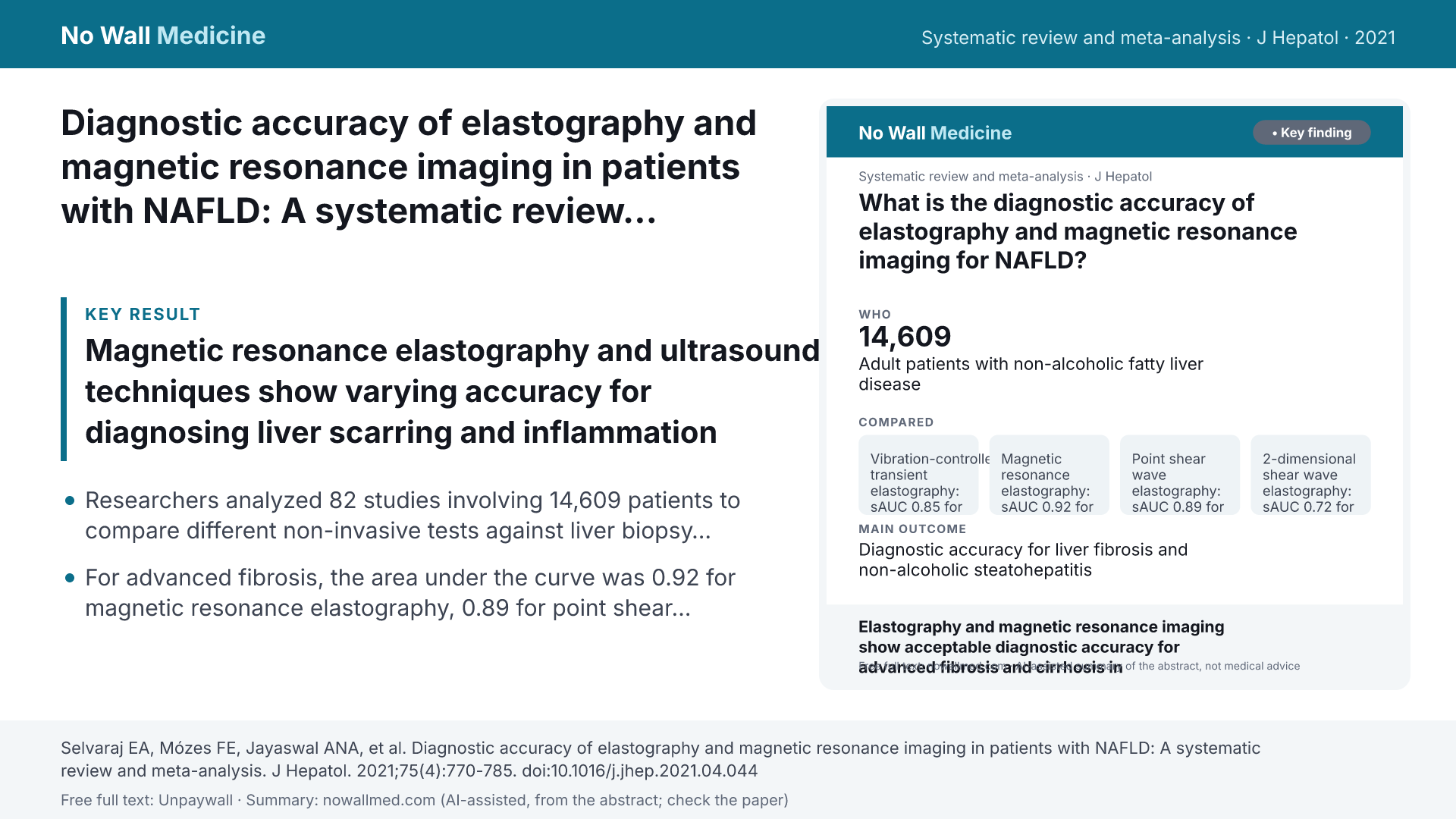
Magnetic resonance elastography and ultrasound techniques show varying accuracy for diagnosing liver scarring and inflammation
Diagnostic accuracy of elastography and magnetic resonance imaging in patients with NAFLD: A systematic review and meta-analysis
Systematic review and meta-analysisKey finding
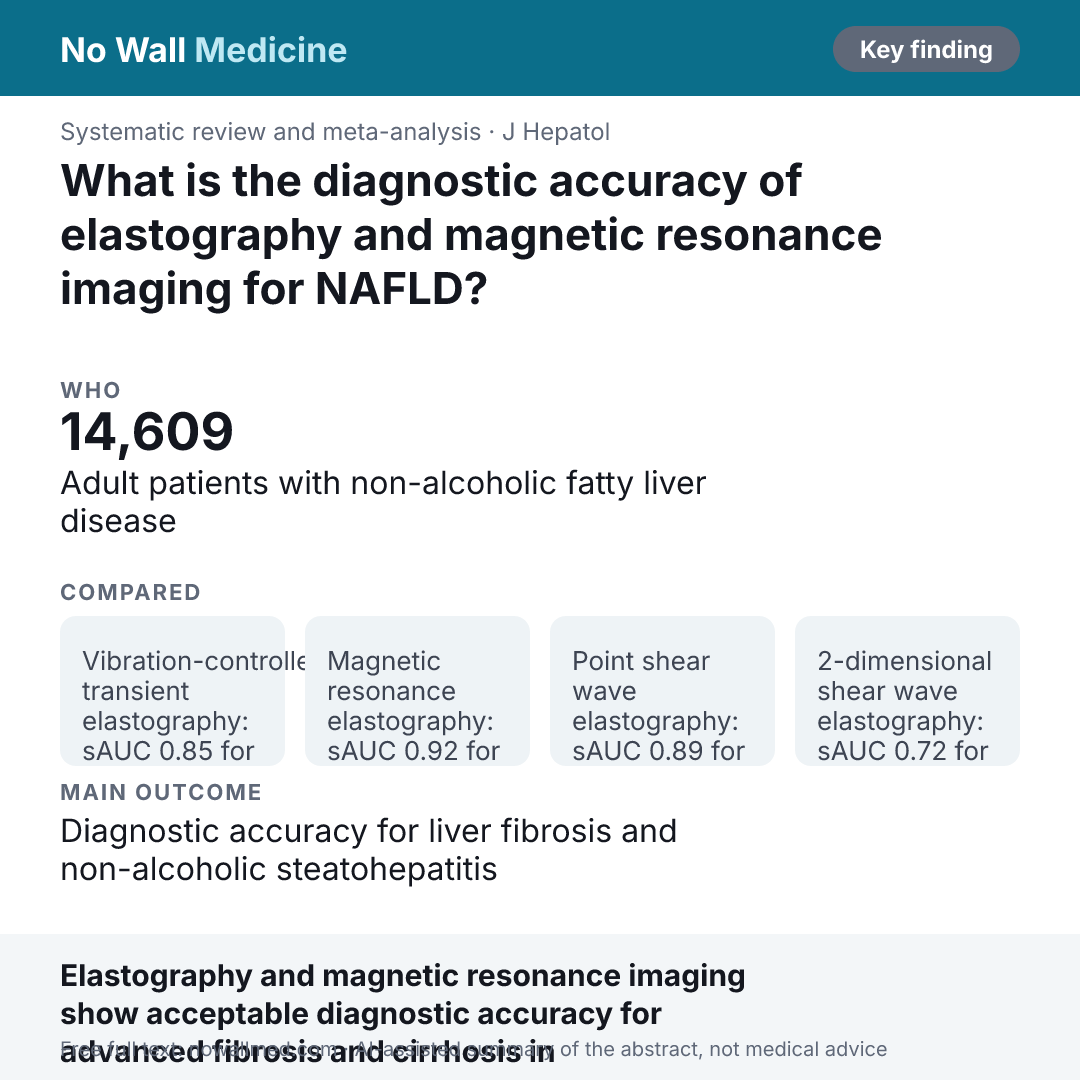
What is the diagnostic accuracy of elastography and magnetic resonance imaging for NAFLD?
Who
14,609
Adult patients with non-alcoholic fatty liver disease
Compared
Vibration-controlled transient elastography: sAUC 0.85 for advanced fibrosis
Magnetic resonance elastography: sAUC 0.92 for advanced fibrosis
Point shear wave elastography: sAUC 0.89 for advanced fibrosis
2-dimensional shear wave elastography: sAUC 0.72 for advanced fibrosis
Main outcome
Diagnostic accuracy for liver fibrosis and non-alcoholic steatohepatitis
Bottom line: Elastography and magnetic resonance imaging show acceptable diagnostic accuracy for advanced fibrosis and cirrhosis in non-alcoholic fatty liver disease.
J Hepatol · 2021-05-13 · Save PNG
Clinical question: What is the diagnostic accuracy of elastography and magnetic resonance imaging for NAFLD?
Key points
- Researchers analyzed 82 studies involving 14,609 patients to compare different non-invasive tests against liver biopsy for diagnosing liver disease.
- For advanced fibrosis, the area under the curve was 0.92 for magnetic resonance elastography, 0.89 for point shear wave elastography, 0.85 for vibration-controlled transient elastography, and 0.72 for 2-dimensional shear wave elastography.
- Magnetic resonance elastography had an area under the curve of 0.83 for diagnosing non-alcoholic steatohepatitis, which is fatty liver inflammation.
Headline and key points written with AI from the paper’s abstract, with every number checked against it. Read the paper before relying on them.
Was this summary helpful?
Abstract
Background and aims
Vibration-controlled transient elastography (VCTE), point shear wave elastography (pSWE), 2-dimensional shear wave elastography (2DSWE), magnetic resonance elastography (MRE), and magnetic resonance imaging (MRI) have been proposed as non-invasive tests for patients with non-alcoholic fatty liver disease (NAFLD). This study evaluated their diagnostic accuracy for liver fibrosis and non-alcoholic steatohepatitis (NASH).Methods
PubMED/MEDLINE, EMBASE and the Cochrane Library were searched for studies examining the diagnostic accuracy of these index tests, against histology as the reference standard, in adult patients with NAFLD. Two authors independently screened and assessed methodological quality of studies and extracted data. Summary estimates of sensitivity, specificity and area under the curve (sAUC) were calculated for fibrosis stages and NASH, using a random effects bivariate logit-normal model.Results
We included 82 studies (14,609 patients). Meta-analysis for diagnosing fibrosis stages was possible in 53 VCTE, 11 MRE, 12 pSWE and 4 2DSWE studies, and for diagnosing NASH in 4 MRE studies. sAUC for diagnosis of significant fibrosis were: 0.83 for VCTE, 0.91 for MRE, 0.86 for pSWE and 0.75 for 2DSWE. sAUC for diagnosis of advanced fibrosis were: 0.85 for VCTE, 0.92 for MRE, 0.89 for pSWE and 0.72 for 2DSWE. sAUC for diagnosis of cirrhosis were: 0.89 for VCTE, 0.90 for MRE, 0.90 for pSWE and 0.88 for 2DSWE. MRE had sAUC of 0.83 for diagnosis of NASH. Three (4%) studies reported intention-to-diagnose analyses and 15 (18%) studies reported diagnostic accuracy against pre-specified cut-offs.Conclusions
When elastography index tests are acquired successfully, they have acceptable diagnostic accuracy for advanced fibrosis and cirrhosis. The potential clinical impact of these index tests cannot be assessed fully as intention-to-diagnose analyses and validation of pre-specified thresholds are lacking.Lay summary
Non-invasive tests that measure liver stiffness or use magnetic resonance imaging (MRI) have been suggested as alternatives to liver biopsy for assessing the severity of liver scarring (fibrosis) and fatty inflammation (steatohepatitis) in patients with non-alcoholic fatty liver disease (NAFLD). In this study, we summarise the results of previously published studies on how accurately these non-invasive tests can diagnose liver fibrosis and inflammation, using liver biopsy as the reference. We found that some techniques that measure liver stiffness had a good performance for the diagnosis of severe liver scarring.
Abstract reproduced under the article’s CC BY-NC-ND licence.
Subject terms
Headline, design, result, key points, caveat and citation as plain text.
Cite this article
Selvaraj EA, Mózes FE, Jayaswal ANA, et al. Diagnostic accuracy of elastography and magnetic resonance imaging in patients with NAFLD: A systematic review and meta-analysis. J Hepatol. 2021;75(4):770-785. doi:10.1016/j.jhep.2021.04.044
Spotted a mistake? Suggest a correction