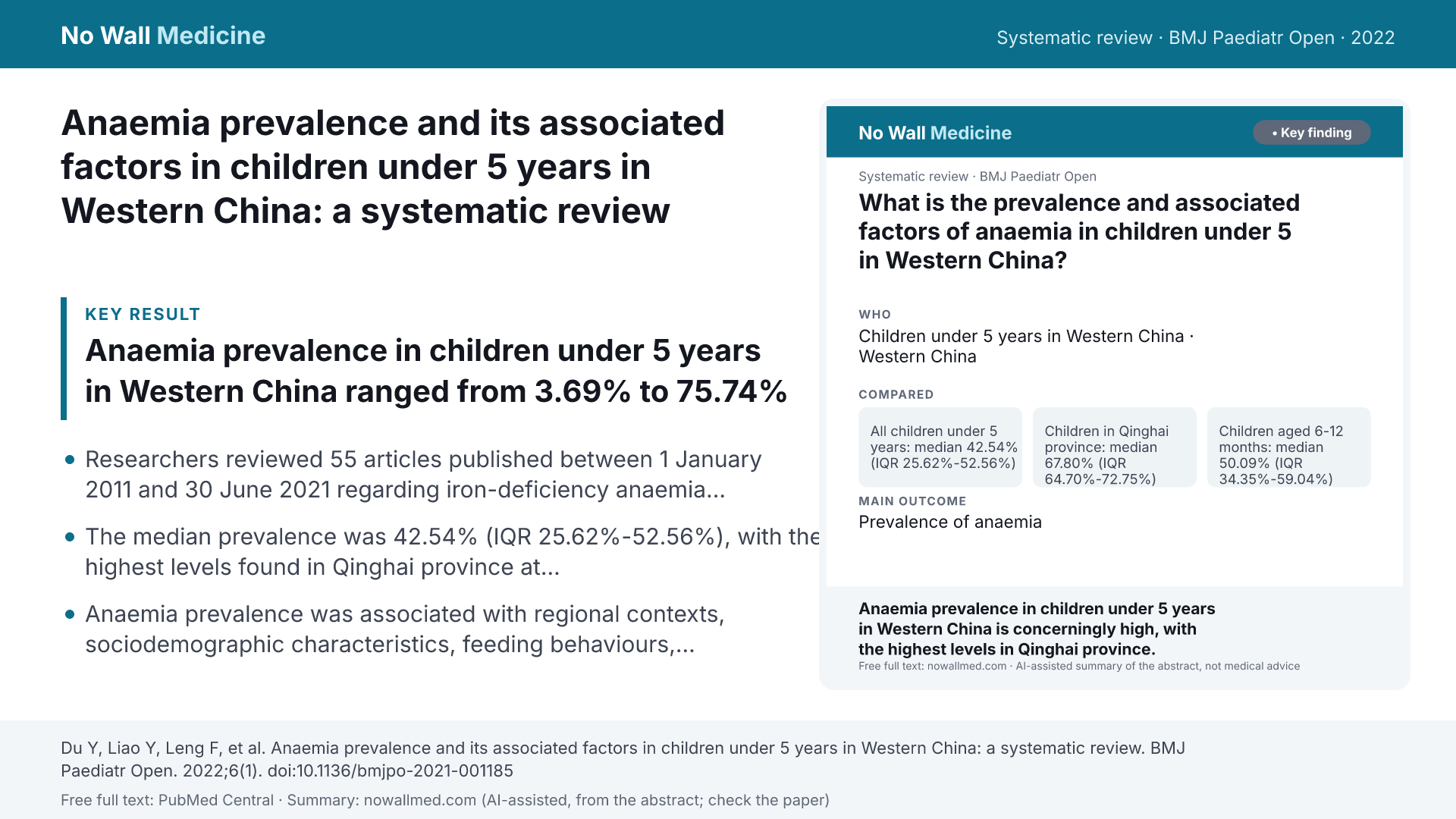
Anaemia prevalence in children under 5 years in Western China ranged from 3.69% to 75.74%
Anaemia prevalence and its associated factors in children under 5 years in Western China: a systematic review
Systematic reviewKey finding
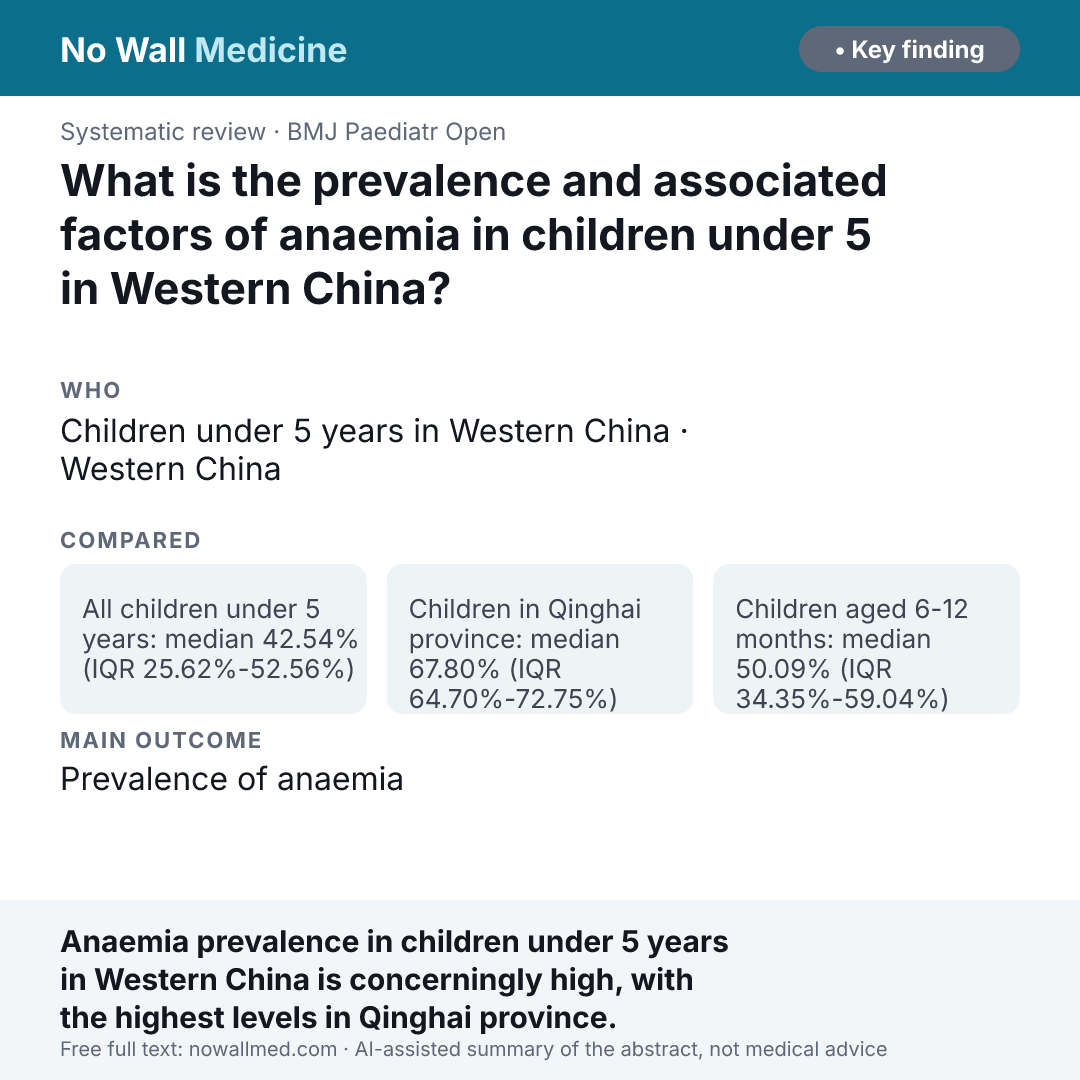
What is the prevalence and associated factors of anaemia in children under 5 in Western China?
Who
Children under 5 years in Western China · Western China
Compared
All children under 5 years: median 42.54% (IQR 25.62%-52.56%)
Children in Qinghai province: median 67.80% (IQR 64.70%-72.75%)
Children aged 6-12 months: median 50.09% (IQR 34.35%-59.04%)
Main outcome
Prevalence of anaemia
Bottom line: Anaemia prevalence in children under 5 years in Western China is concerningly high, with the highest levels in Qinghai province.
BMJ Paediatr Open · 2022-09-02
Why it matters: The large heterogeneity of published studies makes it difficult to understand the true prevalence and associated factors of iron-deficiency anaemia in Western China.
Headline and visual abstract written with AI from the paper’s abstract, with every number checked against it. Read the paper before relying on them.
Was this summary helpful?
Abstract
Background
Iron-deficiency anaemia disproportionately affects children in low-income and middle-income areas; Western China is a prime example. Given the health risks associated with childhood anaemia and the large heterogeneity of published studies on this subject, we conducted a systematic review of the evidence regarding anaemia prevalence and associated factors in children under 5 years in Western China. Methods
We searched for all relevant studies on the prevalence of iron deficiency anaemia in children under 5 years in Western China, obtaining research between 1 January 2011 and 30 June 2021, in English and Chinese from Medline, Embase, PubMed, Web of Science, CNKI, WanFang Data and VIP. Two reviewers independently screened titles and abstracts; three reviewed full texts of relevant articles for data extraction and performed quality assessments. The median prevalence was calculated on unweighted pooling, stratified by region, sex, age and ethnic group. Associated factors and a linear trend chart were conducted to identify trends and research highlights. Results
Among the 55 articles included, most were cross-sectional studies (39, 70.91%). The prevalence of anaemia in children under 5 years in Western China ranged from 3.69% to 75.74% (median 42.54% (IQR 25.62%-52.56%)); the highest levels were in Qinghai province: 59.10%-75.74% (median 67.80% (IQR 64.70%-72.75%)); the highest levels were reported in the subgroup of children aged 6-12 months (median 50.09% (IQR 34.35%-59.04%)). Regional contexts, individual sociodemographic characteristics and feeding behaviours, and nutritional programme interventions were factors associated with anaemia prevalence. Conclusion
The prevalence of anaemia in children under 5 years in Western China is concerningly high. For this multiethnic and economically underdeveloped region, more high-quality and prospective studies are needed to inform evidence based and targeted preventive strategies to decrease the high prevalence of anaemia among young children.
Abstract reproduced under the article’s CC BY NC licence.
Subject terms
Cite this article
Du Y, Liao Y, Leng F, et al. Anaemia prevalence and its associated factors in children under 5 years in Western China: a systematic review. BMJ Paediatr Open. 2022;6(1). doi:10.1136/bmjpo-2021-001185
Spotted a mistake? Suggest a correction