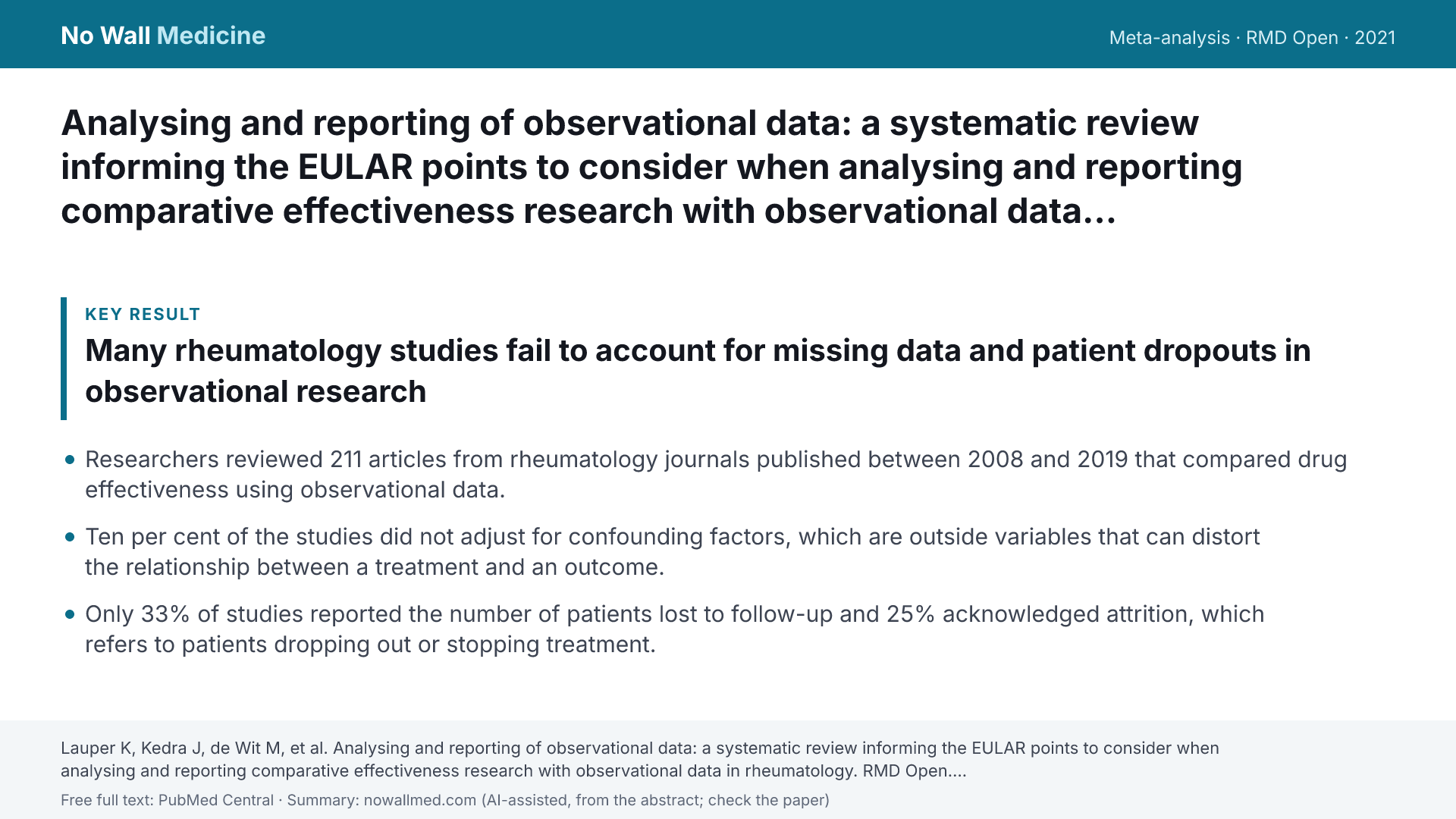
Analysing and reporting of observational data: a systematic review informing the EULAR points to consider when analysing and reporting comparative effectiveness research with observational data in rheumatology
Key result: Many rheumatology studies fail to account for missing data and patient dropouts in observational research
Key points
- Researchers reviewed 211 articles from rheumatology journals published between 2008 and 2019 that compared drug effectiveness using observational data.
- Ten per cent of the studies did not adjust for confounding factors, which are outside variables that can distort the relationship between a treatment and an outcome.
- Only 33% of studies reported the number of patients lost to follow-up and 25% acknowledged attrition, which refers to patients dropping out or stopping treatment.
Discussion prompts
- Would these patients look like yours? Who was left out?
- Is the main outcome one that matters to patients?
- Is the difference large enough to change what you do?
Cite: Lauper K, Kedra J, de Wit M, et al. Analysing and reporting of observational data: a systematic review informing the EULAR points to consider when analysing and reporting comparative effectiveness research with observational data in rheumatology. RMD Open. 2021. doi:10.1136/rmdopen-2021-001818
Free full text: PubMed Central · Summary and visual abstract: nowallmed.com/a/analysing-and-reporting-of-observational-data-a-systematic-review-1r8qeka/ (AI-assisted from the abstract; check the paper before relying on it).