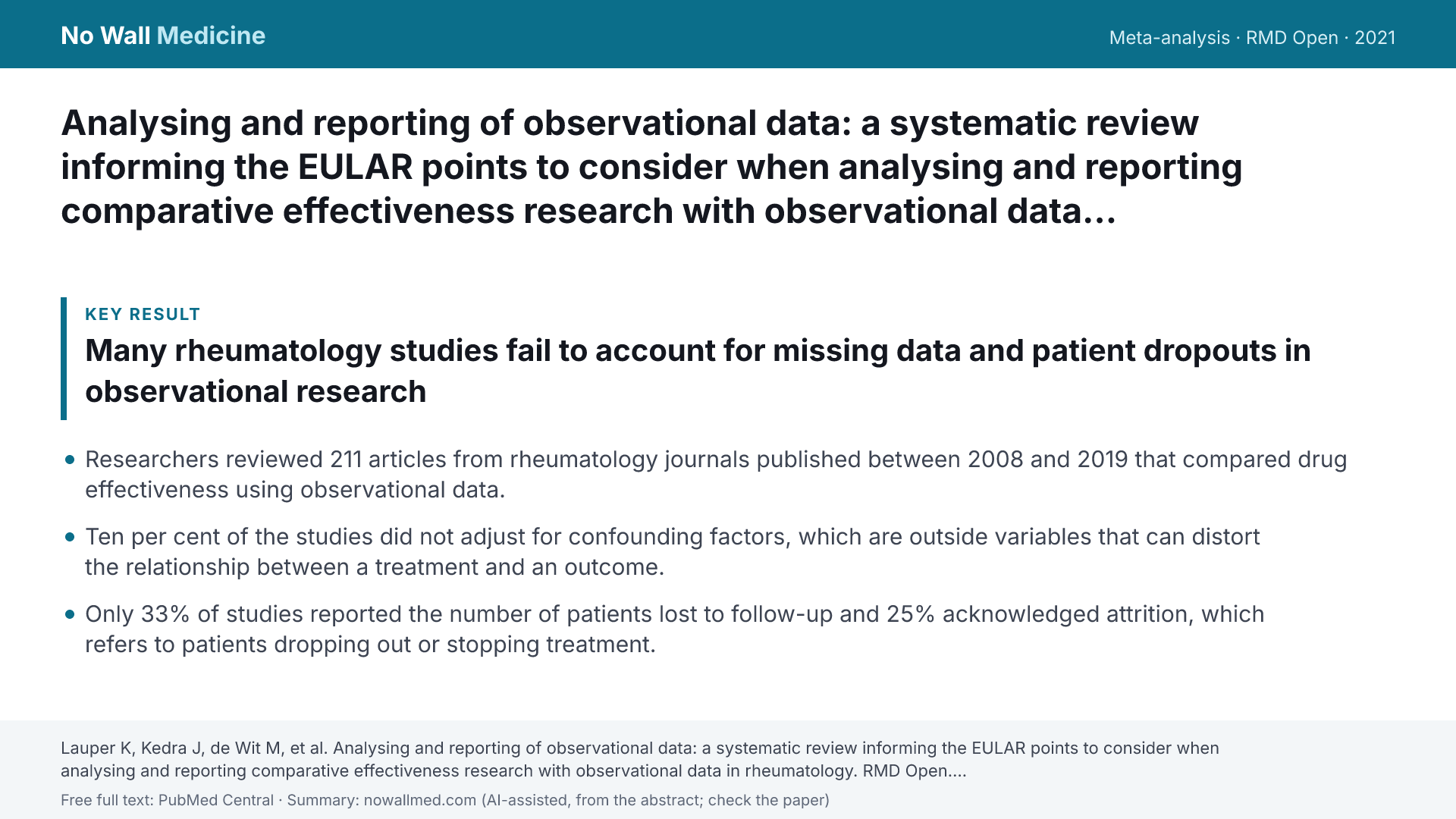
Many rheumatology studies fail to account for missing data and patient dropouts in observational research
Analysing and reporting of observational data: a systematic review informing the EULAR points to consider when analysing and reporting comparative effectiveness research with observational data in rheumatology
Key points
- Researchers reviewed 211 articles from rheumatology journals published between 2008 and 2019 that compared drug effectiveness using observational data.
- Ten per cent of the studies did not adjust for confounding factors, which are outside variables that can distort the relationship between a treatment and an outcome.
- Only 33% of studies reported the number of patients lost to follow-up and 25% acknowledged attrition, which refers to patients dropping out or stopping treatment.
Headline and key points written with AI from the paper’s abstract, with every number checked against it. Read the paper before relying on them.
Was this summary helpful?
Abstract
Objectives
To evaluate the analysis and reporting of comparative effectiveness research with observational data in rheumatology, informing European Alliance of Associations for Rheumatology points to consider. Methods
We performed a systematic literature review searching Ovid MEDLINE for original articles comparing drug effectiveness in longitudinal observational studies, published in key rheumatology journals between 2008 and 2019. The extracted information focused on reporting and types of analyses. We evaluated if year of publication impacted results. Results
From 9969 abstracts reviewed, 211 articles fulfilled the inclusion criteria. Ten per cent of studies did not adjust for confounding factors. Some studies did not explain how they chose covariates for adjustment (9%), used bivariate screening (21%) and/or stepwise selection procedures (18%). Only 33% studies reported the number of patients lost to follow-up and 25% acknowledged attrition (drop-out or treatment cessation). To account for attrition, studies used non-responder imputation, followed by last observation carried forward (LOCF) and complete case (CC) analyses. Most studies did not report the number of missing data on covariates (83%), and when addressed, 49% used CC and 11% LOCF. Date of publication did not influence the results. Conclusion
Most studies did not acknowledge missing data and attrition, and a tenth did not adjust for any confounding factors. When attempting to account for them, several studies used methods which potentially increase bias (LOCF, CC analysis, bivariate screening…). This study shows that there is no improvement over the last decade, highlighting the need for recommendations for the assessment and reporting of comparative drug effectiveness in observational data in rheumatology.
Abstract reproduced under the article’s CC BY licence.
Subject terms
Headline, design, result, key points, caveat and citation as plain text.
Cite this article
Lauper K, Kedra J, de Wit M, et al. Analysing and reporting of observational data: a systematic review informing the EULAR points to consider when analysing and reporting comparative effectiveness research with observational data in rheumatology. RMD Open. 2021. doi:10.1136/rmdopen-2021-001818
Spotted a mistake? Suggest a correction