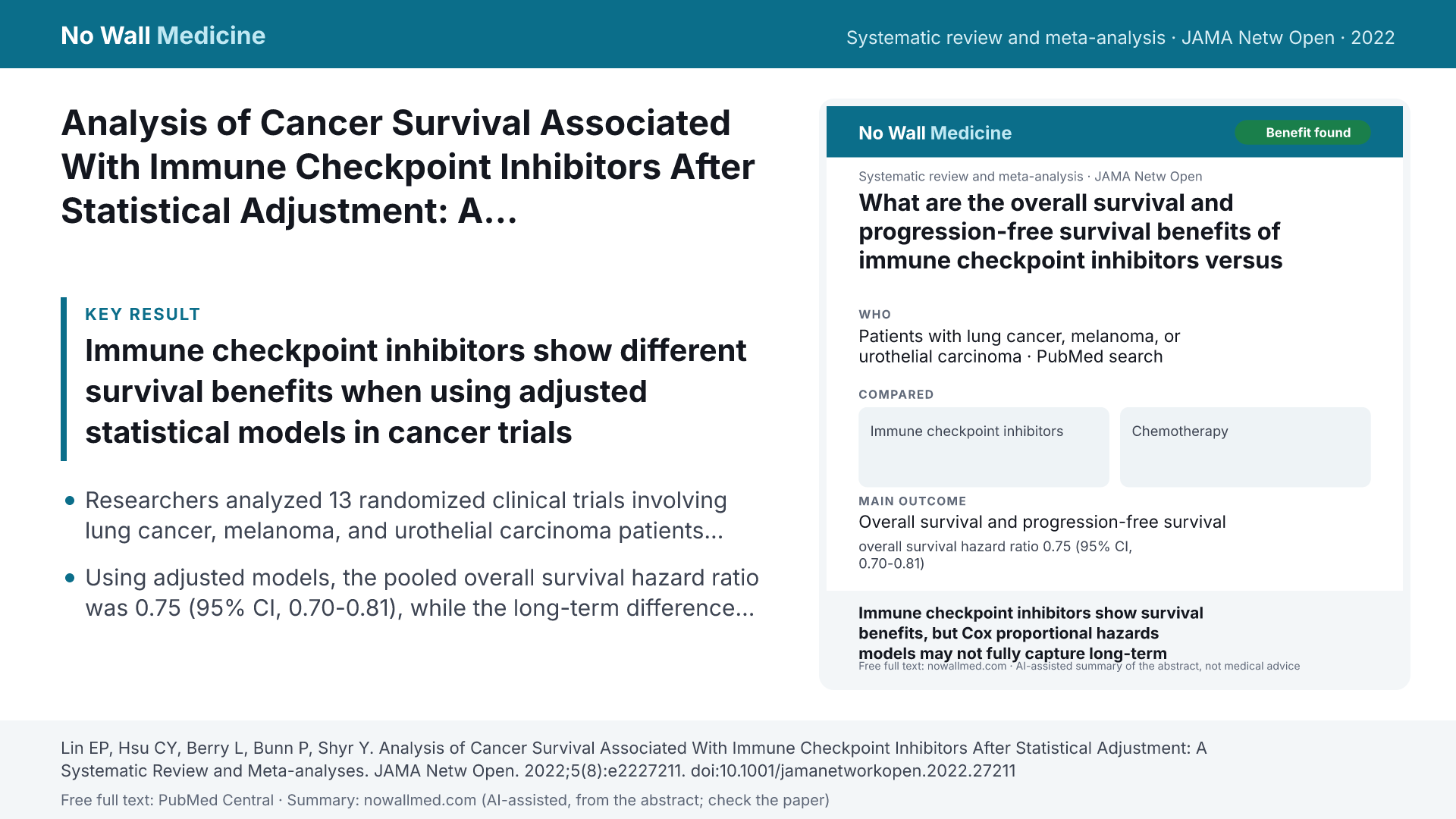
Analysis of Cancer Survival Associated With Immune Checkpoint Inhibitors After Statistical Adjustment: A Systematic Review and Meta-analyses
Key result: Immune checkpoint inhibitors show different survival benefits when using adjusted statistical models in cancer trials
Key points
- Researchers analyzed 13 randomized clinical trials involving lung cancer, melanoma, and urothelial carcinoma patients to compare immune checkpoint inhibitors against chemotherapy.
- Using adjusted models, the pooled overall survival hazard ratio was 0.75 (95% CI, 0.70-0.81), while the long-term difference in proportions was 0.08 (95% CI, 0.06-0.10).
- The pooled progression-free survival hazard ratio was 0.77 (95% CI, 0.64-0.91), but the short-term hazard ratio was 1.02 (95% CI, 0.84-1.24).
Why it matters: Standard statistical models may not fully capture survival outcomes when the risk reduction from immune checkpoint inhibitor therapy is not constant over time.
Discussion prompts
- Would these patients look like yours? Who was left out?
- Is the main outcome one that matters to patients?
- Is the difference large enough to change what you do?
Cite: Lin EP, Hsu CY, Berry L, Bunn P, Shyr Y. Analysis of Cancer Survival Associated With Immune Checkpoint Inhibitors After Statistical Adjustment: A Systematic Review and Meta-analyses. JAMA Netw Open. 2022;5(8):e2227211. doi:10.1001/jamanetworkopen.2022.27211
Free full text: PubMed Central · Summary and visual abstract: nowallmed.com/a/analysis-of-cancer-survival-associated-with-immune-checkpoint-1v9co6b/ (AI-assisted from the abstract; check the paper before relying on it).