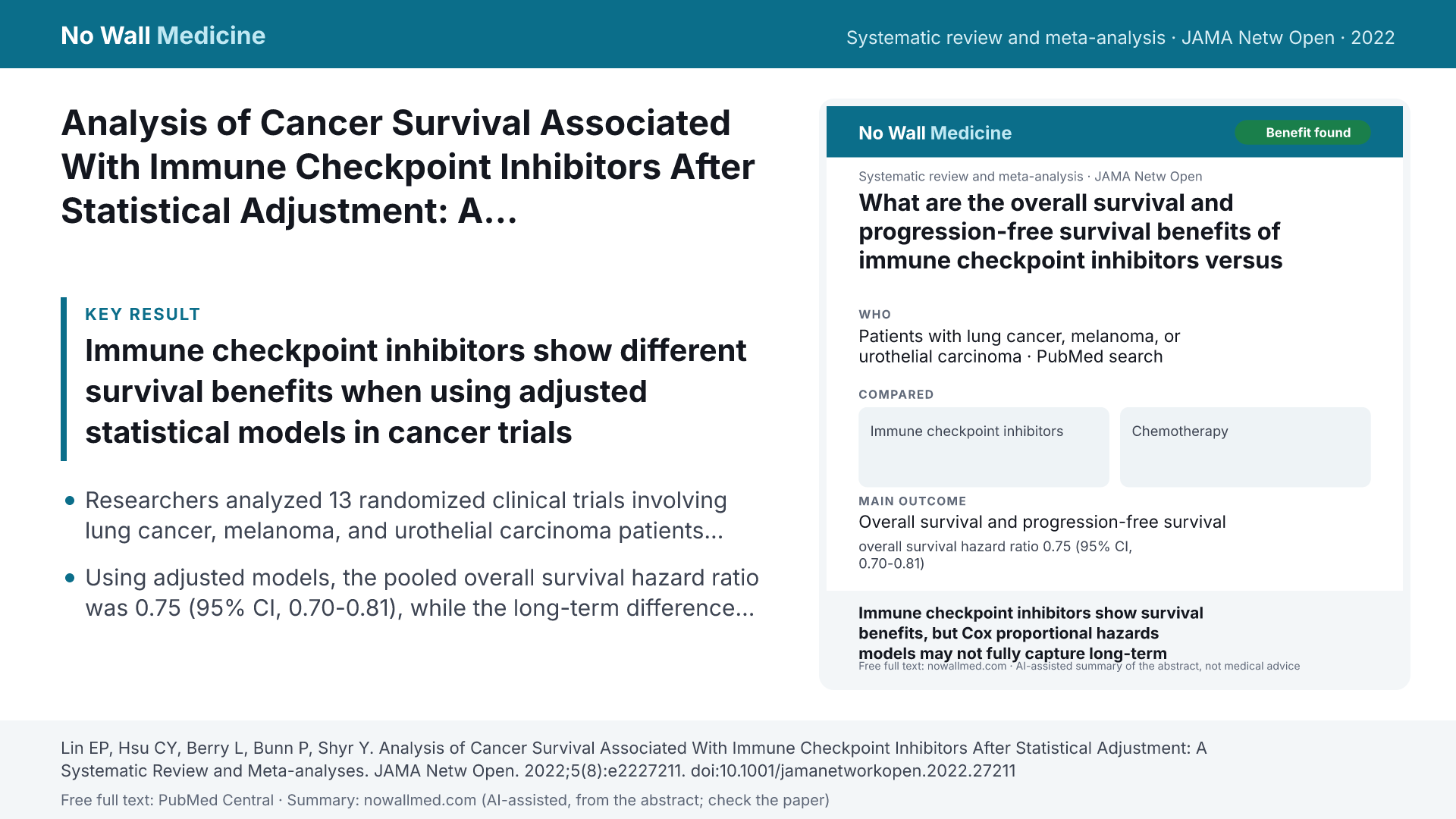
Immune checkpoint inhibitors show different survival benefits when using adjusted statistical models in cancer trials
Analysis of Cancer Survival Associated With Immune Checkpoint Inhibitors After Statistical Adjustment: A Systematic Review and Meta-analyses
Systematic review and meta-analysisBenefit found
What are the overall survival and progression-free survival benefits of immune checkpoint inhibitors versus chemotherapy?
Who
Patients with lung cancer, melanoma, or urothelial carcinoma · PubMed search
Compared
Immune checkpoint inhibitors
Chemotherapy
Main outcome
Overall survival and progression-free survival
Result: overall survival hazard ratio 0.75 (95% CI, 0.70-0.81)
Bottom line: Immune checkpoint inhibitors show survival benefits, but Cox proportional hazards models may not fully capture long-term survival outcomes.
JAMA Netw Open · 2022-08-01 · Save PNG
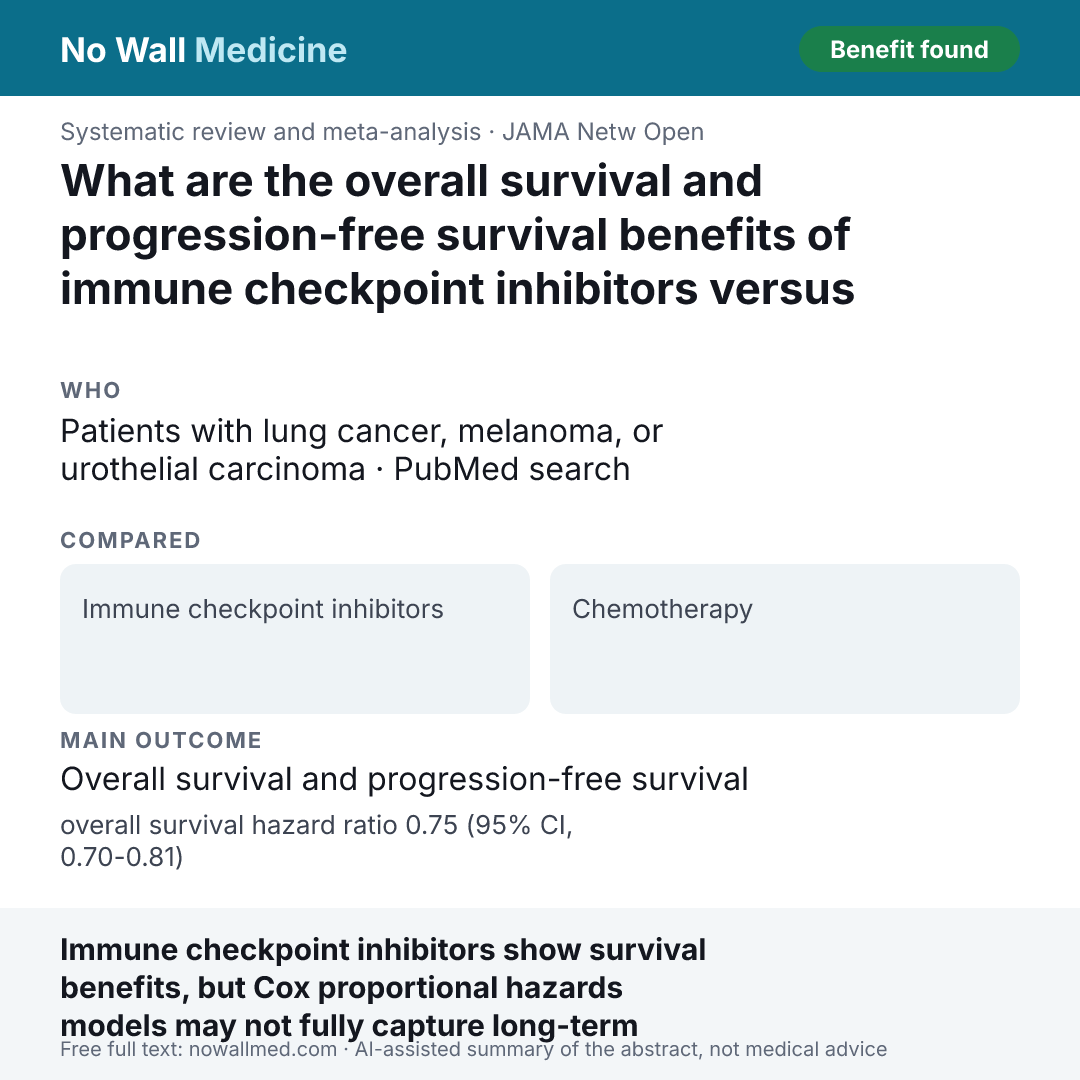
Clinical question: What are the overall survival and progression-free survival benefits of immune checkpoint inhibitors versus chemotherapy?
Why it matters: Standard statistical models may not fully capture survival outcomes when the risk reduction from immune checkpoint inhibitor therapy is not constant over time.
Key points
- Researchers analyzed 13 randomized clinical trials involving lung cancer, melanoma, and urothelial carcinoma patients to compare immune checkpoint inhibitors against chemotherapy.
- Using adjusted models, the pooled overall survival hazard ratio was 0.75 (95% CI, 0.70-0.81), while the long-term difference in proportions was 0.08 (95% CI, 0.06-0.10).
- The pooled progression-free survival hazard ratio was 0.77 (95% CI, 0.64-0.91), but the short-term hazard ratio was 1.02 (95% CI, 0.84-1.24).
Headline and key points written with AI from the paper’s abstract, with every number checked against it. Read the paper before relying on them.
Was this summary helpful?
Subject terms
Headline, design, result, key points, caveat and citation as plain text.
Cite this article
Lin EP, Hsu CY, Berry L, Bunn P, Shyr Y. Analysis of Cancer Survival Associated With Immune Checkpoint Inhibitors After Statistical Adjustment: A Systematic Review and Meta-analyses. JAMA Netw Open. 2022;5(8):e2227211. doi:10.1001/jamanetworkopen.2022.27211
Spotted a mistake? Suggest a correction