FGFR3 mutation was associated with worse survival and response to immunotherapy in metastatic bladder cancer
Fibroblast growth factor receptor 3 mutation attenuates response to immune checkpoint blockade in metastatic urothelial carcinoma by driving immunosuppressive microenvironment
Propensity score matched analysis and meta-analysisHarm found
Does FGFR3 mutation attenuate response to immune checkpoint blockade in metastatic urothelial carcinoma?
Who
938
Patients with metastatic urothelial carcinoma treated with atezolizumab · Multicenter
Compared
9.2 monthsFGFR3-mutated
21.0 monthsFGFR3-wildtype
Main outcome
Overall survival and disease control rate
Result: hazard ratio 1.28 (95% CI 1.04 to 1.59)
Bottom line: FGFR3 mutation is associated with worse overall survival and lower disease control rates after immune checkpoint blockade.
J Immunother Cancer · 2023-10-01Download image
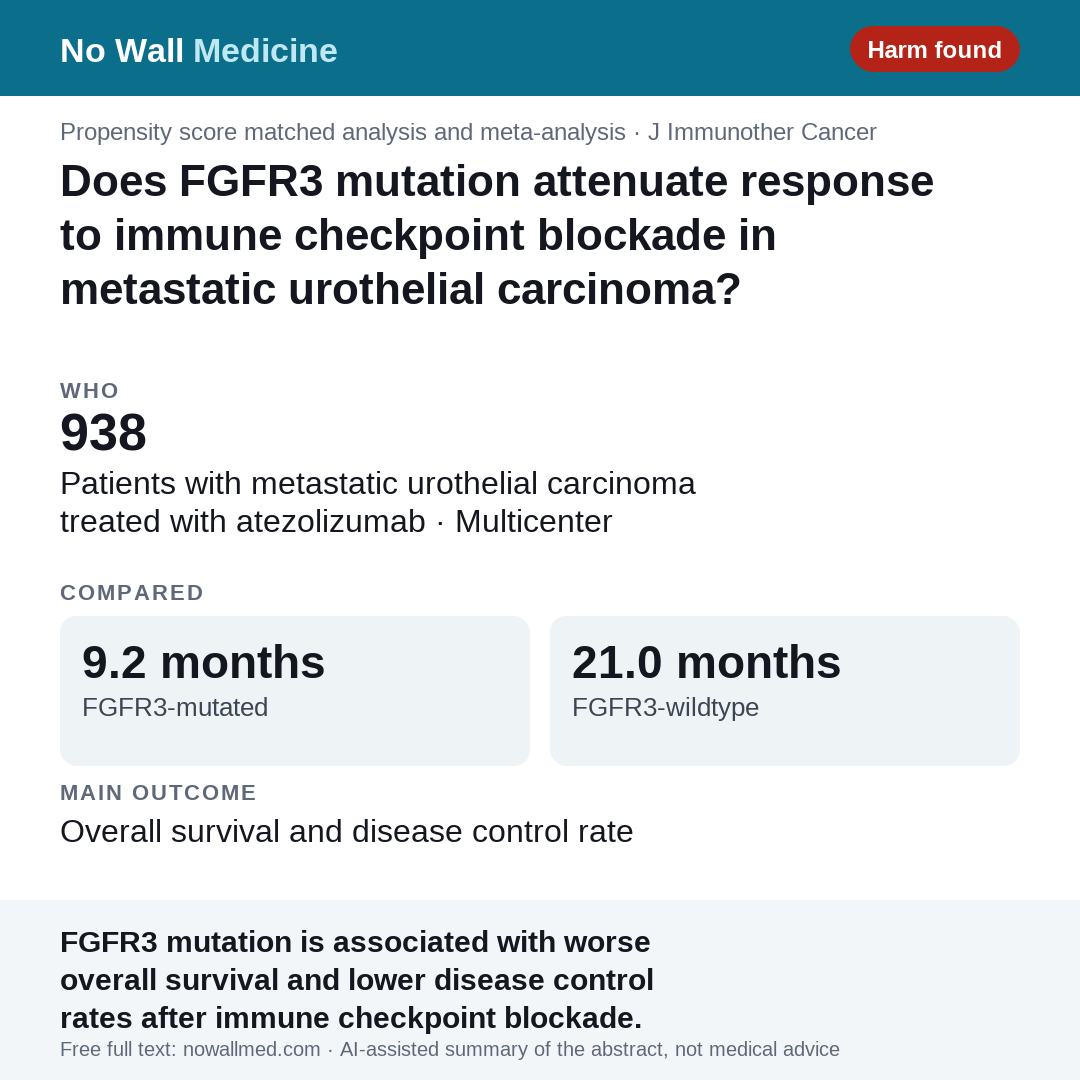
Clinical question: Does FGFR3 mutation attenuate response to immune checkpoint blockade in metastatic urothelial carcinoma?
Why it matters: It was unknown if FGFR3 mutations affect how patients with metastatic urothelial carcinoma respond to immune checkpoint blockade therapy.
Key points
- Researchers analyzed 39 patients with FGFR3-mutated and 39 patients with FGFR3-wildtype metastatic urothelial carcinoma treated with atezolizumab, an immune checkpoint blockade.
- Patients with FGFR3 mutations had a median overall survival of 9.2 months compared to 21.0 months for those without the mutation.
- The disease control rate was lower in the FGFR3-mutated group at 41.0% compared to 66.7% in the FGFR3-wildtype group.
Headline and key points written with AI from the paper’s abstract, with every number checked against it. Read the paper before relying on them.
Was this summary helpful?
Abstract
Background
Immune checkpoint blockade (ICB) therapy holds promise in metastatic urothelial carcinoma (UC). Fibroblast growth factor receptor 3 (FGFR3) mutation drives T-cell-depleted microenvironment in UC, which led to the hypothesis that FGFR3 mutation might attenuate response to ICB in patients with metastatic UC. The study aims to compare prognosis and response between patients with FGFR3-mutated and FGFR3-wildtype metastatic UC after ICB therapy, and decode the potential molecular mechanisms. Methods
Based on the single-arm, multicenter, phase 2 trial, IMvigor210, we conducted a propensity score matched (PSM) analysis. After a 1:1 ratio PSM method, 39 patients with FGFR3-mutated and 39 FGFR3-wildtype metastatic UC treated with atezolizumab were enrolled. A meta-analysis through systematical database retrieval was conducted for validation. In addition, we performed single-cell RNA sequencing on three FGFR3-mutated and three FGFR3-wildtype UC tumors and analyzed 58,069 single cells. Results
The PSM analysis indicated FGFR3-mutated patients had worse overall survival (OS) in comparison to FGFR3-wildtype patients (HR=2.11, 95% CI=(1.16 to 3.85), p=0.015) receiving atezolizumab. The median OS was 9.2 months (FGFR3-mutated) versus 21.0 months (FGFR3-wildtype). FGFR3-mutated patients had lower disease control rate than FGFR3-wildtype patients (41.0% vs 66.7%, p=0.023). The meta-analysis involving 938 patients with metastatic UC confirmed FGFR3 mutation was associated with worse OS after ICB (HR=1.28, 95% CI=(1.04 to 1.59), p=0.02). Single-cell RNA transcriptome analysis identified FGFR3-mutated UC carried a stronger immunosuppressive microenvironment compared with FGFR3-wildtype UC. FGFR3-mutated UC exhibited less immune infiltration, and lower T-cell cytotoxicity. Higher TREM2+ macrophage abundance in FGFR3-mutated UC can undermine and suppress the T cells, potentially contributing to the formation of an immunosuppressive microenvironment. Lower inflammatory-cancer-associated fibroblasts in FGFR3-mutated UC recruited less chemokines in antitumor immunity but expressed growth factors to promote FGFR3-mutated malignant cell development. FGFR3-mutated UC carried abundance of malignant cells characterized by high hypoxia/metabolism and low interferon response phenotype. Conclusions
FGFR3 mutation can attenuate prognosis and response to ICB in patients with metastatic UC. FGFR3-mutated UC carries a stronger immunosuppressive microenvironment in comparison with FGFR3-wildtype UC. Inhibition of FGFR3 might activate the immune microenvironment, and the combination of FGFR inhibitor targeted therapy and ICB might be a promising therapeutic regimen in metastatic UC, providing important implications for UC clinical management.
Abstract reproduced under the article’s CC BY NC licence.
Subject terms
Cite this article
Song Y, Peng Y, Qin C, Wang Y, Yang W, Du Y. Fibroblast growth factor receptor 3 mutation attenuates response to immune checkpoint blockade in metastatic urothelial carcinoma by driving immunosuppressive microenvironment. J Immunother Cancer. 2023. doi:10.1136/jitc-2022-006643
Spotted a mistake? Suggest a correction
Top studies every Monday
The week’s key trials and guidelines in your specialties, plus any topics you follow. By email, free.
Get the weekly digest