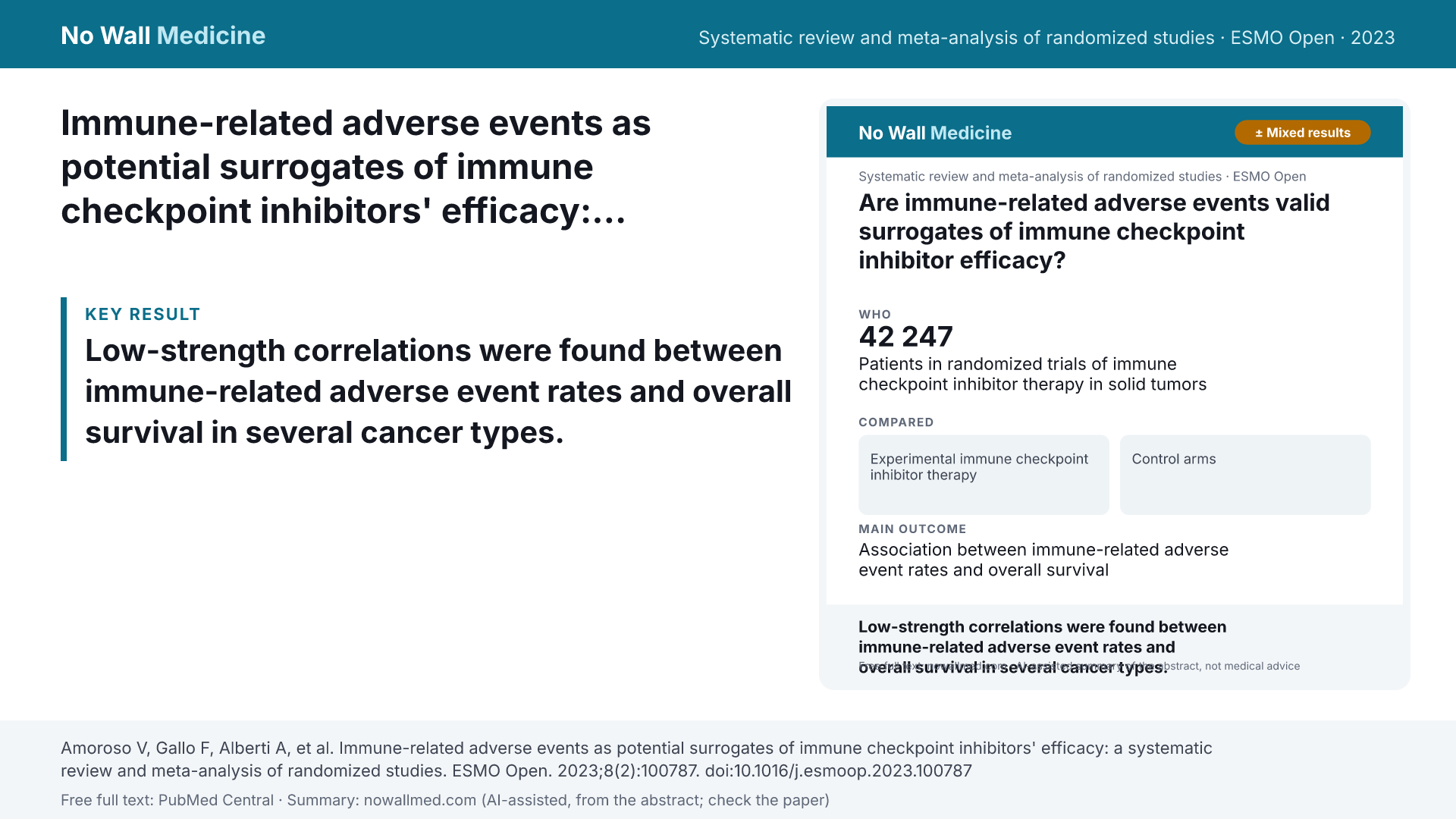
Immune-related adverse events as potential surrogates of immune checkpoint inhibitors' efficacy: a systematic review and meta-analysis of randomized studies
Systematic review and meta-analysis of randomized studiesMixed results
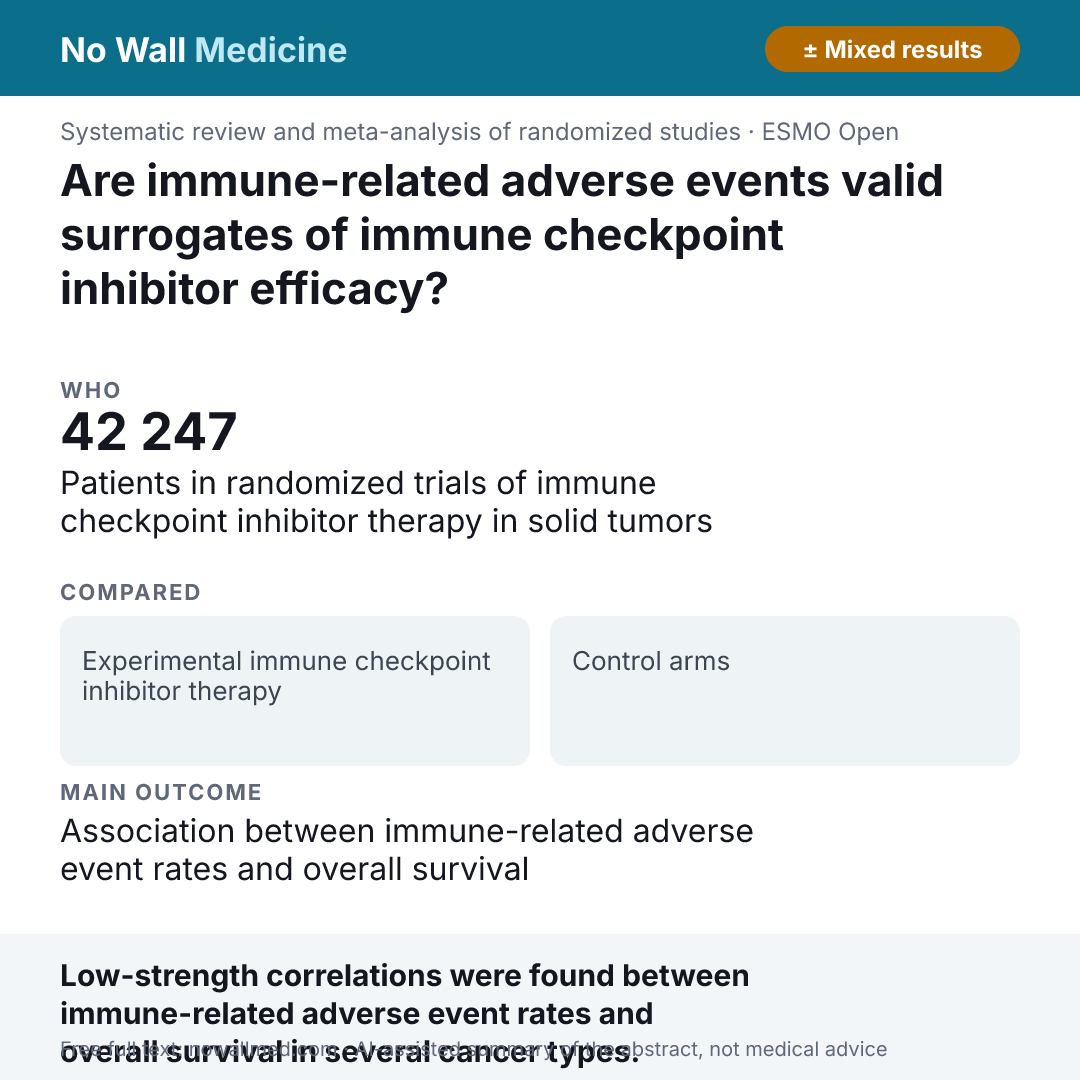
Are immune-related adverse events valid surrogates of immune checkpoint inhibitor efficacy?
Who
42 247
Patients in randomized trials of immune checkpoint inhibitor therapy in solid tumors
Compared
Experimental immune checkpoint inhibitor therapy
Control arms
Main outcome
Association between immune-related adverse event rates and overall survival
Bottom line: Low-strength correlations were found between immune-related adverse event rates and overall survival in several cancer types.
ESMO Open · 2023-02-24
Abstract
Background
Immune-related adverse events (irAEs) are frequently reported during immune checkpoint inhibitor (ICI) therapy and are associated with long-term outcomes. It is unknown if the irAE occurrence is a valid surrogate of ICIs' efficacy. Methods
We identified articles reporting the results of randomized trials of experimental ICI therapy in solid tumors with a systematic search. The control arms could be placebo, cytotoxic/targeted therapy, or ICI therapy. We extracted the hazard ratios for overall survival (OS) with the number of OS events per arm and the number and percentages of overall and specific irAEs of grade 1-2 and grade 3-4 per arm. We estimated the treatment effect on the potential surrogate outcome with the odds ratio of the irAE rate between the experimental and the control arm. The statistical analysis consisted of weighted linear regression on a logarithmic scale between treatment effects on irAE rate and treatment effects on OS. Results
Sixty-two randomized trials were included for a total of 79 contrasts and 42 247 patients. The analyses found no significant association between the treatment effects for overall grade 1-2 or grade 3-4 irAE rates or specific (skin, gastrointestinal, endocrine) irAE rates. In the non-small-cell lung cancer (NSCLC) trial subset, we observed a negative association between treatment effects on overall grade 1-2 irAEs and treatment effects on OS in studies with patients selected for programmed death-ligand 1 expression (R2 = 0.55; 95% confidence interval 0.20-0.95; R = -0.69). In the melanoma trial subset, a negative association was shown between treatment effects on gastrointestinal grade 3-4 irAEs and treatment effects on OS in trials without an ICI-based control arm (R2 = 0.77; 95% confidence interval 0.24-0.99; R = -0.89). Conclusions
We found low-strength correlations between the ICI therapy effects on overall or specific irAE rates and the treatment effects on OS in several cancer types.
Subject terms
Cite this article
Amoroso V, Gallo F, Alberti A, et al. Immune-related adverse events as potential surrogates of immune checkpoint inhibitors' efficacy: a systematic review and meta-analysis of randomized studies. ESMO Open. 2023;8(2):100787. doi:10.1016/j.esmoop.2023.100787
Spotted a mistake? Suggest a correction