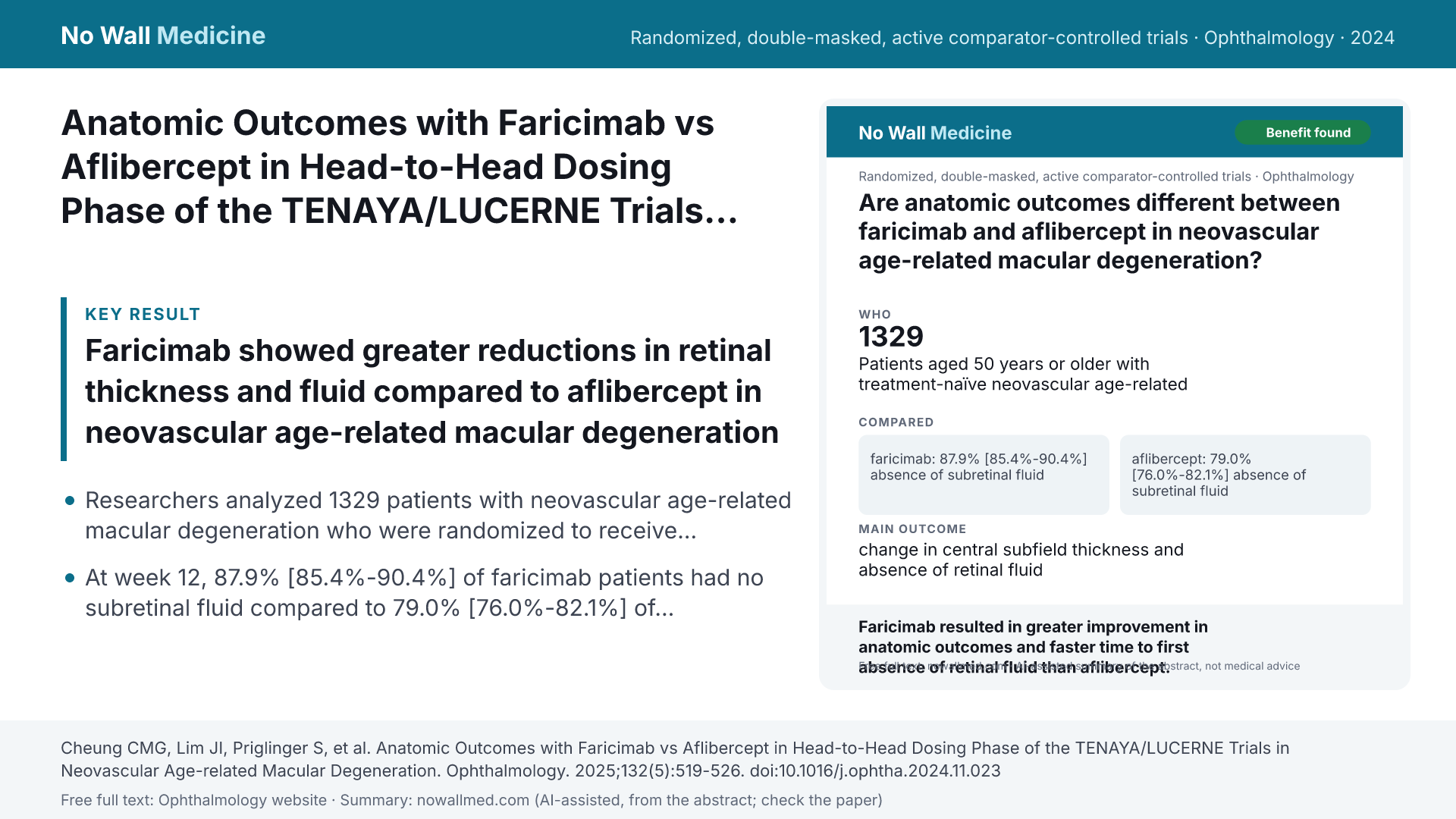
Faricimab showed greater reductions in retinal thickness and fluid compared to aflibercept in neovascular age-related macular degeneration
Anatomic Outcomes with Faricimab vs Aflibercept in Head-to-Head Dosing Phase of the TENAYA/LUCERNE Trials in Neovascular Age-related Macular Degeneration
Randomized, double-masked, active comparator-controlled trialsBenefit found
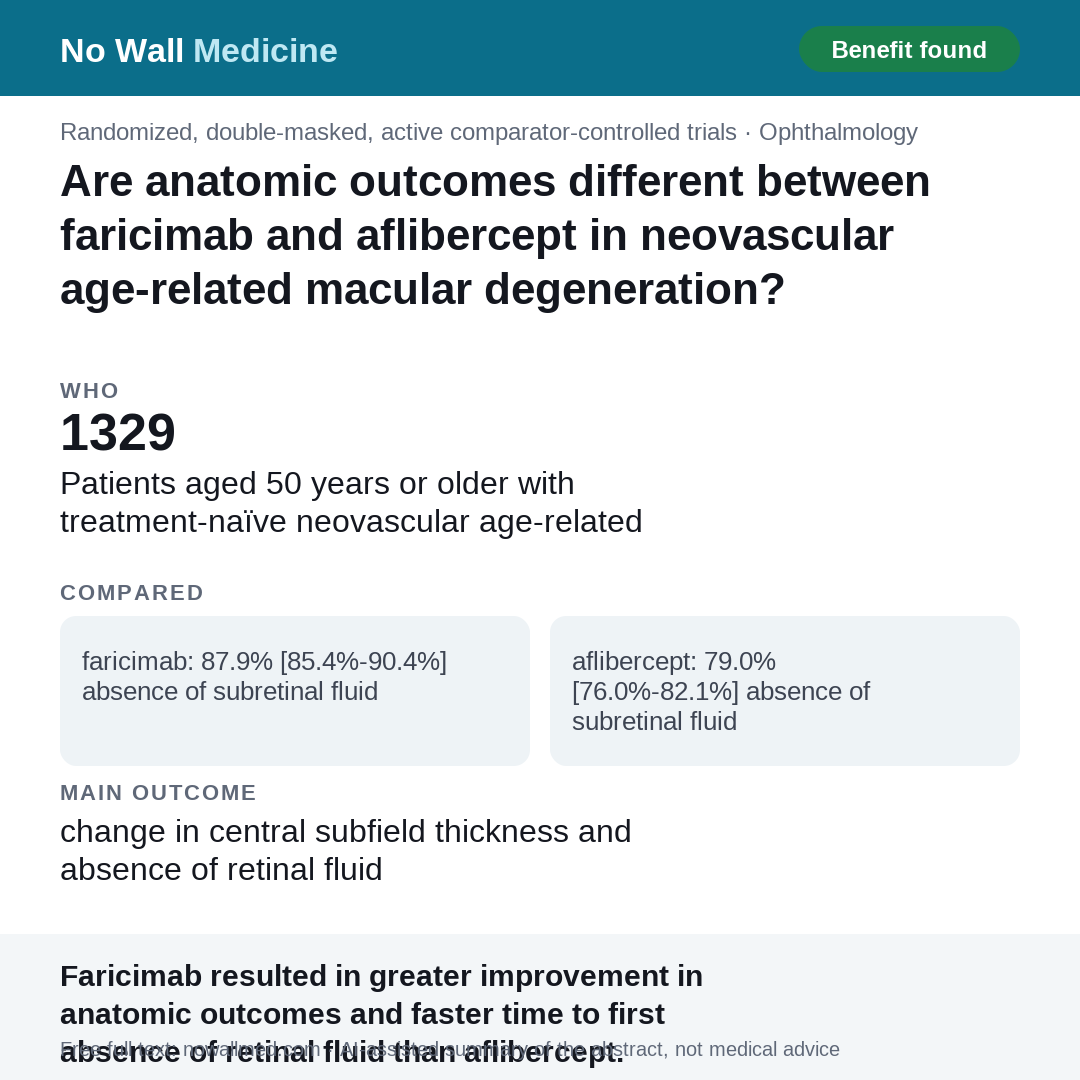
Are anatomic outcomes different between faricimab and aflibercept in neovascular age-related macular degeneration?
Who
1329
Patients aged 50 years or older with treatment-naïve neovascular age-related macular degeneration
Compared
faricimab: 87.9% [85.4%-90.4%] absence of subretinal fluid
aflibercept: 79.0% [76.0%-82.1%] absence of subretinal fluid
Main outcome
change in central subfield thickness and absence of retinal fluid
Bottom line: Faricimab resulted in greater improvement in anatomic outcomes and faster time to first absence of retinal fluid than aflibercept.
Ophthalmology · 2024-11-30Download image
Clinical question: Are anatomic outcomes different between faricimab and aflibercept in neovascular age-related macular degeneration?
Why it matters: It was unknown how faricimab compared to aflibercept regarding anatomic outcomes like retinal thickness and fluid clearance during the initial dosing phase.
Key points
- Researchers analyzed 1329 patients with neovascular age-related macular degeneration who were randomized to receive either faricimab or aflibercept.
- At week 12, 87.9% [85.4%-90.4%] of faricimab patients had no subretinal fluid compared to 79.0% [76.0%-82.1%] of aflibercept patients.
- Faricimab patients reached the 75th percentile for the first absence of both intraretinal and subretinal fluid at week 8, while aflibercept patients reached it at week 12.
Headline and key points written with AI from the paper’s abstract, with every number checked against it. Read the paper before relying on them.
Was this summary helpful?
Subject terms
Cite this article
Cheung CMG, Lim JI, Priglinger S, Querques G, Margaron P, Patel S. Anatomic Outcomes with Faricimab vs Aflibercept in Head-to-Head Dosing Phase of the TENAYA/LUCERNE Trials in Neovascular Age-related Macular Degeneration. Ophthalmology. 2024. doi:10.1016/j.ophtha.2024.11.023
Spotted a mistake? Suggest a correction