Anatomic Outcomes with Faricimab vs Aflibercept in Head-to-Head Dosing Phase of the TENAYA/LUCERNE Trials in Neovascular Age-related Macular Degeneration
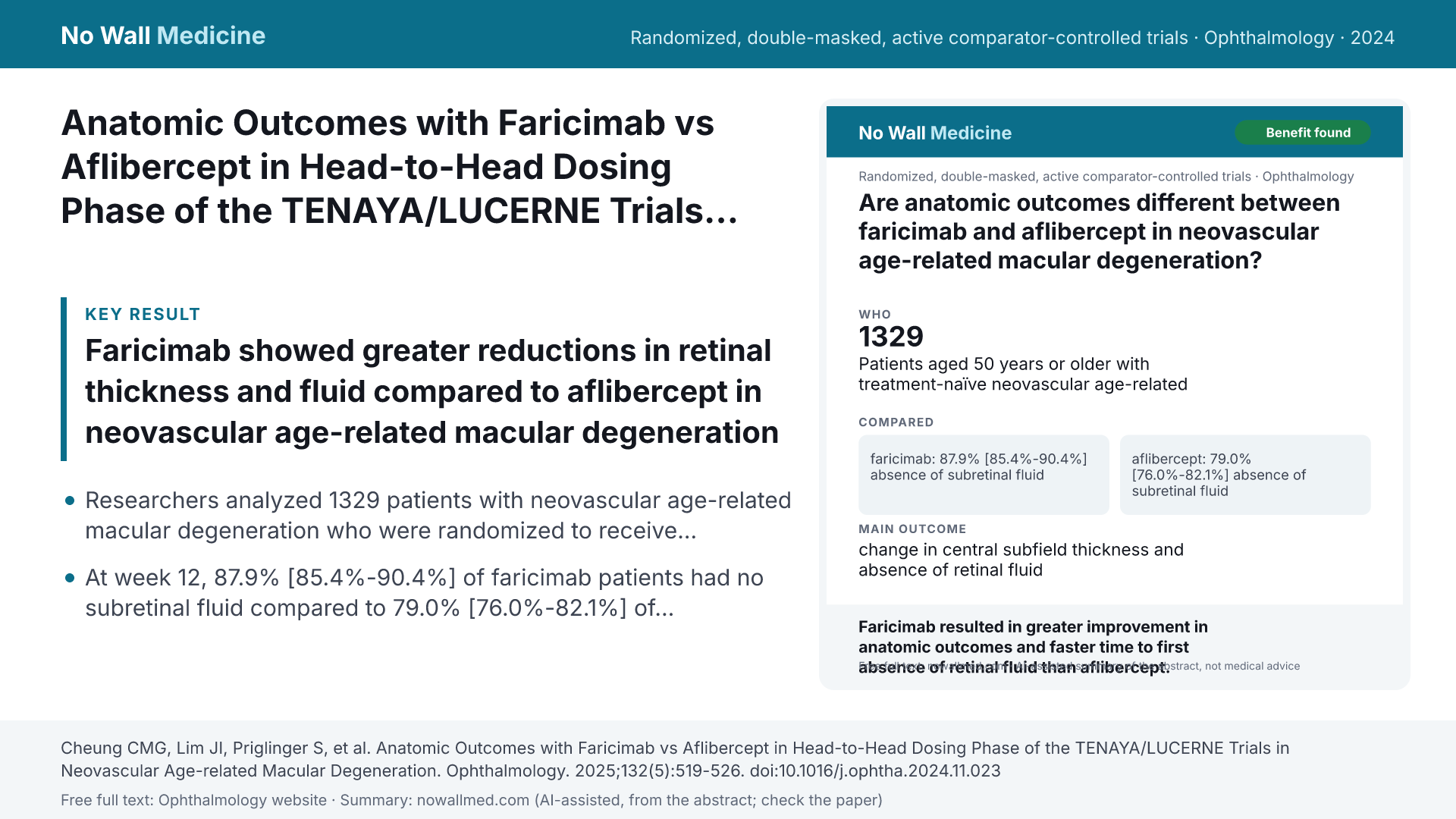
Key result: Faricimab showed greater reductions in retinal thickness and fluid compared to aflibercept in neovascular age-related macular degeneration
Randomized, double-masked, active comparator-controlled trialsBenefit found
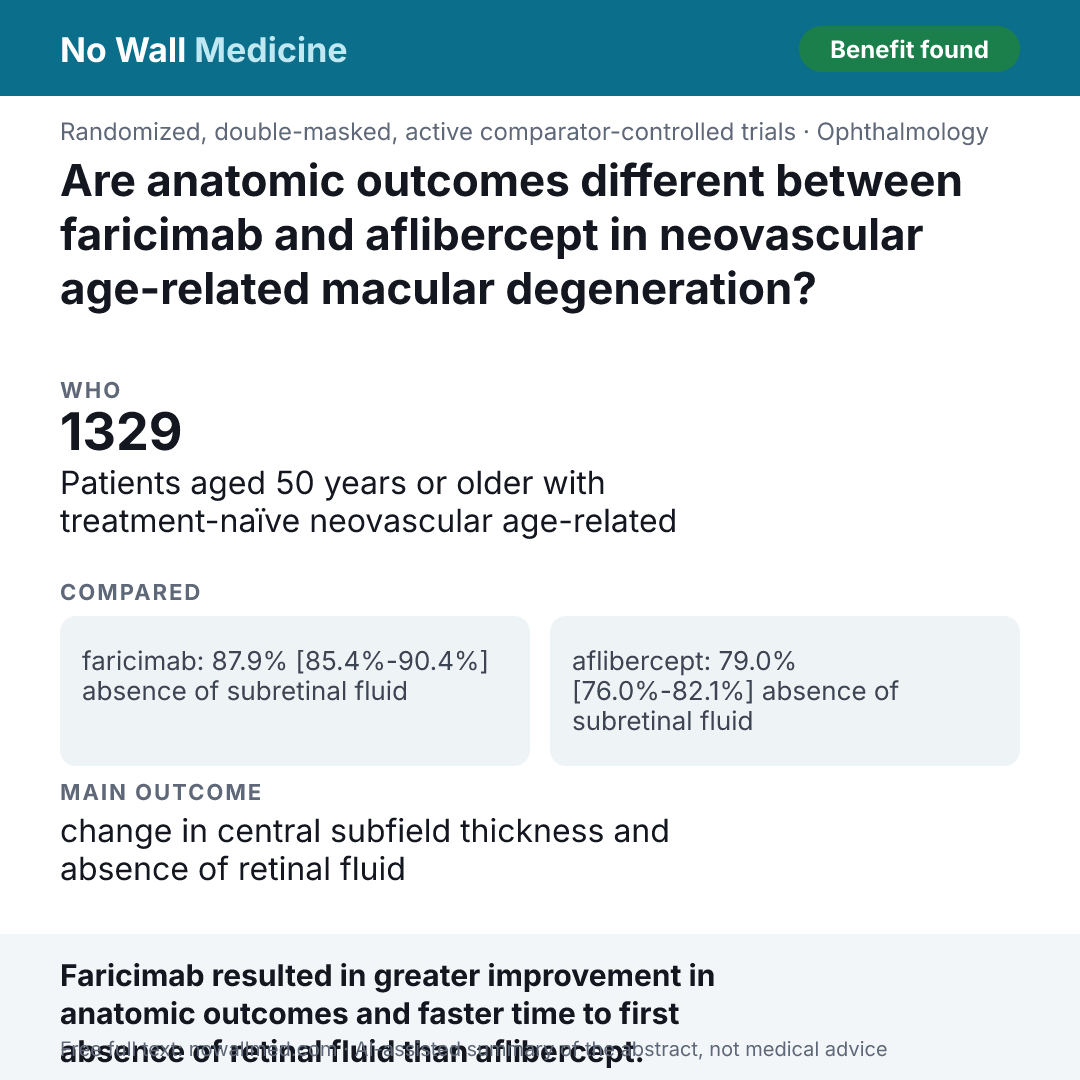
Are anatomic outcomes different between faricimab and aflibercept in neovascular age-related macular degeneration?
Who
1329
Patients aged 50 years or older with treatment-naïve neovascular age-related macular degeneration
Compared
faricimab: 87.9% [85.4%-90.4%] absence of subretinal fluid
aflibercept: 79.0% [76.0%-82.1%] absence of subretinal fluid
Main outcome
change in central subfield thickness and absence of retinal fluid
Bottom line: Faricimab resulted in greater improvement in anatomic outcomes and faster time to first absence of retinal fluid than aflibercept.
Ophthalmology · 2024-11-30 · Save PNG
Key points
- Researchers analyzed 1329 patients with neovascular age-related macular degeneration who were randomized to receive either faricimab or aflibercept.
- At week 12, 87.9% [85.4%-90.4%] of faricimab patients had no subretinal fluid compared to 79.0% [76.0%-82.1%] of aflibercept patients.
- Faricimab patients reached the 75th percentile for the first absence of both intraretinal and subretinal fluid at week 8, while aflibercept patients reached it at week 12.
Discussion prompts
- Would these patients look like yours? Who was left out?
- Is the main outcome one that matters to patients?
- Is the difference large enough to change what you do?
Cite: Cheung CMG, Lim JI, Priglinger S, et al. Anatomic Outcomes with Faricimab vs Aflibercept in Head-to-Head Dosing Phase of the TENAYA/LUCERNE Trials in Neovascular Age-related Macular Degeneration. Ophthalmology. 2025;132(5):519-526. doi:10.1016/j.ophtha.2024.11.023
Free full text: Ophthalmology website · Summary and visual abstract: nowallmed.com/a/anatomic-outcomes-with-faricimab-vs-aflibercept-in-head-to-head-kz83py/ (AI-assisted from the abstract; check the paper before relying on it).