Anatomic, stage-based repair of secondary mitral valve disease
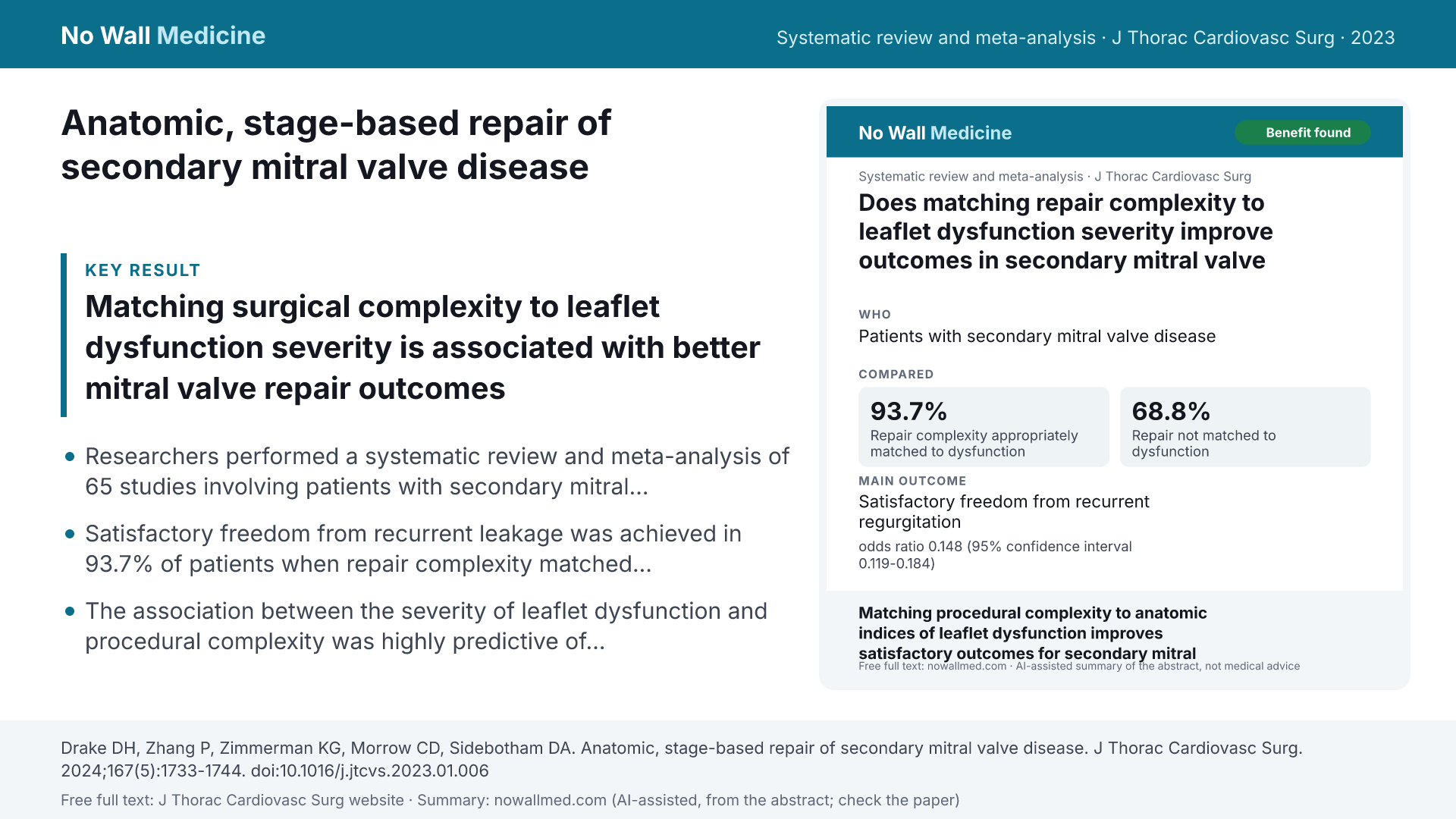
Key result: Matching surgical complexity to leaflet dysfunction severity is associated with better mitral valve repair outcomes
Systematic review and meta-analysisBenefit found
Does matching repair complexity to leaflet dysfunction severity improve outcomes in secondary mitral valve disease?
Who
Patients with secondary mitral valve disease
Compared
93.7%Repair complexity appropriately matched to dysfunction
68.8%Repair not matched to dysfunction
Main outcome
Satisfactory freedom from recurrent regurgitation
Result: odds ratio 0.148 (95% confidence interval 0.119-0.184)
Bottom line: Matching procedural complexity to anatomic indices of leaflet dysfunction improves satisfactory outcomes for secondary mitral valve repair.
J Thorac Cardiovasc Surg · 2023-01-11
Key points
- Researchers performed a systematic review and meta-analysis of 65 studies involving patients with secondary mitral valve disease, which is a condition where the valve leaks due to heart muscle issues.
- Satisfactory freedom from recurrent leakage was achieved in 93.7% of patients when repair complexity matched leaflet dysfunction severity, compared to 68.8% when they were not matched.
- The association between the severity of leaflet dysfunction and procedural complexity was highly predictive of successful outcomes.
Discussion prompts
- Would these patients look like yours? Who was left out?
- Is the main outcome one that matters to patients?
- Is the difference large enough to change what you do?
Cite: Drake DH, Zhang P, Zimmerman KG, Morrow CD, Sidebotham DA. Anatomic, stage-based repair of secondary mitral valve disease. J Thorac Cardiovasc Surg. 2024;167(5):1733-1744. doi:10.1016/j.jtcvs.2023.01.006
Free full text: J Thorac Cardiovasc Surg website · Summary and visual abstract: nowallmed.com/a/anatomic-stage-based-repair-of-secondary-mitral-valve-dwnxq7/ (AI-assisted from the abstract; check the paper before relying on it).