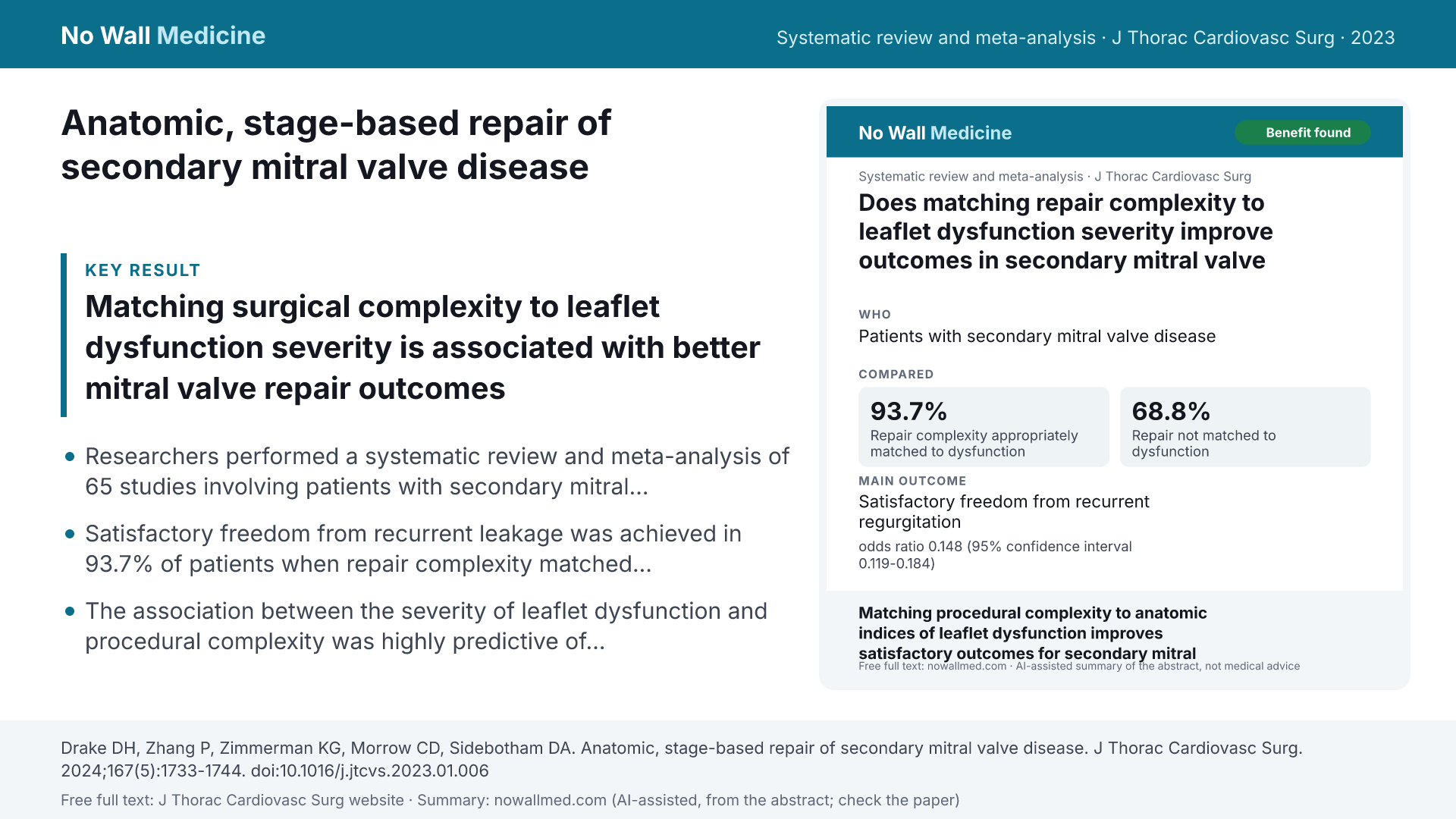
Matching surgical complexity to leaflet dysfunction severity is associated with better mitral valve repair outcomes
Anatomic, stage-based repair of secondary mitral valve disease
Systematic review and meta-analysisBenefit found
Does matching repair complexity to leaflet dysfunction severity improve outcomes in secondary mitral valve disease?
Who
Patients with secondary mitral valve disease
Compared
93.7%Repair complexity appropriately matched to dysfunction
68.8%Repair not matched to dysfunction
Main outcome
Satisfactory freedom from recurrent regurgitation
Result: odds ratio 0.148 (95% confidence interval 0.119-0.184)
Bottom line: Matching procedural complexity to anatomic indices of leaflet dysfunction improves satisfactory outcomes for secondary mitral valve repair.
J Thorac Cardiovasc Surg · 2023-01-11Download image
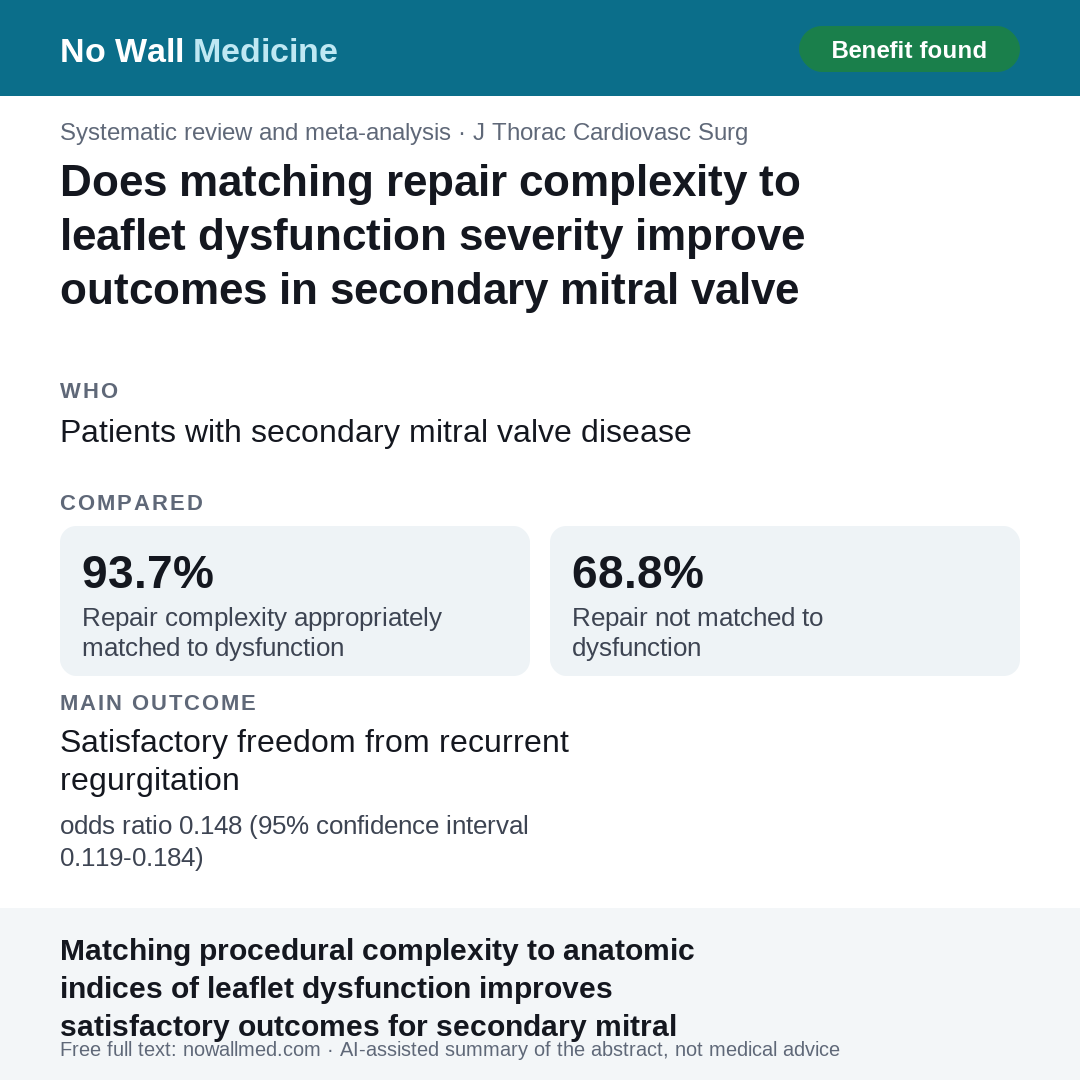
Clinical question: Does matching repair complexity to leaflet dysfunction severity improve outcomes in secondary mitral valve disease?
Key points
- Researchers performed a systematic review and meta-analysis of 65 studies involving patients with secondary mitral valve disease, which is a condition where the valve leaks due to heart muscle issues.
- Satisfactory freedom from recurrent leakage was achieved in 93.7% of patients when repair complexity matched leaflet dysfunction severity, compared to 68.8% when they were not matched.
- The association between the severity of leaflet dysfunction and procedural complexity was highly predictive of successful outcomes.
Headline and key points written with AI from the paper’s abstract, with every number checked against it. Read the paper before relying on them.
Was this summary helpful?
Subject terms
Headline, design, result, key points, caveat and citation as plain text.
Cite this article
Drake DH, Zhang P, Zimmerman KG, Morrow CD, Sidebotham DA. Anatomic, stage-based repair of secondary mitral valve disease. J Thorac Cardiovasc Surg. 2023. doi:10.1016/j.jtcvs.2023.01.006
Spotted a mistake? Suggest a correction