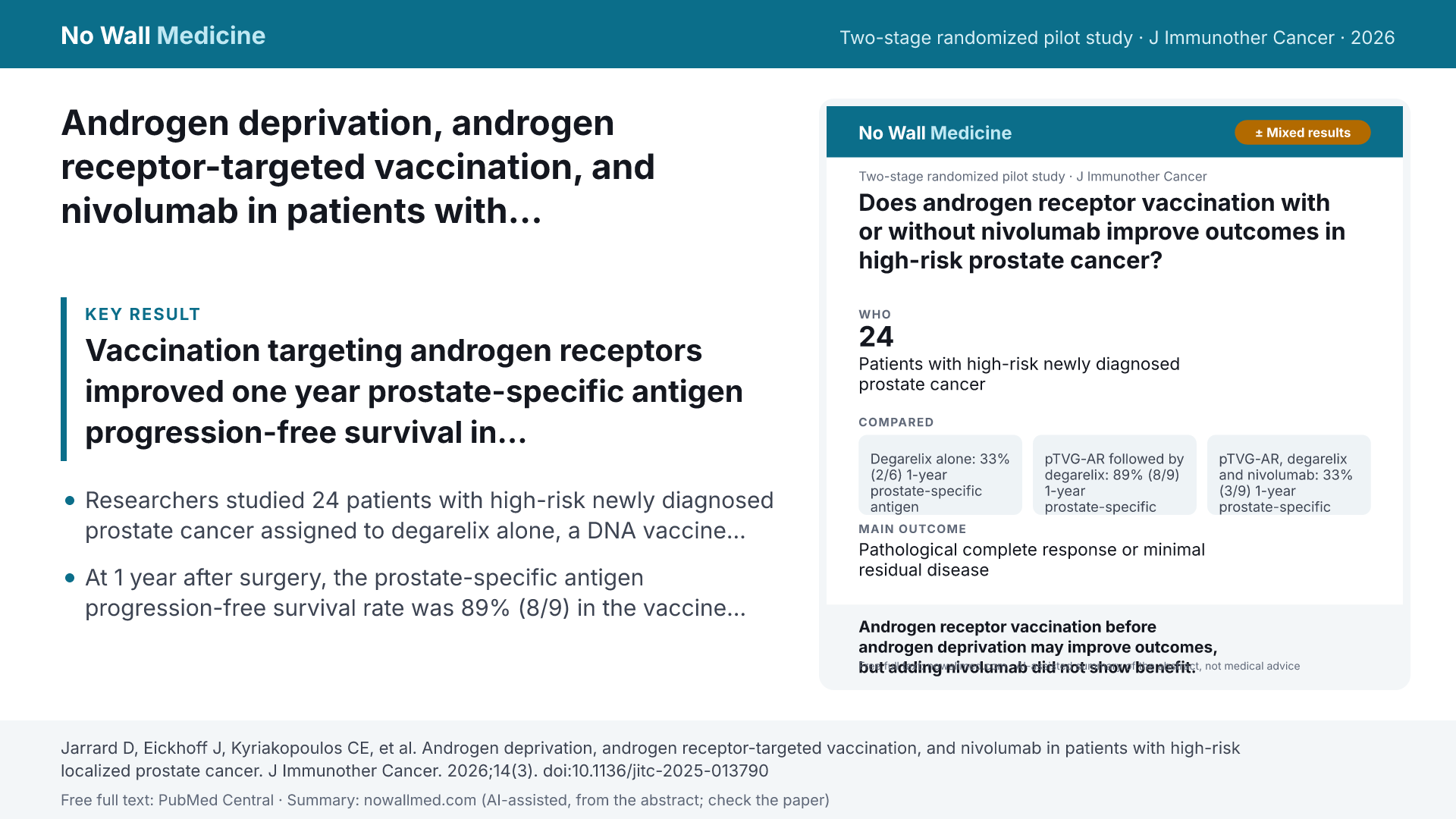
Vaccination targeting androgen receptors improved one year prostate-specific antigen progression-free survival in high-risk prostate cancer
Androgen deprivation, androgen receptor-targeted vaccination, and nivolumab in patients with high-risk localized prostate cancer
Two-stage randomized pilot studyMixed results
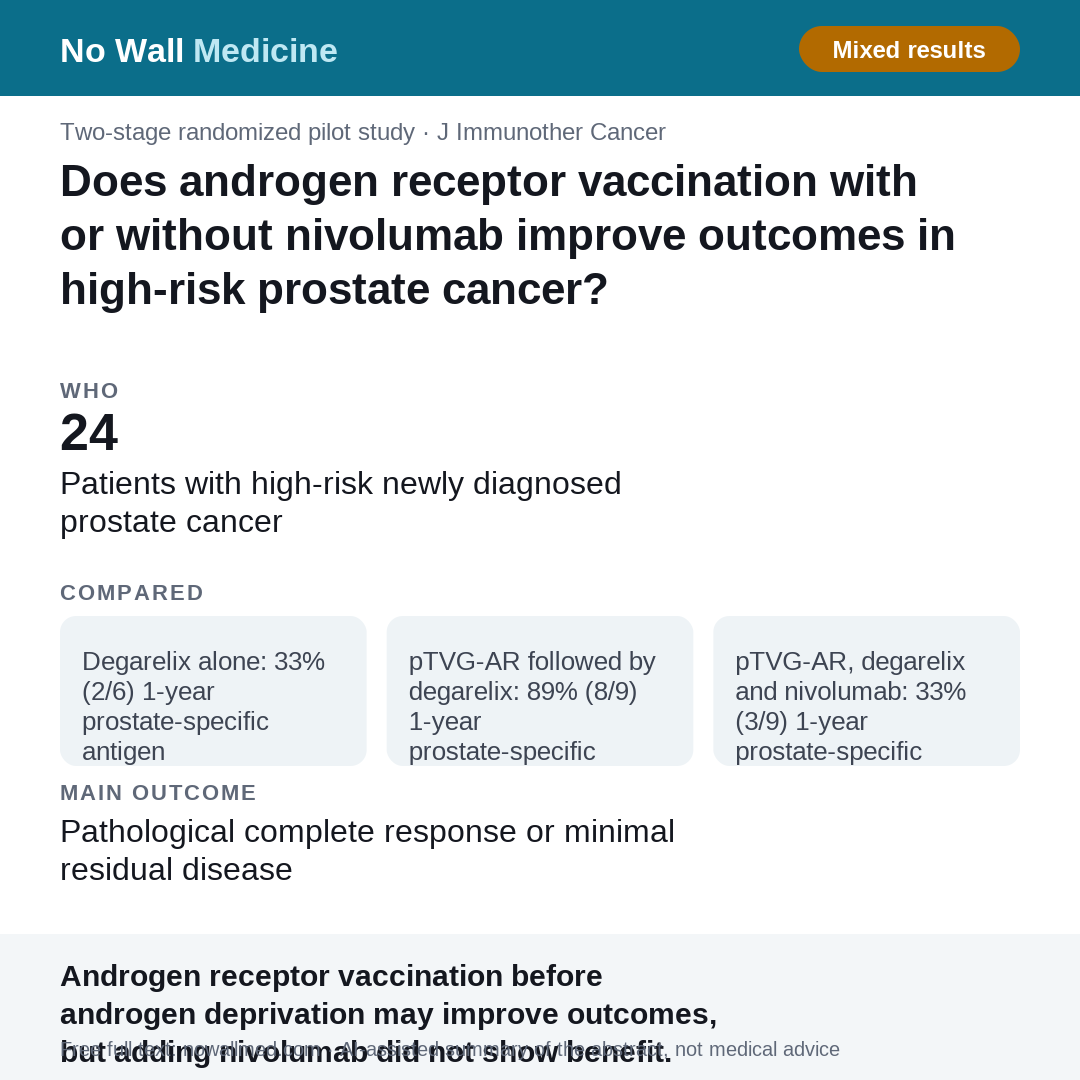
Does androgen receptor vaccination with or without nivolumab improve outcomes in high-risk prostate cancer?
Who
24
Patients with high-risk newly diagnosed prostate cancer
Compared
Degarelix alone: 33% (2/6) 1-year prostate-specific antigen progression-free survival
pTVG-AR followed by degarelix: 89% (8/9) 1-year prostate-specific antigen progression-free survival
pTVG-AR, degarelix and nivolumab: 33% (3/9) 1-year prostate-specific antigen progression-free survival
Main outcome
Pathological complete response or minimal residual disease
Bottom line: Androgen receptor vaccination before androgen deprivation may improve outcomes, but adding nivolumab did not show benefit.
J Immunother Cancer · 2026-03-04Download image
Clinical question: Does androgen receptor vaccination with or without nivolumab improve outcomes in high-risk prostate cancer?
Why it matters: It is unclear if a DNA vaccine targeting the androgen receptor can improve outcomes for high-risk localized prostate cancer when used with or without immune checkpoint blockade.
Key points
- Researchers studied 24 patients with high-risk newly diagnosed prostate cancer assigned to degarelix alone, a DNA vaccine plus degarelix, or a vaccine, degarelix, and nivolumab.
- At 1 year after surgery, the prostate-specific antigen progression-free survival rate was 89% (8/9) in the vaccine and degarelix group compared to 33% (2/6) and 33% (3/9) in the other groups.
- One patient achieved minimal residual disease and three patients had a residual cancer burden less than 0.25 cubic centimeters, all within the vaccine and degarelix group.
Limitation the authors note: The authors state this is a first stage of a pilot study that awaits confirmation with larger numbers of patients.
Headline and key points written with AI from the paper’s abstract, with every number checked against it. Read the paper before relying on them.
Was this summary helpful?
Abstract
Background
In murine studies, we demonstrated that a DNA vaccine encoding the androgen receptor (pTVG-AR) given prior to androgen deprivation elicited prostate tumor-infiltrating lymphocytes and an antitumor response. The current trial evaluated this approach, with or without programmed cell death protein-1 (PD-1) blockade, in patients with high-risk newly diagnosed prostate cancer. Methods
In the first stage of a two-stage protocol, 24 patients were randomized to treatment with (1) degarelix alone (n=6); (2) pTVG-AR followed by degarelix (n=9); or (3) pTVG-AR, degarelix and nivolumab (n=9), each delivered over 12 weeks prior to prostatectomy. The primary objectives were safety and pathological complete response or minimal residual disease (MRD). Secondary endpoints were residual cancer burden (RCB) <0.25 cm3 and 1-year prostate-specific antigen (PSA) progression-free survival. Results
Adverse events were almost exclusively in Arm 3, attributed to nivolumab. One patient achieved MRD (Arm 2), and three patients had an RCB <0.25 cm3 (all in Arm 2). At 1 year after surgery, the PSA progression-free survival rate was 33% (2/6) in Arm 1, 89% (8/9) in Arm 2, and 33% (3/9) in Arm 3 (p=0.039). Tissue analysis at prostatectomy demonstrated reduced CD4+cells with a regulatory phenotype in patients in Arm 2. Conclusion
In this first stage of a pilot study that awaits confirmation with larger numbers of patients, our results suggest that vaccination targeting AR given prior to androgen deprivation therapy might improve outcome for patients with high-risk prostate cancer. Contrary to our initial hypothesis, this was not improved with the addition of PD-1 blockade, possibly due to the activation of regulatory CD4+T cells. Trial registration number
NCT04989946.
Abstract reproduced under the article’s CC BY NC licence.
Subject terms
Cite this article
Jarrard D, Eickhoff J, Kyriakopoulos CE, et al. Androgen deprivation, androgen receptor-targeted vaccination, and nivolumab in patients with high-risk localized prostate cancer. J Immunother Cancer. 2026. doi:10.1136/jitc-2025-013790
Spotted a mistake? Suggest a correction