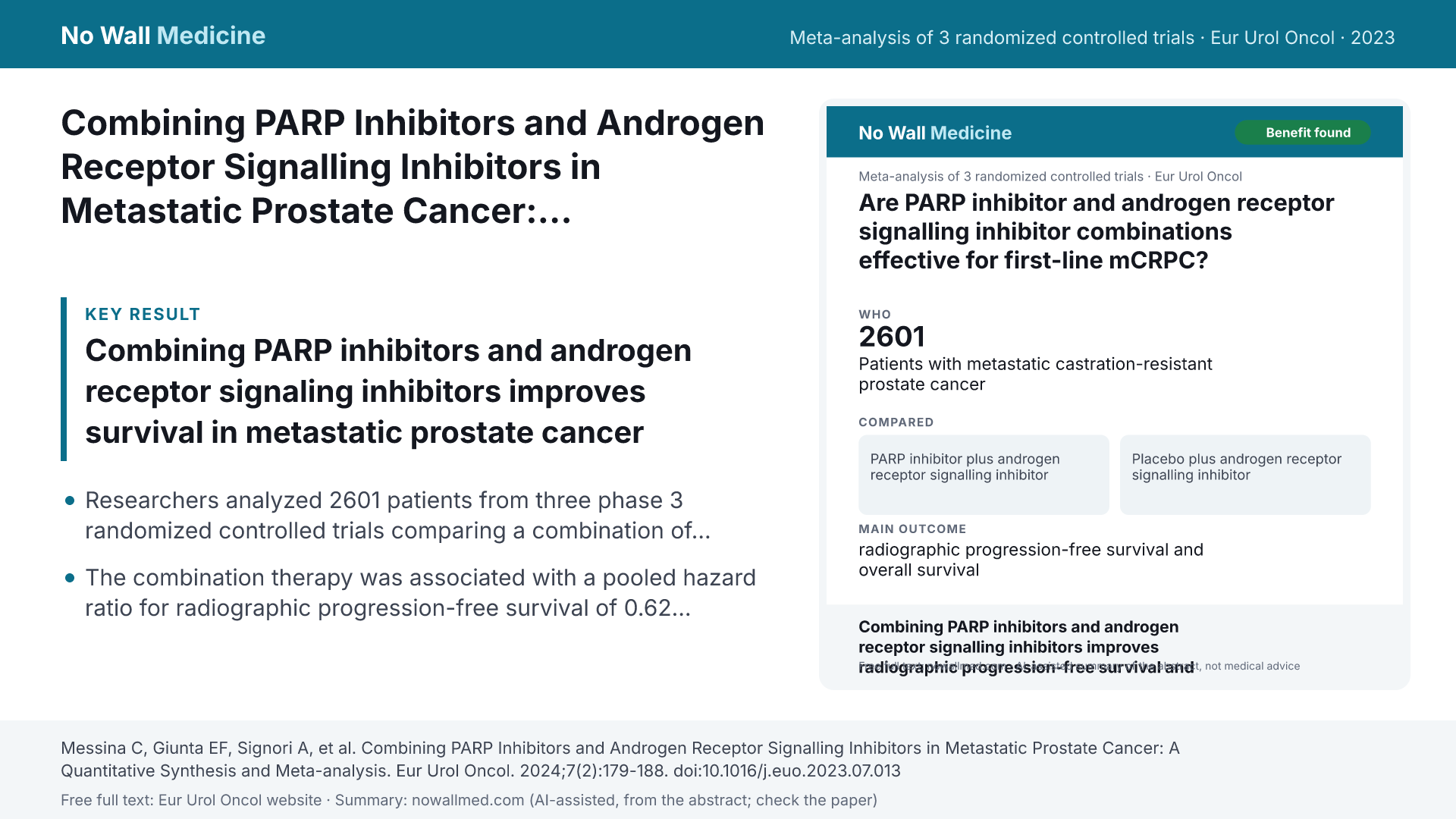
Combining PARP inhibitors and androgen receptor signaling inhibitors improves survival in metastatic prostate cancer
Combining PARP Inhibitors and Androgen Receptor Signalling Inhibitors in Metastatic Prostate Cancer: A Quantitative Synthesis and Meta-analysis
Meta-analysis of 3 randomized controlled trialsBenefit found
Are PARP inhibitor and androgen receptor signalling inhibitor combinations effective for first-line mCRPC?
Who
2601
Patients with metastatic castration-resistant prostate cancer
Compared
PARP inhibitor plus androgen receptor signalling inhibitor
Placebo plus androgen receptor signalling inhibitor
Main outcome
radiographic progression-free survival and overall survival
Result: hazard ratio 0.62 (95% confidence interval 0.53-0.72) for radiographic progression-free survival
Bottom line: Combining PARP inhibitors and androgen receptor signalling inhibitors improves radiographic progression-free survival and overall survival in metastatic castration-resistant prostate cancer.
Limitation: Combinations might be less clinically relevant in homologous recombination repair-proficient cancers.
Eur Urol Oncol · 2023-08-12 · Save PNG
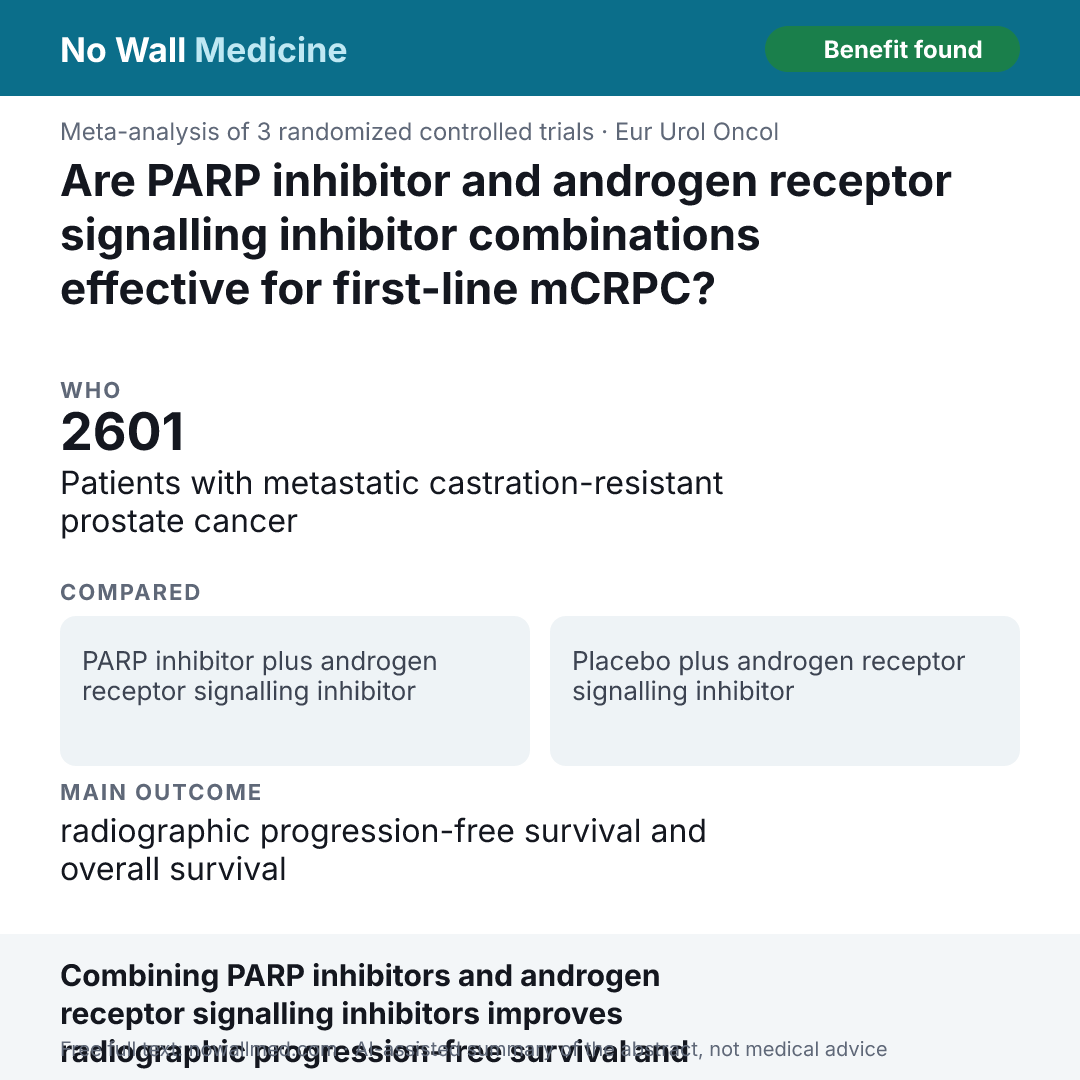
Clinical question: Are PARP inhibitor and androgen receptor signalling inhibitor combinations effective for first-line mCRPC?
Key points
- Researchers analyzed 2601 patients from three phase 3 randomized controlled trials comparing a combination of PARP inhibitors and androgen receptor signaling inhibitors against a placebo plus androgen receptor signaling inhibitor.
- The combination therapy was associated with a pooled hazard ratio for radiographic progression-free survival of 0.62 (95% confidence interval 0.53-0.72).
- The combination was associated with a pooled hazard ratio for overall survival of 0.84 (95% confidence interval 0.72-0.98), representing a 16% reduction in the risk of death.
Headline and key points written with AI from the paper’s abstract, with every number checked against it. Read the paper before relying on them.
Was this summary helpful?
Abstract
Context
PARP inhibitors (PARPi) are established treatments for metastatic castration-resistant prostate cancer (mCRPC) with homologous recombination repair (HRR) deficiency after androgen receptor signalling inhibitor (ARSI) failure. New PARPi + ARSI combinations have been tested in all comers, although their clinical relevance in HRR-proficient tumours remains uncertain.Objective
To quantitatively synthesise evidence from randomised trials assessing the efficacy and safety of PARPi + ARSI combinations for first-line treatment of mCRPC.Evidence acquisition
We searched the PubMed, EMBASE, SCOPUS, and Cochrane Library databases up to February 28, 2023. Randomised controlled trials (RCTs) comparing PARPi + ARSI versus placebo + ARSI for first-line treatment of mCRPC were eligible. Two reviewers independently performed screening and data extraction and assessed the risk of bias, while a third reviewer evaluated the eligibility criteria.Evidence synthesis
Overall, three phase 3 RCTs were included in the systematic review: PROPEL, MAGNITUDE, and TALAPRO-2. A total of 2601 patients with mCRPC were enrolled. Two of these trials (PROPEL and TALAPRO-2) assessed the radiographic progression-free survival benefit of PARPi + ARSI for first-line treatment of mCRPC, independent of HRR status. The pooled hazard ratio was 0.62 (95% confidence interval 0.53-0.72). The pooled hazard ratio for overall survival was 0.84 (95% confidence interval 0.72-0.98), indicating a 16% reduction in the risk of death among patients who received the combination.Conclusions
Results from this meta-analysis support the use of ARSI + PARPi combinations in biomarker-unselected mCRPC. However, such combinations might be less clinically relevant in HRR-proficient cancers, especially considering the change in treatment landscape for mCRPC.Patient summary
We looked at outcomes from trials testing combinations of two classes of drugs (PARP inhibitors and ARSI) in advanced prostate cancer. We found that these combinations seem to work regardless of gene mutations identified as biomarkers of response to PARP inhibitors when used on their own.
Abstract reproduced under the article’s CC BY-NC-ND licence.
Subject terms
Headline, design, result, key points, caveat and citation as plain text.
Cite this article
Messina C, Giunta EF, Signori A, et al. Combining PARP Inhibitors and Androgen Receptor Signalling Inhibitors in Metastatic Prostate Cancer: A Quantitative Synthesis and Meta-analysis. Eur Urol Oncol. 2024;7(2):179-188. doi:10.1016/j.euo.2023.07.013
Spotted a mistake? Suggest a correction