Combining two ligament reconstructions reduced graft failure rates in young patients with knee injuries
Anterior cruciate ligament reconstruction combined with anterolateral ligament reconstruction using hamstring autograft versus anterior cruciate ligament reconstruction using bone-patellar tendon-bone autograft: a randomised controlled trial with 5-year follow-up
Randomised, single-centre, controlled trialBenefit found
Does combining anterolateral ligament reconstruction with anterior cruciate ligament reconstruction reduce graft failure?
Who
593
Patients aged 18-35 years with symptomatic anterior cruciate ligament rupture · Santy Orthopedic Center in Lyon, France
Compared
Anterior cruciate ligament reconstruction plus anterolateral ligament reconstruction: 12/283 (4.2%)
Anterior cruciate ligament reconstruction: 28/273 (10.3%)
Main outcome
Graft failure at 5 years
Result: adjusted odds ratio 2.54 (95% CI 1.27 to 5.36)
Bottom line: Combining anterior cruciate ligament reconstruction with anterolateral ligament reconstruction significantly decreased graft failure compared to anterior cruciate ligament reconstruction alone.
Funded by: GCS Ramsay Santé pour l'Enseignement et la Recherche
Lancet Reg Health Eur · 2025-12-20 · Save PNG
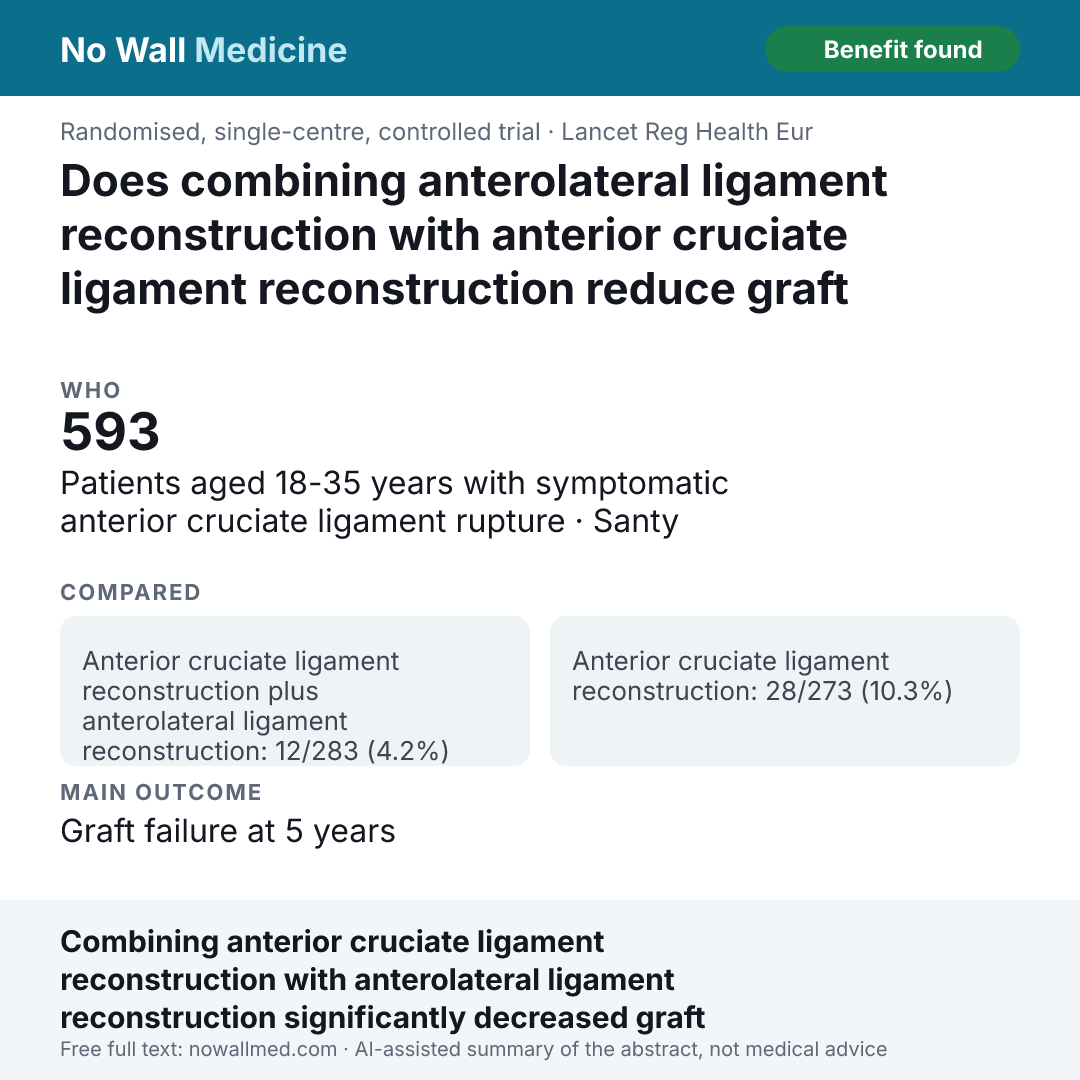
Clinical question: Does combining anterolateral ligament reconstruction with anterior cruciate ligament reconstruction reduce graft failure?
Why it matters: Graft failure rates remain high in young active patients undergoing standard anterior cruciate ligament reconstruction.
Key points
- Researchers studied 593 patients aged 18 to 35 years, comparing combined anterior cruciate ligament and anterolateral ligament reconstruction to anterior cruciate ligament reconstruction alone.
- Graft failure occurred in 12/283 (4.2%) patients receiving both reconstructions compared to 28/273 (10.3%) patients receiving only anterior cruciate ligament reconstruction.
- The number needed to treat to prevent one failure was 17 overall and 9 in patients younger than 25 years.
Limitation the authors note: The study was a single-centre trial and the outcome assessors were not blinded.
Headline and key points written with AI from the paper’s abstract, with every number checked against it. Read the paper before relying on them.
Was this summary helpful?
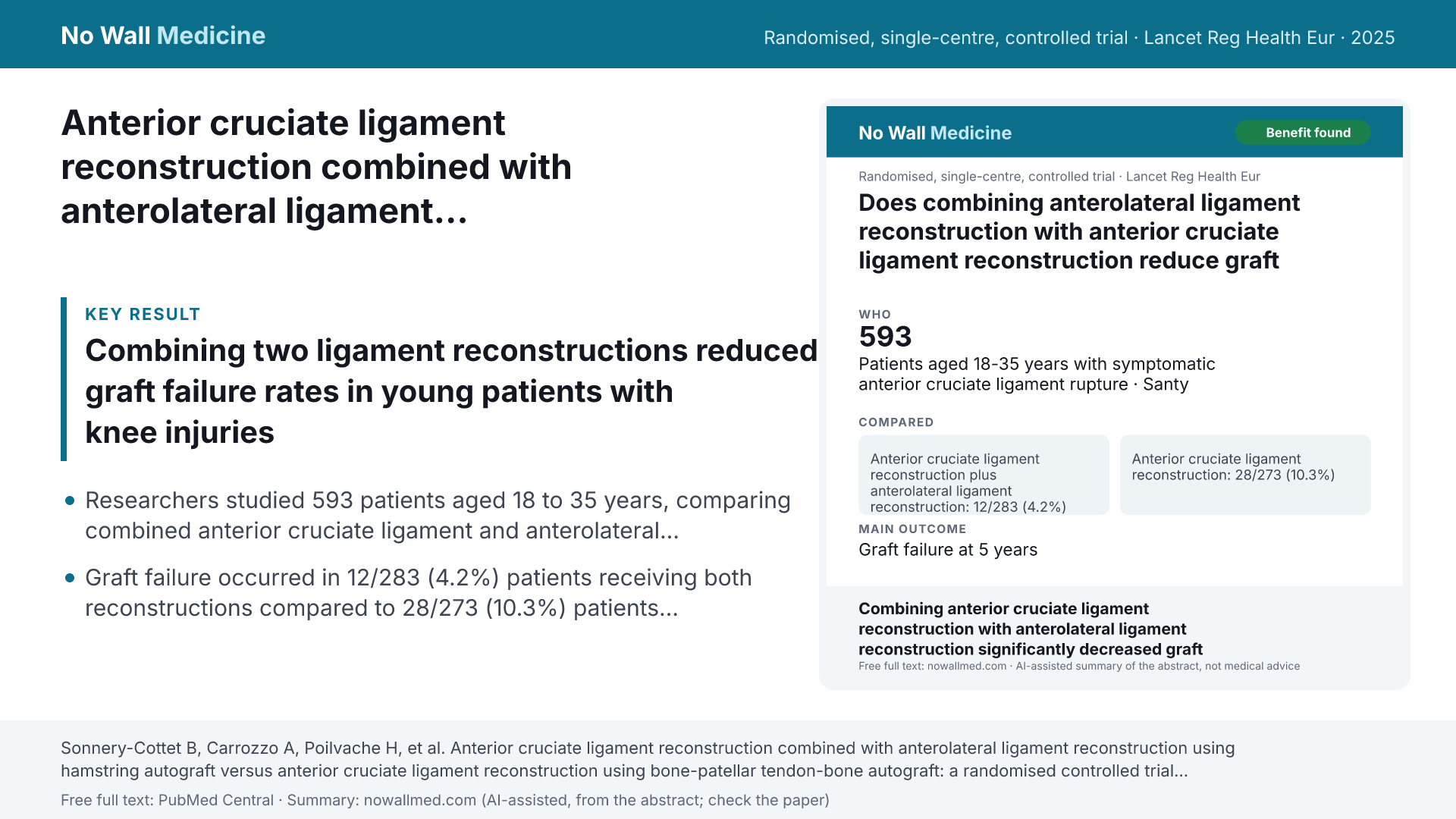
Headline, design, result, key points, caveat and citation as plain text.
Cite this article
Sonnery-Cottet B, Carrozzo A, Poilvache H, et al. Anterior cruciate ligament reconstruction combined with anterolateral ligament reconstruction using hamstring autograft versus anterior cruciate ligament reconstruction using bone-patellar tendon-bone autograft: a randomised controlled trial with 5-year follow-up. Lancet Reg Health Eur. 2026;62:101561. doi:10.1016/j.lanepe.2025.101561
Spotted a mistake? Suggest a correction