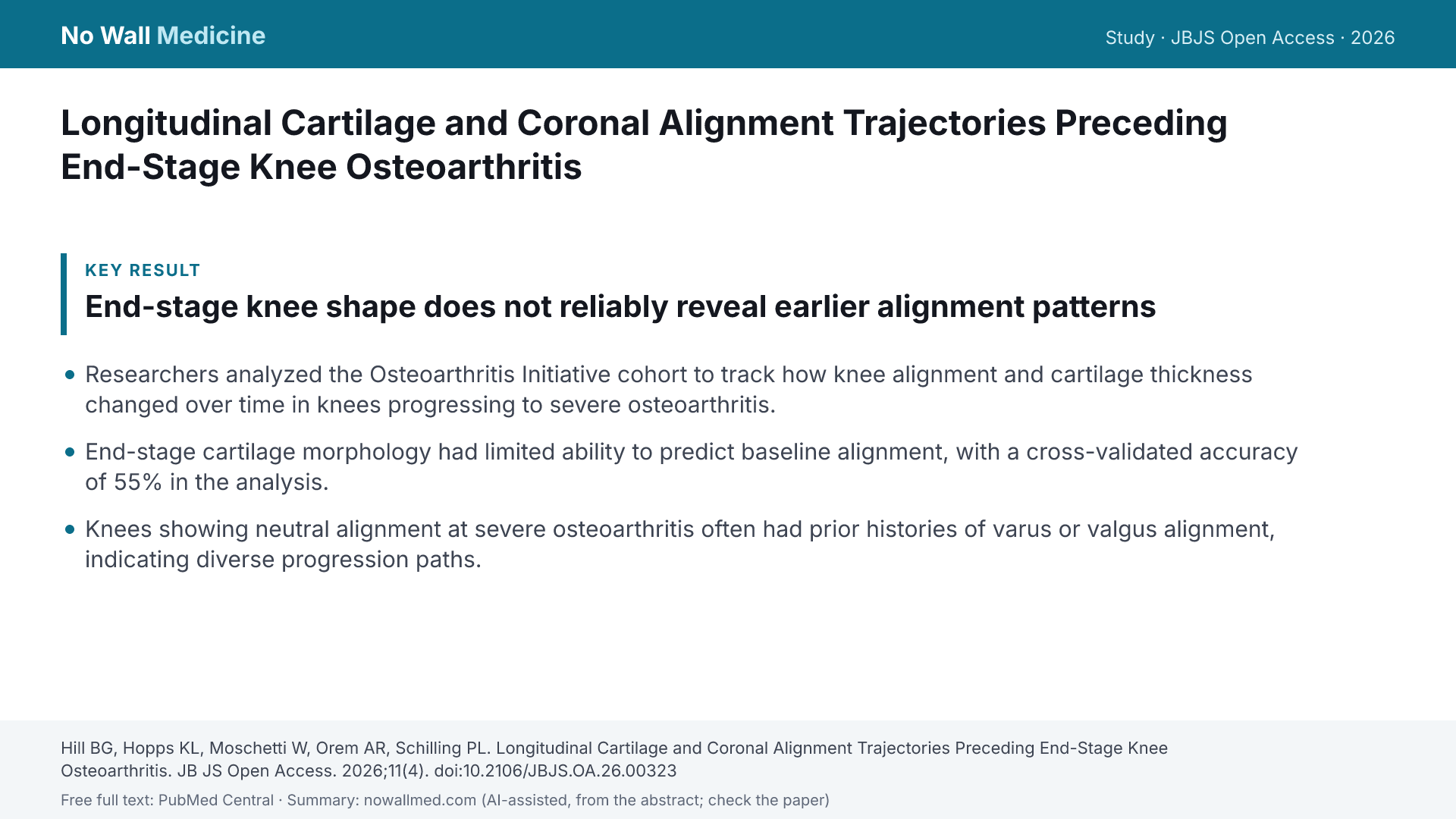
End-stage knee shape does not reliably reveal earlier alignment patterns
Longitudinal Cartilage and Coronal Alignment Trajectories Preceding End-Stage Knee Osteoarthritis
Why it matters: Applies to surgical planning for total knee arthroplasty; suggests that current knee shape may not reflect the patient's original alignment.
Key points
- Researchers analyzed the Osteoarthritis Initiative cohort to track how knee alignment and cartilage thickness changed over time in knees progressing to severe osteoarthritis.
- End-stage cartilage morphology had limited ability to predict baseline alignment, with a cross-validated accuracy of 55% in the analysis.
- Knees showing neutral alignment at severe osteoarthritis often had prior histories of varus or valgus alignment, indicating diverse progression paths.
Limitation the authors note: The study was a retrospective longitudinal analysis of the Osteoarthritis Initiative cohort.
Study type: Observational study: it can show a link, but not prove that one thing causes another.
Headline and key points written with AI from the paper’s abstract, with every number checked against it. Read the paper before relying on them.
Was this summary helpful?
Headline, design, result, key points, caveat and citation as plain text.
Cite this article
Hill BG, Hopps KL, Moschetti W, Orem AR, Schilling PL. Longitudinal Cartilage and Coronal Alignment Trajectories Preceding End-Stage Knee Osteoarthritis. JB JS Open Access. 2026;11(4). doi:10.2106/JBJS.OA.26.00323
Spotted a mistake? Suggest a correction