Longitudinal Cartilage and Coronal Alignment Trajectories Preceding End-Stage Knee Osteoarthritis
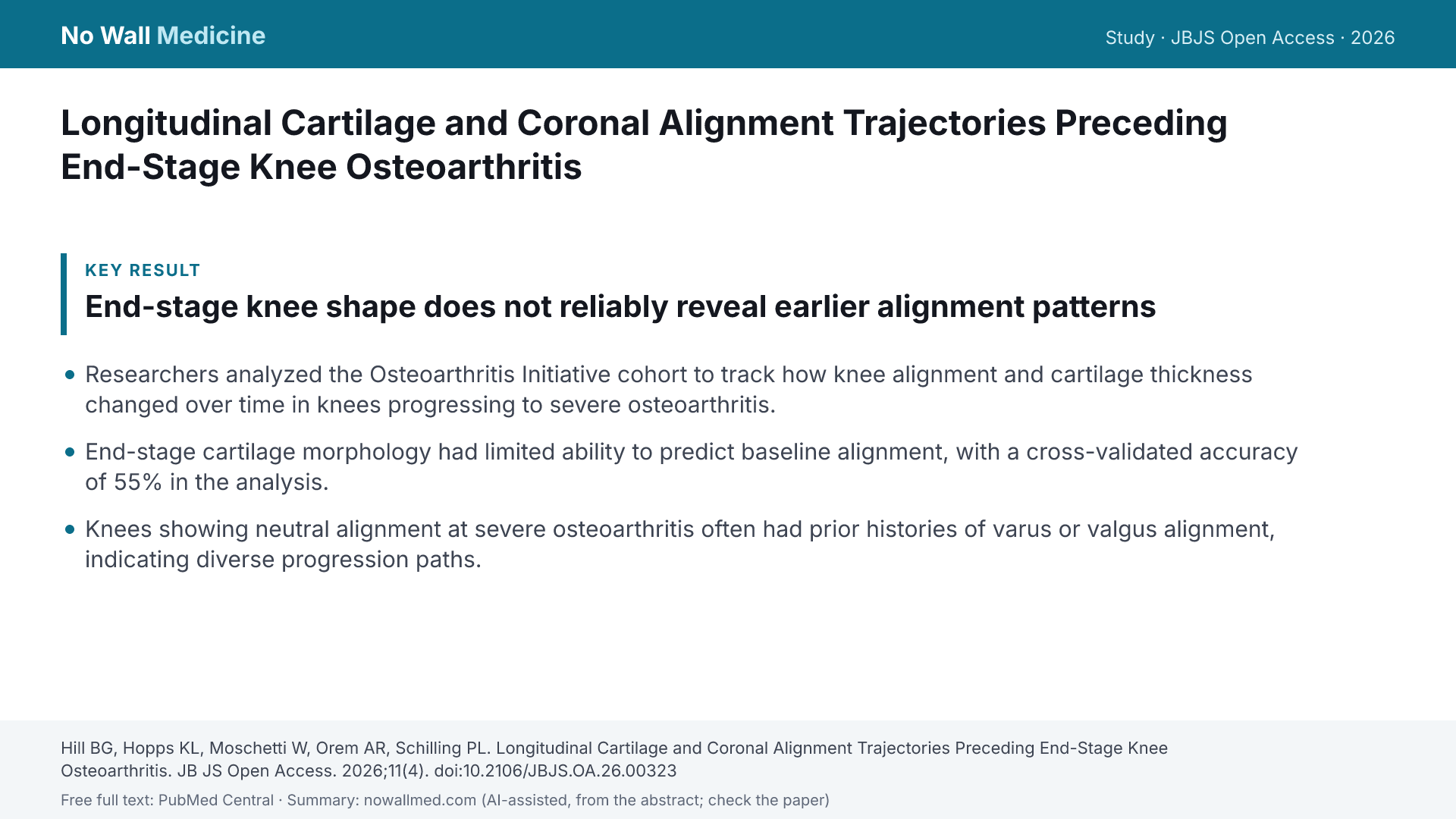
Key result: End-stage knee shape does not reliably reveal earlier alignment patterns
Key points
- Researchers analyzed the Osteoarthritis Initiative cohort to track how knee alignment and cartilage thickness changed over time in knees progressing to severe osteoarthritis.
- End-stage cartilage morphology had limited ability to predict baseline alignment, with a cross-validated accuracy of 55% in the analysis.
- Knees showing neutral alignment at severe osteoarthritis often had prior histories of varus or valgus alignment, indicating diverse progression paths.
Why it matters: Applies to surgical planning for total knee arthroplasty; suggests that current knee shape may not reflect the patient's original alignment.
Limitation the authors note: The study was a retrospective longitudinal analysis of the Osteoarthritis Initiative cohort.
Discussion prompts
- Would these patients look like yours? Who was left out?
- Is the main outcome one that matters to patients?
- Is the difference large enough to change what you do?
Cite: Hill BG, Hopps KL, Moschetti W, Orem AR, Schilling PL. Longitudinal Cartilage and Coronal Alignment Trajectories Preceding End-Stage Knee Osteoarthritis. JB JS Open Access. 2026;11(4). doi:10.2106/JBJS.OA.26.00323
Free full text: PubMed Central · Summary and visual abstract: nowallmed.com/a/longitudinal-cartilage-and-coronal-alignment-trajectories-preceding-142yx2x/ (AI-assisted from the abstract; check the paper before relying on it).