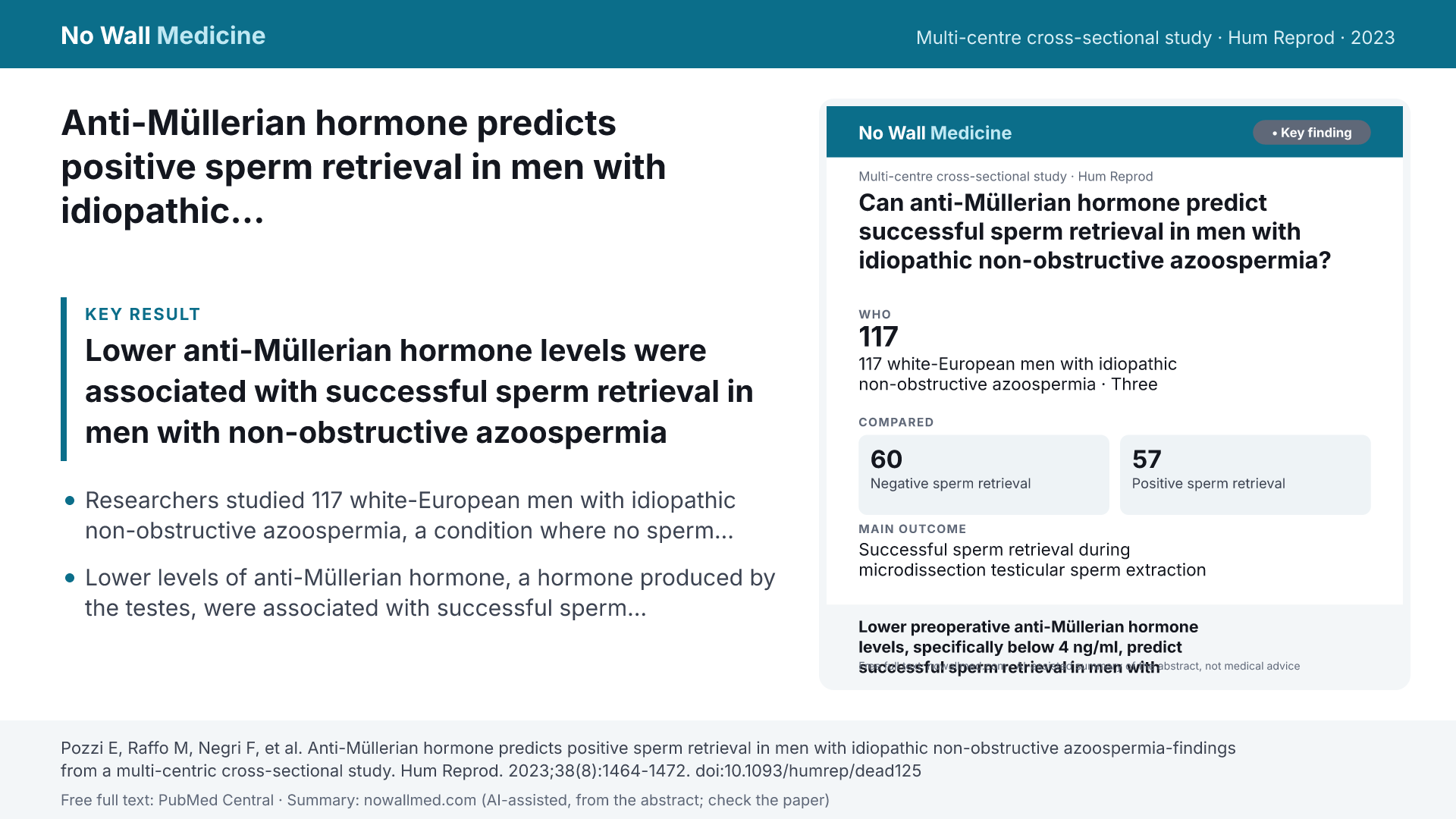
Lower anti-Müllerian hormone levels were associated with successful sperm retrieval in men with non-obstructive azoospermia
Anti-Müllerian hormone predicts positive sperm retrieval in men with idiopathic non-obstructive azoospermia-findings from a multi-centric cross-sectional study
Multi-centre cross-sectional studyKey finding
Can anti-Müllerian hormone predict successful sperm retrieval in men with idiopathic non-obstructive azoospermia?
Who
117
117 white-European men with idiopathic non-obstructive azoospermia · Three tertiary-referral centres
Compared
60Negative sperm retrieval (51.3%)
57Positive sperm retrieval (48.7%)
Main outcome
Successful sperm retrieval during microdissection testicular sperm extraction
Result: odds ratio 0.79 (95% CI 0.64-0.93)
Bottom line: Lower preoperative anti-Müllerian hormone levels, specifically below 4 ng/ml, predict successful sperm retrieval in men with idiopathic non-obstructive azoospermia.
Limitation: Need for external validation in larger cohorts across different centres and ethnicities.
Funded by: Urological Research Institute
Hum Reprod · 2023-06-16 · Save PNG
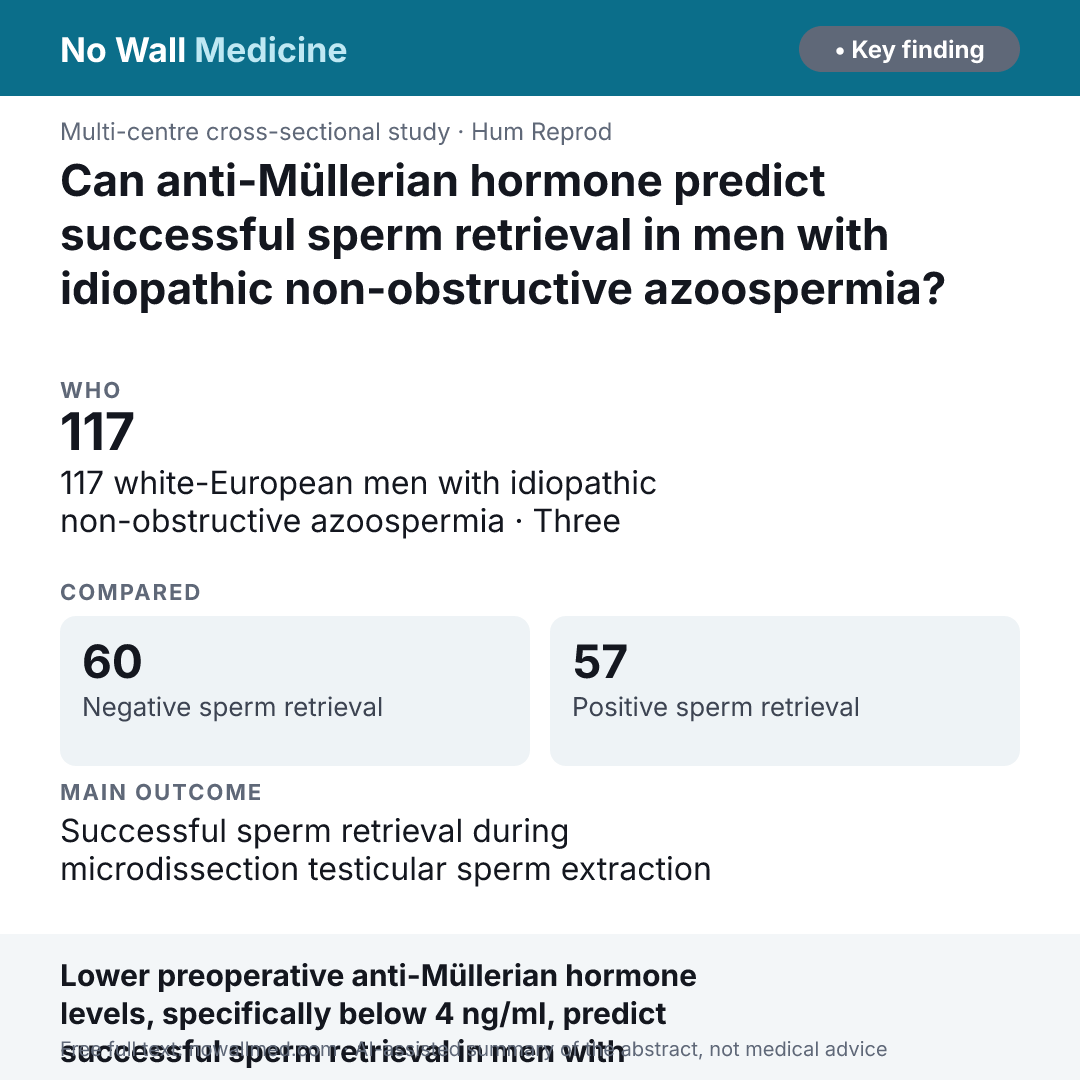
Clinical question: Can anti-Müllerian hormone predict successful sperm retrieval in men with idiopathic non-obstructive azoospermia?
Key points
- Researchers studied 117 white-European men with idiopathic non-obstructive azoospermia, a condition where no sperm is present in the ejaculate, undergoing microdissection testicular sperm extraction.
- Lower levels of anti-Müllerian hormone, a hormone produced by the testes, were associated with successful sperm retrieval, with an anti-Müllerian hormone threshold of <4 ng/ml achieving an accuracy of 70.3%.
- Among the participants, 60 (51.3%) men had unsuccessful sperm retrieval and 57 (48.7%) had successful sperm retrieval during the procedure.
Limitation the authors note: The authors state a need for external validation in larger cohorts across different centres and ethnicities.
Headline and key points written with AI from the paper’s abstract, with every number checked against it. Read the paper before relying on them.
Was this summary helpful?
Subject terms
Headline, design, result, key points, caveat and citation as plain text.
Cite this article
Pozzi E, Raffo M, Negri F, et al. Anti-Müllerian hormone predicts positive sperm retrieval in men with idiopathic non-obstructive azoospermia-findings from a multi-centric cross-sectional study. Hum Reprod. 2023;38(8):1464-1472. doi:10.1093/humrep/dead125
Spotted a mistake? Suggest a correction