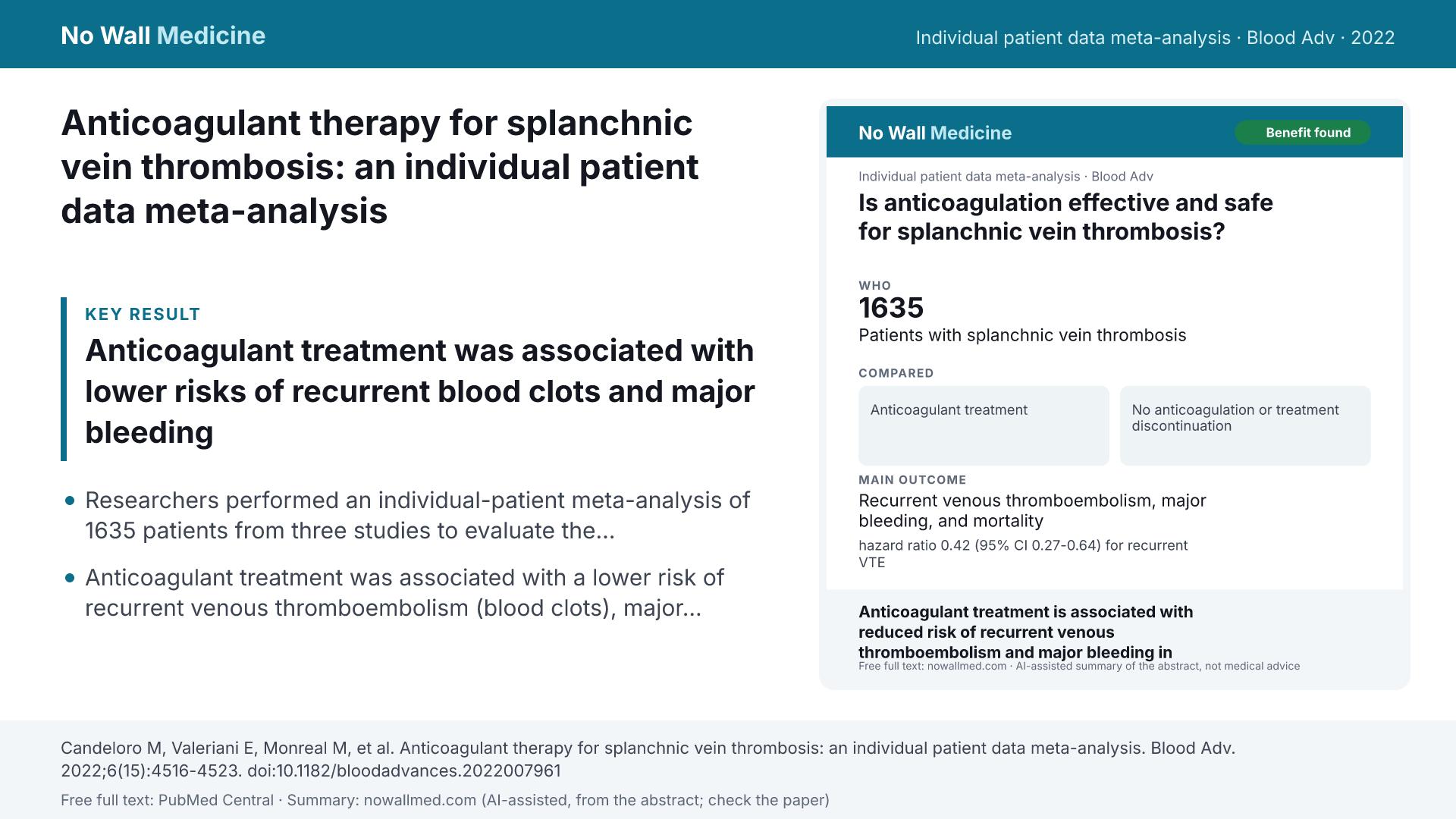
Anticoagulant treatment was associated with lower risks of recurrent blood clots and major bleeding
Anticoagulant therapy for splanchnic vein thrombosis: an individual patient data meta-analysis
Individual patient data meta-analysisBenefit found
Is anticoagulation effective and safe for splanchnic vein thrombosis?
Who
1635
Patients with splanchnic vein thrombosis
Compared
Anticoagulant treatment
No anticoagulation or treatment discontinuation
Main outcome
Recurrent venous thromboembolism, major bleeding, and mortality
Result: hazard ratio 0.42 (95% CI 0.27-0.64) for recurrent VTE
Bottom line: Anticoagulant treatment is associated with reduced risk of recurrent venous thromboembolism and major bleeding in patients with splanchnic vein thrombosis.
Blood Adv · 2022-05-26 · Save PNG
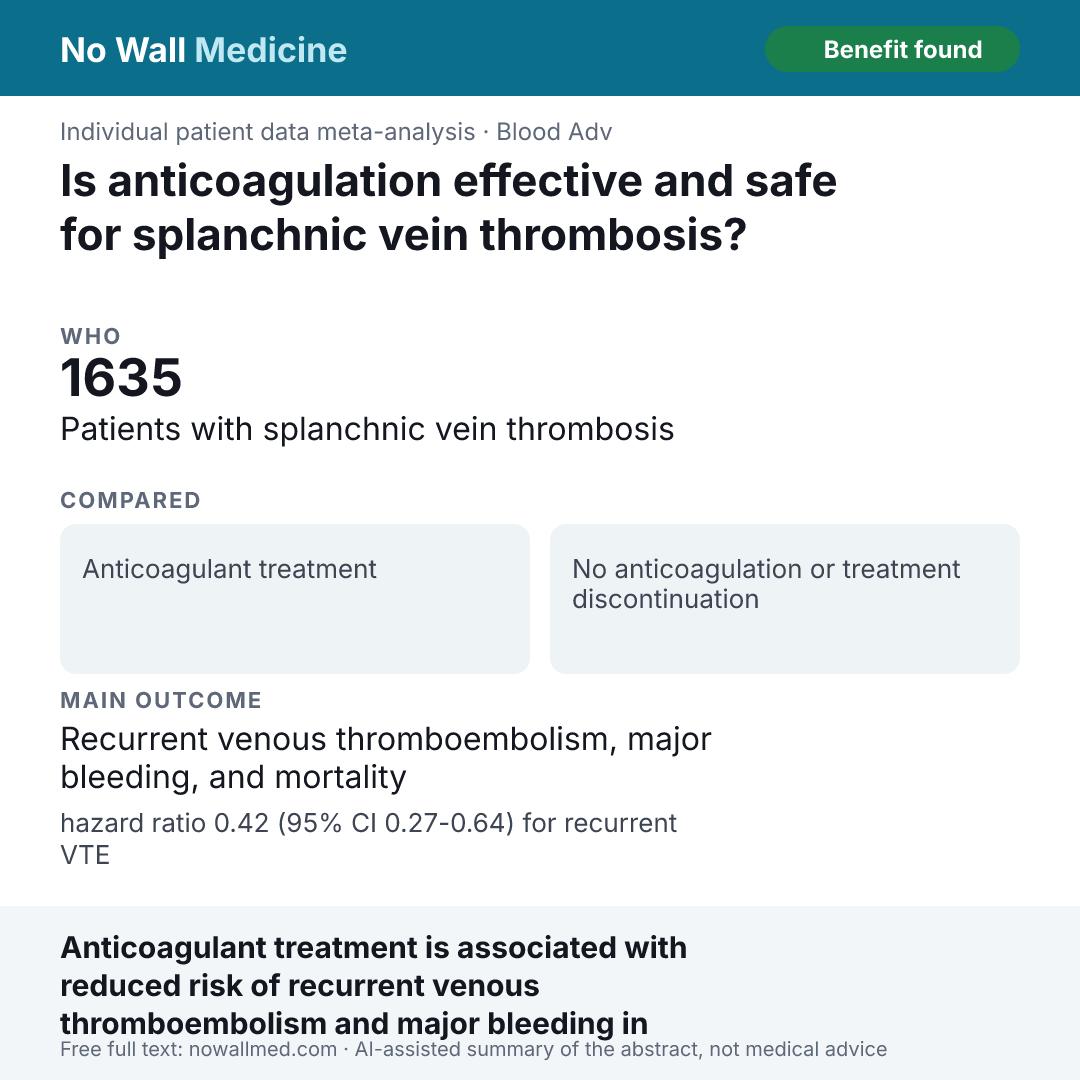
Clinical question: Is anticoagulation effective and safe for splanchnic vein thrombosis?
Why it matters: Robust evidence on the optimal management of splanchnic vein thrombosis, which is a blood clot in the veins of the abdomen, is lacking.
Key points
- Researchers performed an individual-patient meta-analysis of 1635 patients from three studies to evaluate the effectiveness and safety of blood-thinning medication for splanchnic vein thrombosis.
- Anticoagulant treatment was associated with a lower risk of recurrent venous thromboembolism (blood clots), major bleeding, and mortality compared to no treatment or treatment discontinuation.
- The overall incidence rates were 5.3 per 100 patient-years for recurrent venous thromboembolism, 4.4 per 100 patient-years for major bleeding, and 13.0 per 100 patient-years for mortality.
Headline and key points written with AI from the paper’s abstract, with every number checked against it. Read the paper before relying on them.
Was this summary helpful?
Abstract
Robust evidence on the optimal management of splanchnic vein thrombosis (SVT) is lacking. We conducted an individual-patient meta-analysis to evaluate the effectiveness and safety of anticoagulation for SVT. Medline, Embase, and clincaltrials.gov were searched up to June 2021 for prospective cohorts or randomized clinical trials including patients with SVT. Data from individual datasets were merged, and any discrepancy with published data was resolved by contacting study authors. Three studies of a total of 1635 patients were included. Eighty-five percent of patients received anticoagulation for a median duration of 316 days (range, 1-730 days). Overall, incidence rates for recurrent venous thromboembolism (VTE), major bleeding, and mortality were 5.3 per 100 patient-years (p-y; 95% confidence interval [CI], 5.1-5.5), 4.4 per 100 p-y (95% CI, 4.2-4.6), and 13.0 per 100 p-y (95% CI, 12.4-13.6), respectively. The incidence rates of all outcomes were lower during anticoagulation and higher after treatment discontinuation or when anticoagulation was not administered. In multivariable analysis, anticoagulant treatment appeared to be associated with a lower risk of recurrent VTE (hazard ratio [HR], 0.42; 95% CI, 0.27-0.64), major bleeding (HR, 0.47; 95% CI, 0.30-0.74), and mortality (HR, 0.23; 95% CI, 0.17-0.31). Results were consistent in patients with cirrhosis, solid cancers, myeloproliferative neoplasms, unprovoked SVT, and SVT associated with transient or persistent nonmalignant risk factors. In patients with SVT, the risk of recurrent VTE and major bleeding is substantial. Anticoagulant treatment is associated with reduced risk of both outcomes.
Abstract reproduced under the article’s CC BY NC ND licence.
Subject terms
Headline, design, result, key points, caveat and citation as plain text.
Cite this article
Candeloro M, Valeriani E, Monreal M, et al. Anticoagulant therapy for splanchnic vein thrombosis: an individual patient data meta-analysis. Blood Adv. 2022;6(15):4516-4523. doi:10.1182/bloodadvances.2022007961
Spotted a mistake? Suggest a correction