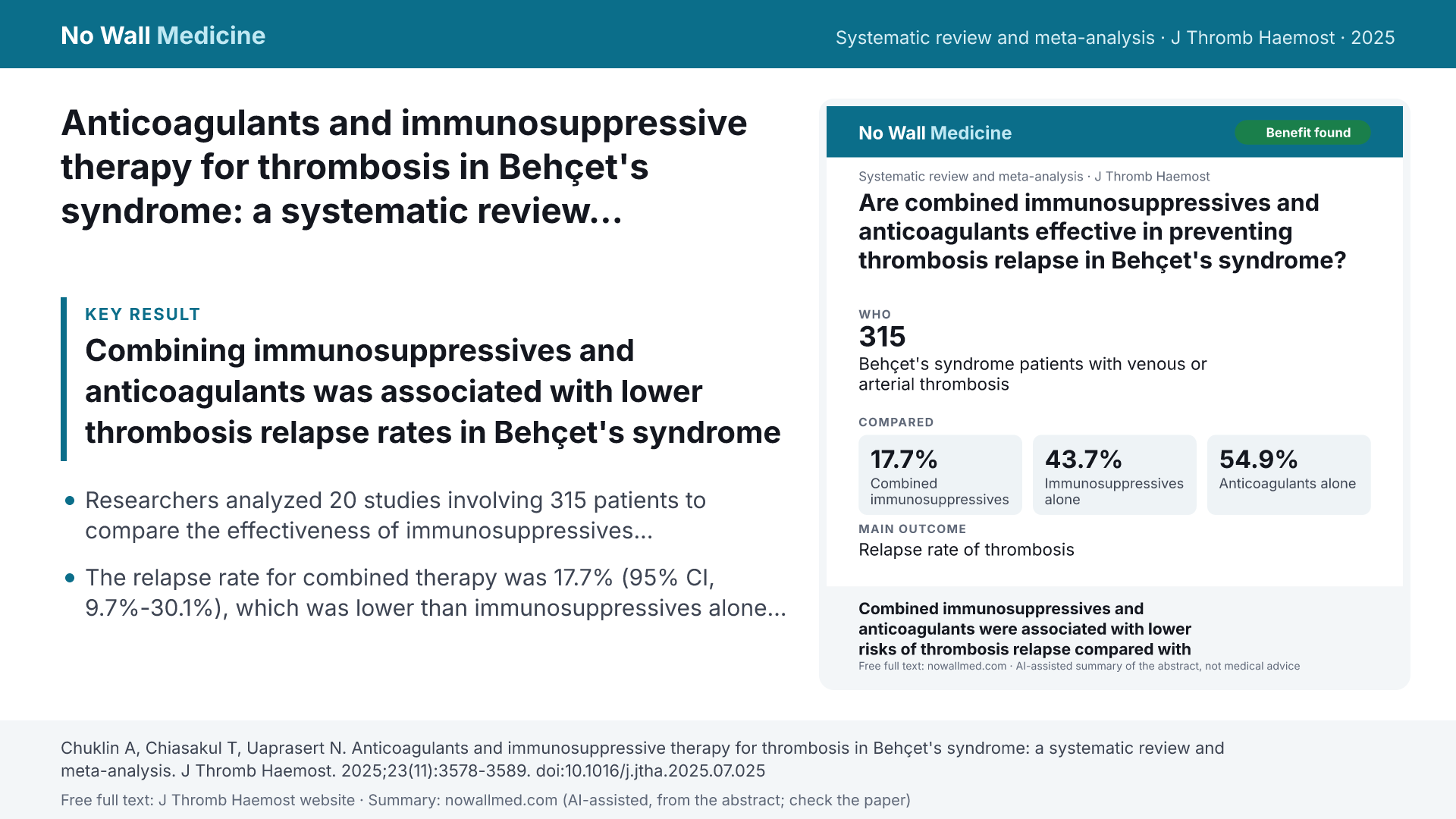
Combining immunosuppressives and anticoagulants was associated with lower thrombosis relapse rates in Behçet's syndrome
Anticoagulants and immunosuppressive therapy for thrombosis in Behçet's syndrome: a systematic review and meta-analysis
Systematic review and meta-analysisBenefit found
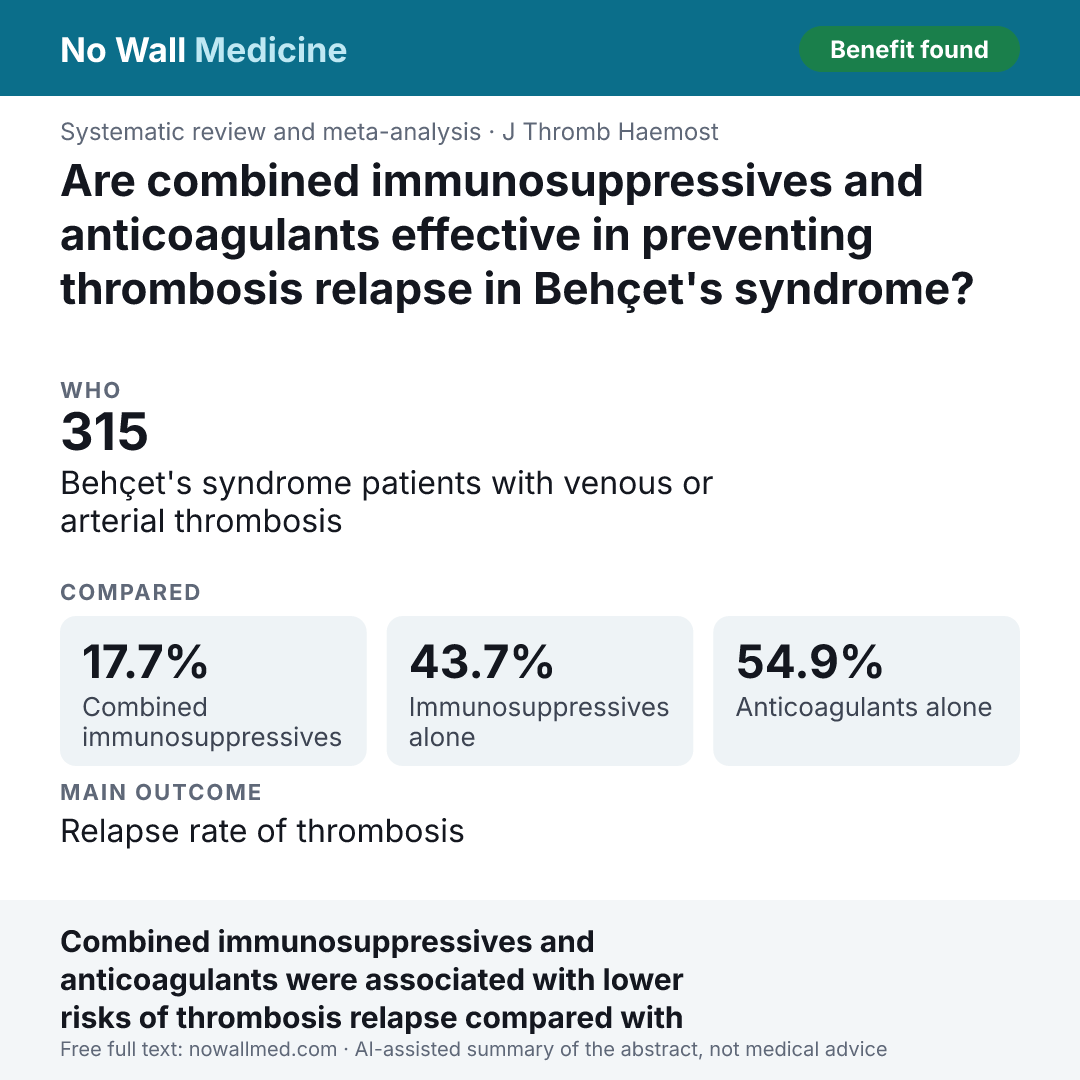
Are combined immunosuppressives and anticoagulants effective in preventing thrombosis relapse in Behçet's syndrome?
Who
315
Behçet's syndrome patients with venous or arterial thrombosis
Compared
17.7%Combined immunosuppressives and anticoagulants (95% CI, 9.7%-30.1%)
43.7%Immunosuppressives alone (95% CI, 25.8%-63.4%)
54.9%Anticoagulants alone (95% CI, 0.322%-0.758%)
Main outcome
Relapse rate of thrombosis
Bottom line: Combined immunosuppressives and anticoagulants were associated with lower risks of thrombosis relapse compared with either treatment alone.
Limitation: Most included studies were retrospective
J Thromb Haemost · 2025-08-05 · Save PNG
Clinical question: Are combined immunosuppressives and anticoagulants effective in preventing thrombosis relapse in Behçet's syndrome?
Why it matters: The role of anticoagulants, which are blood-thinning medications, remains unestablished for treating vascular manifestations of Behçet's syndrome.
Key points
- Researchers analyzed 20 studies involving 315 patients to compare the effectiveness of immunosuppressives alone, anticoagulants alone, or a combination of both treatments.
- The relapse rate for combined therapy was 17.7% (95% CI, 9.7%-30.1%), which was lower than immunosuppressives alone at 43.7% (95% CI, 25.8%-63.4%) or anticoagulants alone at 54.9% (95% CI, 0.322%-0.758%).
Limitation the authors note: The majority of the included studies were retrospective in design.
Headline and key points written with AI from the paper’s abstract, with every number checked against it. Read the paper before relying on them.
Was this summary helpful?
Subject terms
Headline, design, result, key points, caveat and citation as plain text.
Cite this article
Chuklin A, Chiasakul T, Uaprasert N. Anticoagulants and immunosuppressive therapy for thrombosis in Behçet's syndrome: a systematic review and meta-analysis. J Thromb Haemost. 2025;23(11):3578-3589. doi:10.1016/j.jtha.2025.07.025
Spotted a mistake? Suggest a correction